
Getting your salary credited into the right bank account can make everyday money management much easier. A good salary account can offer zero-balance banking, premium debit cards, insurance, rewards, lounge access, preferential loan rates and family banking benefits.
But not every salary account is equally useful. The best choice depends on your salary, employer-bank tie-up, spending habits, ATM needs and the benefits you actually use. This guide compares major salary accounts in India for 2026 and explains what to check before choosing one.
Best Salary Accounts in India 2026: Quick Overview
Salary accounts are usually savings accounts opened through an employer-bank arrangement. The biggest attraction is that they generally do not require you to maintain the minimum balance applicable to regular savings accounts while salary credits continue.
Major banks offer different salary-account variants depending on employer category and salary level. SBI, HDFC Bank, ICICI Bank, Axis Bank and Kotak Mahindra Bank are among the prominent options worth comparing.
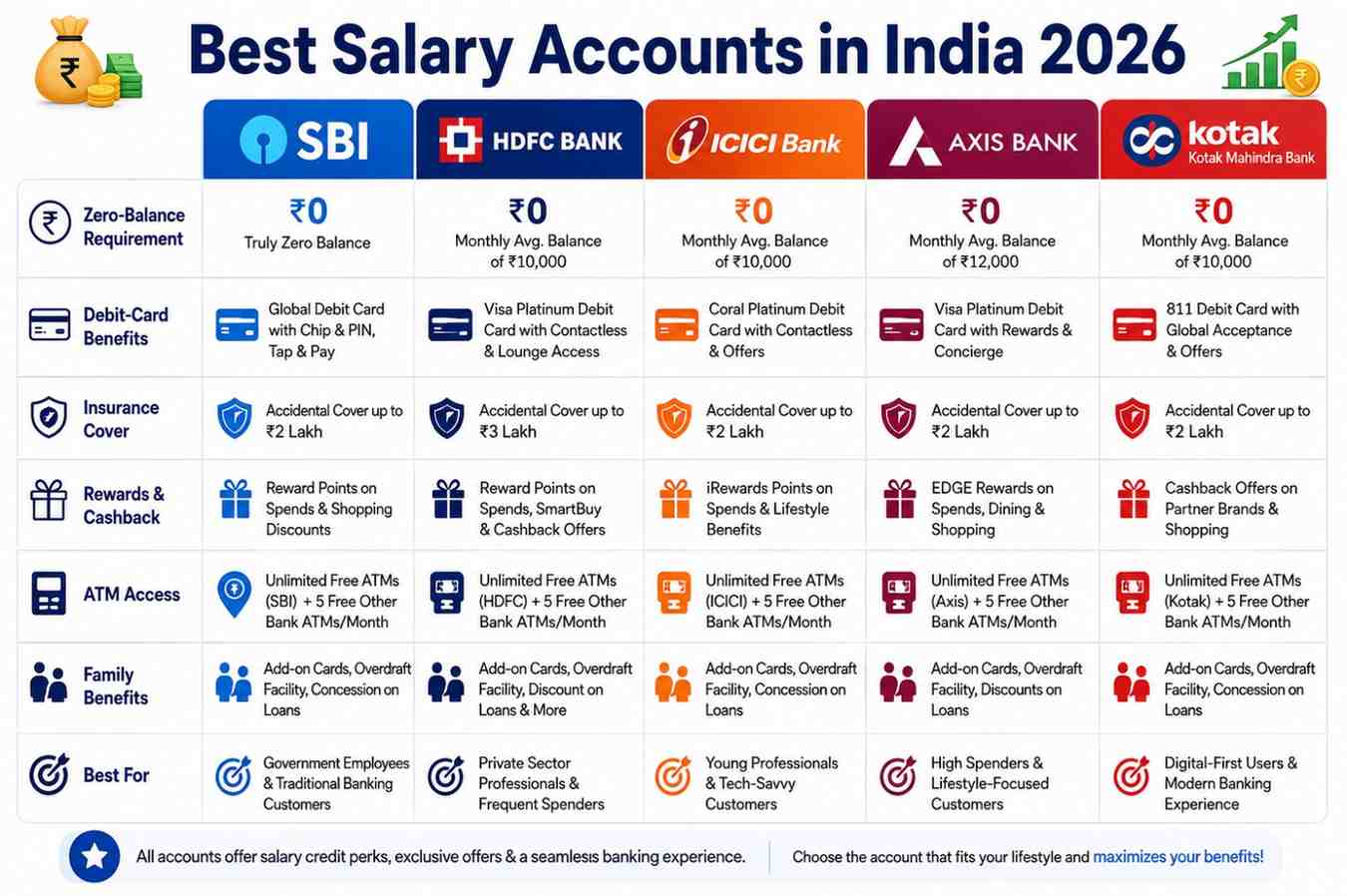
| Bank | Key Attraction | Zero Balance | Debit Card Benefits | Best For |
|---|---|---|---|---|
| SBI | Wide network and salary packages | Yes, subject to package | Package-dependent | Employees wanting extensive branch/ATM access |
| HDFC Bank | Premium banking ecosystem | Yes, subject to salary arrangement | Strong card and lifestyle benefits | Digital banking and premium perks |
| ICICI Bank | Insurance and family benefits | Yes | Complimentary card and ATM access | Employees seeking broad bundled benefits |
| Axis Bank | Rewards, insurance and premium tiers | Yes, subject to variant | Strong premium-card benefits | Rewards and lifestyle benefits |
| Kotak Mahindra Bank | Zero-balance banking and ActivMoney | Yes, subject to salary credits | Insurance-linked benefits | Digital-first users and savers |
| Other banks | Employer-specific packages | Often | Varies | Employees with existing corporate tie-ups |
The exact benefits can vary by employer, salary slab, account variant and current bank terms. Therefore, the bank's offer for your employer should always take priority over generic advertisements.
What Is a Salary Account and How Does It Work?
1. Salary account meaning
A salary account is a savings account opened under an arrangement between an employer and a bank. Your employer uses the account to deposit your monthly salary electronically.
Unlike a standard savings account, the salary variant may provide special benefits because the account is linked to regular salary credits.
Banks can offer benefits such as zero minimum balance requirements, complimentary debit cards, insurance, preferential loan processing and lifestyle offers.
2. Why banks offer extra benefits
Salary accounts can become the centre of an employee's financial relationship with a bank.
Once your salary arrives in the account, you may also use the same bank for credit cards, investments, insurance, personal loans, home loans and fixed deposits.
This is why banks compete aggressively for corporate salary relationships.
3. What happens if salary stops?
This is one of the most important points people overlook.
Zero-balance status is generally connected to continuing salary credits. For example, HDFC Bank's terms state that an account can be converted to a regular savings account if salary credits stop continuously for three months.
Axis Bank similarly states that special salary-account features can be withdrawn when salary is not credited for more than three consecutive months, after which normal savings-account charges may apply.
So, zero balance does not necessarily mean zero conditions forever.
SBI Salary Account: Best for Network and Traditional Banking
1. Major SBI salary account benefits
State Bank of India offers multiple salary packages designed for different employment categories, including corporate employees, central and state government employees, railways, defence personnel and other segments.
Depending on the package, benefits can include:
- Zero-balance banking
- Debit card facilities
- Internet and mobile banking
- Free or preferential banking services
- Auto-sweep facilities on eligible variants
- Cheque and demand-draft benefits
- Loan-related benefits
- Insurance benefits on selected packages
SBI's salary packages are particularly attractive for employees who value a large branch and ATM network.
2. Who should choose SBI?
SBI can be a strong choice if you frequently use physical branches, travel across different parts of India or work in government, defence or a large corporate organisation.
Its salary-account ecosystem is broad rather than being built around one single account variant. Benefits depend heavily on the package linked to your employer.
SBI's published salary-package information also shows zero-balance facilities and package-specific benefits such as auto-sweep and free banking services.
HDFC Bank Salary Account: Best for Premium Banking
1. Key HDFC salary account benefits
HDFC Bank salary accounts are designed around a combination of everyday banking and premium financial services.
An HDFC corporate salary-account offering can include a zero-balance account, NetBanking, mobile banking and a complimentary debit card. Certain salary variants also provide access to higher debit-card limits, cashback and accident-related benefits.
The wider HDFC ecosystem can also be useful if you want credit cards, investments and loans from the same banking relationship.
2. Debit card and lifestyle benefits
Depending on the salary variant, card benefits can include shopping-related rewards, insurance protection and higher transaction limits.
Some corporate salary offerings mention unlimited transactions at other-bank ATMs in India and daily ATM and shopping limits that vary by card.
This makes HDFC particularly interesting for employees who use their debit card regularly rather than simply receiving salary and transferring it elsewhere.
3. The important HDFC condition
HDFC's terms explicitly connect special salary benefits with regular salary credits. If salary is not credited for three continuous months, the bank may convert the account to a regular savings account.
Therefore, check the applicable regular savings-account balance requirements before assuming the account will remain free indefinitely.
ICICI Bank Salary Account: Best for Insurance and Family Benefits
1. Main ICICI salary account features
ICICI Bank offers salary accounts through its Power Pay and employer-specific salary programmes.
Its published salary-account offerings include no minimum balance requirements, a complimentary debit card and access to the bank's ATM network. Certain offerings also include complimentary air insurance and personal accident insurance.
The combination can make ICICI attractive for employees who want more than basic salary-credit functionality.
2. Family banking advantage
One interesting feature is the ability to extend selected salary-account benefits to family members.
ICICI's Select Banking proposition can extend benefits to up to five family members, subject to applicable conditions. It can also provide domestic lounge access and preferential processing benefits on selected financial products.
This becomes more valuable if several members of your household use the same banking ecosystem.
3. Demat and investment benefits
Some ICICI salary-account propositions also provide a 3-in-1 Demat and trading account with account-opening and first-year AMC benefits subject to the applicable offer.
For employees who already invest in stocks or mutual funds, having banking and investment services integrated can reduce friction.
Axis Bank Salary Account: Best for Rewards and Lifestyle Perks
1. Key Axis salary account benefits
Axis Bank offers several salary-account tiers, ranging from standard programmes to premium propositions.
Published Axis salary-account programmes can include zero opening and monthly balance requirements, complimentary cards, unlimited ATM transactions on eligible variants, free NEFT/RTGS and reward benefits.
2. Premium debit card advantages
Premium Axis salary variants can offer higher ATM withdrawal and shopping limits, airport lounge access, insurance coverage and accelerated reward points.
For example, the bank's Priority Salary Account includes a complimentary Priority Platinum Debit Card, personal accident insurance and access to additional lifestyle and relationship-management benefits.
Higher-tier salary propositions can provide even broader benefits, but eligibility and salary requirements matter.
3. Who should choose Axis?
Axis can make sense if you value rewards, lifestyle offers, airport lounge benefits and premium banking.
However, do not choose a premium variant simply because its benefit list looks impressive. If you rarely use lounges, premium cards or reward programmes, a simpler salary account may deliver better practical value.
Kotak Mahindra Bank Salary Account: Best for Digital Savers
1. Main Kotak salary account benefits
Kotak Mahindra Bank offers corporate salary accounts with zero-balance facilities subject to regular salary credits.
Its published salary-account page highlights complimentary debit-card insurance, online fund transfers and the ActivMoney feature, which can help eligible customers earn higher returns on surplus funds while retaining liquidity.
2. ActivMoney advantage
One reason Kotak can stand out is its approach to idle money.
Instead of leaving a large balance sitting in a regular savings account, eligible balances can be moved into a linked deposit structure through ActivMoney, subject to applicable terms.
This can appeal to employees who maintain a cash buffer but still want the money to remain accessible.
3. Who should consider Kotak?
Kotak may suit employees who prefer digital banking, keep surplus funds in their salary account and want an automated way to potentially earn more on eligible balances.
As with every bank, check the exact salary variant offered by your employer before opening the account.
Salary Account Comparison: SBI vs HDFC vs ICICI vs Axis vs Kotak
1. Best for zero-balance banking
All five banks offer salary-account propositions where minimum-balance requirements can be waived, but the exact conditions differ.
The critical question is not simply "Does this bank offer a zero-balance salary account?"
Instead, ask:
"What happens if my salary stops for three months?"
That answer determines whether the account remains cost-effective during a job change, career break or employer switch.
2. Best for debit card benefits
For debit-card-focused users, HDFC, ICICI and Axis have particularly broad premium propositions.
HDFC highlights cashback and insurance-related benefits on selected salary debit cards. ICICI provides complimentary debit cards with certain insurance benefits. Axis offers multiple card tiers with rewards, insurance and lifestyle privileges.
The best card is therefore not necessarily the one with the longest feature list. It is the one whose benefits match your actual spending.
3. Best for ATM and branch access
SBI is difficult to ignore when physical banking access is important.
Its extensive branch network and broad salary-package structure can be particularly useful for employees who move between cities or need traditional banking services.
Private banks may be more appealing if most of your banking happens through mobile apps and online channels.
4. Best for premium lifestyle benefits
Axis, HDFC and ICICI can be attractive for employees interested in premium cards, rewards, lounge access, family banking and bundled financial products.
But eligibility can depend on salary, employer relationship and account variant.
How to Choose the Right Salary Account
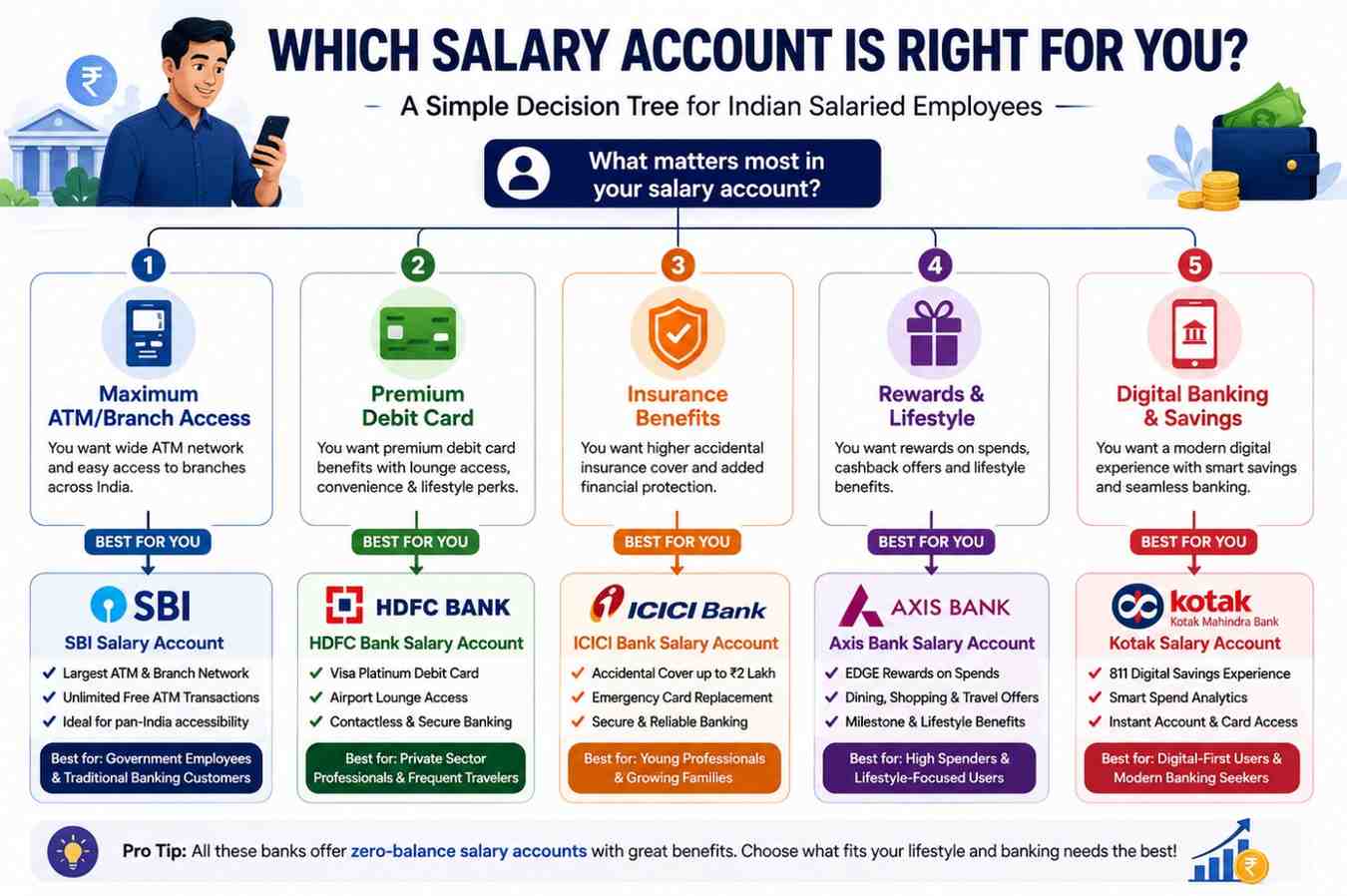
1. Check your employer's bank tie-up
This should be your first step.
Many salary accounts are opened under corporate agreements. You may not be able to access every variant advertised publicly.
Ask your HR or payroll team which banks and salary-account packages are officially available.
2. Compare the debit card carefully
A "free debit card" can mean very different things.
Check:
- Annual card charges
- ATM withdrawal limits
- Other-bank ATM usage
- Lounge access
- Reward points
- Insurance coverage
- Shopping limits
- Fuel benefits
- Replacement charges
A card's headline benefit means little if you never use it.
3. Understand the post-salary rules
This is arguably the most important comparison point.
Find out what happens if:
- You change jobs
- Your salary is temporarily delayed
- You take an unpaid break
- You switch your salary to another bank
- Your employer ends its banking relationship
A salary account can become a regular savings account after salary credits stop.
4. Compare loan benefits separately
Banks often promote preferential rates or processing benefits for salary-account customers.
These can be useful, but never choose a bank solely because it advertises a cheaper loan.
Compare the actual interest rate, processing fee, foreclosure rules and total borrowing cost when you are ready to borrow.
5. Look beyond the word "free"
Free ATM transactions, free cards and free transfers sound attractive.
But the real value comes from recurring savings.
For example, someone who travels frequently may value lounge access more than cashback. A person who rarely uses a debit card may care more about mobile banking and zero-balance conditions.
The best salary account is therefore personal, not universal.
Common Mistakes to Avoid
1. Choosing based only on zero balance
Zero balance is useful, but it is not enough.
If another account gives you substantially better card benefits, insurance, rewards or family banking, it may offer greater overall value.
2. Ignoring account conversion rules
People often forget that salary benefits depend on salary credits.
HDFC and Axis explicitly document conditions under which salary accounts can lose their special status after prolonged absence of salary credits.
Always understand the regular-account charges before relying on the zero-balance feature.
3. Paying for benefits you never use
A premium debit card may offer lounge access, reward points and high transaction limits.
If you never use those features, they should not influence your decision heavily.
4. Opening multiple accounts without a purpose
Having several bank accounts can make money management harder.
Extra accounts mean more statements, cards, UPI IDs, mandates and financial relationships to track.
Keep additional accounts only when they serve a clear purpose.
5. Forgetting to update your salary account after changing jobs
When you switch employers, check whether the new employer supports your existing salary bank.
If not, decide whether to continue using the old account as a normal savings account or move to the new employer's salary-account arrangement.
FAQ
Which is the best salary account in India in 2026?
There is no single best salary account for everyone. SBI can be attractive for network coverage, HDFC for premium banking, ICICI for bundled insurance and family benefits, Axis for rewards and lifestyle benefits, and Kotak for digital banking and surplus-money features.
Are salary accounts really zero balance?
Many salary-account variants have zero minimum-balance requirements while salary credits continue. However, conditions differ by bank and employer. If salary credits stop for a specified period, the account may be converted to a regular savings account.
Which salary account is best for private employees?
For private-sector employees, HDFC, ICICI, Axis and Kotak can all be strong choices. The best option depends on your employer's tie-up, salary slab, debit-card benefits, digital-banking preferences and lifestyle needs.
Which bank gives the best debit card with a salary account?
There is no universal winner. HDFC, ICICI and Axis have strong salary-account card propositions, while SBI also offers package-specific debit-card benefits. Compare lounge access, insurance, rewards, transaction limits and annual charges rather than choosing based only on the bank name.
Can I change my salary account?
Yes. In most cases, you can request your employer to credit your salary to another bank that supports salary accounts for its employees. Your employer's payroll process and banking arrangement determine the practical procedure.
What happens to a salary account after leaving a job?
The account may continue as a regular savings account, depending on the bank's terms and your circumstances. Special salary benefits may be withdrawn if salary credits stop. Check the applicable conversion rules before leaving the employer.
Is SBI better than HDFC for a salary account?
SBI can be better for people who prioritise branch reach and a large ATM network. HDFC may be more appealing to customers who prefer private-bank digital services, premium cards and lifestyle benefits. Your employer's specific salary package should be the deciding factor.
Should I choose a salary account based on cashback?
Cashback should be one factor, not the deciding factor. Calculate how much you would realistically earn from the benefits and compare that with insurance, ATM access, card fees, loan benefits and digital-banking convenience.
Conclusion: Which Salary Account Should You Choose?
The best salary account in India in 2026 is the one that fits your financial behaviour rather than simply having the longest list of benefits. SBI stands out for network reach, HDFC for premium banking, ICICI for bundled protection and family benefits, Axis for rewards and lifestyle perks, and Kotak for digital convenience and surplus-money features.
Before choosing, verify your employer's exact package, debit-card charges, zero-balance conditions and what happens when salary credits stop. A few minutes of comparison can prevent years of unnecessary banking charges.

Write a comment