A personal loan may look simple: compare interest rates, choose the lowest number, and apply. In reality, the cheapest loan on paper is not always the cheapest loan in your bank account. Processing fees, prepayment rules, eligibility requirements, and the rate actually offered to your profile can significantly change the total borrowing cost.
For Indian borrowers in 2026, the biggest comparison is often PSU banks vs private banks. Public sector banks can offer highly competitive rates, especially to salaried employees and borrowers with strong credit profiles. Private banks, meanwhile, often compete through faster approvals, digital applications, and more convenient borrowing experiences. The right choice depends on whether your priority is the lowest personal loan interest rate, lower fees, flexible repayment, or faster disbursal.
Personal Loan Interest Rates in 2026: PSU vs Private Banks
Personal loan rates vary according to credit score, income, employer category, existing relationship with the bank, loan amount, and repayment capacity. Therefore, advertised starting rates should be treated as entry points rather than guaranteed offers.
A broad 2026 comparison shows that several PSU banks are competing aggressively at the lower end of the market, while leading private banks remain close behind.
| Bank | Type | Indicative Interest Rate | Processing Fee |
|---|---|---|---|
| Union Bank of India | PSU | 8.75%–12.55% | Up to 1% |
| Bank of Maharashtra | PSU | 8.75%–13.55% | Up to 1% |
| Canara Bank | PSU | 9.70%–15.15% | Around 0.50% |
| SBI | PSU | 10.00%–15.00% | Up to 1.50% |
| Bank of Baroda | PSU | From about 10.15% for select profiles | Varies |
| Axis Bank | Private | From 9.60% | Up to 2% |
| HDFC Bank | Private | From 9.99% | Up to ₹6,500 + GST |
| ICICI Bank | Private | 9.99%–16.50% | Up to 2% + taxes |
The comparison data above reflects publicly available 2026 rate information and official lender disclosures. Actual offers can change and depend heavily on borrower eligibility.
The most important takeaway is that PSU banks currently have a strong advantage in the lowest advertised rate range, with some public sector lenders starting below 9%. However, a private bank may still offer a better deal to a particular borrower because of a pre-approved rate, lower effective charges, or more flexible service conditions.
Why PSU Banks Often Offer Lower Personal Loan Rates
Public sector banks generally compete strongly on pricing. Their personal loan products are often particularly attractive for government employees, PSU employees, pensioners, and borrowers with stable salaried income.
Lower Starting Interest Rates
In the 2026 market, some PSU lenders have starting personal loan rates around 8.75%. This is lower than the starting rates advertised by many large private banks.
For a borrower with an excellent credit profile, even a one-percentage-point difference can matter. On a ₹5 lakh loan over five years, a lower rate can reduce the EMI and potentially save a meaningful amount in total interest.
The advantage is especially important for borrowers searching for:
- Lowest personal loan interest rate in India
- Personal loans for government employees
- Low-interest loans for salaried employees
- Large loan amounts with longer repayment periods
Strong Value for Stable Salaried Borrowers
PSU banks often have specific pricing advantages for customers whose income is considered highly stable. Government employees and employees of established organizations may receive better eligibility or pricing.
For example, Bank of Baroda's published personal loan pricing shows different rate bands depending on borrower category, employment profile, banking relationship, and credit score. Select government and defence salary-account customers can access lower rate bands than many general borrowers.
This highlights an important point: the best bank for a personal loan is not the same for every borrower.
Potentially Lower Processing Charges
Processing fees can quietly increase the effective cost of borrowing. Several PSU banks publish processing charges around or below 1% for certain products, while private-bank charges can reach 2% or more depending on the lender and product.
For a ₹10 lakh loan, the difference between a 1% and 2% processing charge can be ₹10,000 before applicable taxes and other charges.
That means borrowers should compare the interest rate and upfront fee together, rather than focusing only on the headline rate.
Why Private Banks Remain Popular in 2026
If PSU banks can offer lower rates, why do millions of borrowers still choose private banks?
The answer is speed and convenience.
Faster Digital Loan Processing
Private banks have invested heavily in digital lending. Existing customers may receive pre-approved offers, faster documentation, online KYC, and quick disbursal.
For an urgent financial requirement, waiting several days to save a small amount on interest may not always be practical.
Private banks can be attractive for:
- Medical emergencies
- Short-notice travel
- Debt consolidation
- Urgent home repairs
- Existing customers with pre-approved offers
HDFC Bank currently publishes personal loan rates starting from 9.99%, while ICICI Bank publishes a range starting at 9.99% and extending to 16.50%, depending on the customer's profile and assessment.
Better Experience for Existing Customers
Your relationship with a bank can influence the borrowing experience.
If your salary account, savings account, credit card, or previous loan history is already with a private bank, the lender may have enough internal information to make the application process easier.
This does not automatically mean the interest rate will be lower. But it may mean:
- Less paperwork
- Faster eligibility checks
- Pre-approved loan offers
- Quick online acceptance
- Faster disbursal into your account
For many borrowers, convenience has real financial value, especially when funds are needed immediately.
Competitive Rates for Strong Credit Profiles
Private banks should not be dismissed simply because PSU banks may advertise lower starting rates.
Axis Bank has been listed among private lenders with rates starting around 9.60%, while HDFC and ICICI have advertised starting rates around 9.99%. A borrower with an excellent credit profile may receive an offer that is highly competitive with PSU-bank pricing.
The key is to compare the actual offer received, not just the website's minimum advertised rate.
Processing Fees: Where Borrowers Often Make a Mistake
Processing fees are one of the most overlooked personal loan costs.
Suppose two banks offer the same interest rate:
- Bank A charges 1% processing fee
- Bank B charges 2% processing fee
For a ₹10 lakh loan, the upfront difference is ₹10,000, excluding taxes.
Now consider another situation:
- PSU Bank: 9.5% interest + 1% fee
- Private Bank: 9.8% interest + low fixed processing fee
The private bank could still be competitive depending on the loan amount and tenure.
This is why borrowers should calculate the total borrowing cost.
Compare These Charges Before Applying
Always check:
- Processing fee
- GST on processing fee
- Documentation charges
- Stamp duty
- Part-prepayment charges
- Foreclosure charges
- EMI bounce charges
- Late-payment charges
- Loan cancellation charges
ICICI Bank publishes processing charges of up to 2% plus applicable taxes for personal loans. HDFC Bank lists a processing charge of up to ₹6,500 plus GST, along with separate premature closure and part-payment conditions.
A low rate with expensive fees can sometimes be less attractive than a slightly higher rate with lower overall charges.
Which Offers More Flexibility: PSU or Private Banks?
Flexibility depends on the bank and the product, not only whether the lender is public or private.
Still, private banks often have an advantage in digital convenience, while PSU banks can offer strong value for borrowers who fit their preferred customer categories.
Loan Application Flexibility
Private banks often provide smoother online journeys. Existing customers may complete much of the process digitally.
PSU banks have also improved digital lending significantly, but the customer experience can vary by bank, product, branch, and borrower profile.
If you value a fully digital process, private banks may feel more convenient.
Prepayment and Foreclosure Flexibility
This area deserves close attention.
Some borrowers plan to take a five-year personal loan but expect to repay it within two or three years after receiving a bonus, salary increase, or other funds.
In such cases, foreclosure charges can become important.
For example, ICICI Bank states that foreclosure charges may apply based on its terms, with no charge after 24 EMIs in the disclosed schedule. HDFC Bank's published charges vary according to how many EMIs have been serviced, and part-prepayment conditions also apply.
Before signing a loan agreement, ask:
“If I repay this loan early, exactly how much will it cost me?”
That question can save more money than negotiating a small reduction in the interest rate.
Tenure Flexibility
A longer tenure reduces the EMI but increases total interest paid.
For example, a borrower may feel comfortable with a five-year tenure because the monthly EMI is lower. But if income is strong enough to handle a shorter tenure, a three-year loan could significantly reduce total interest.
The best strategy is often to choose an affordable EMI while keeping the option to prepay without excessive charges.
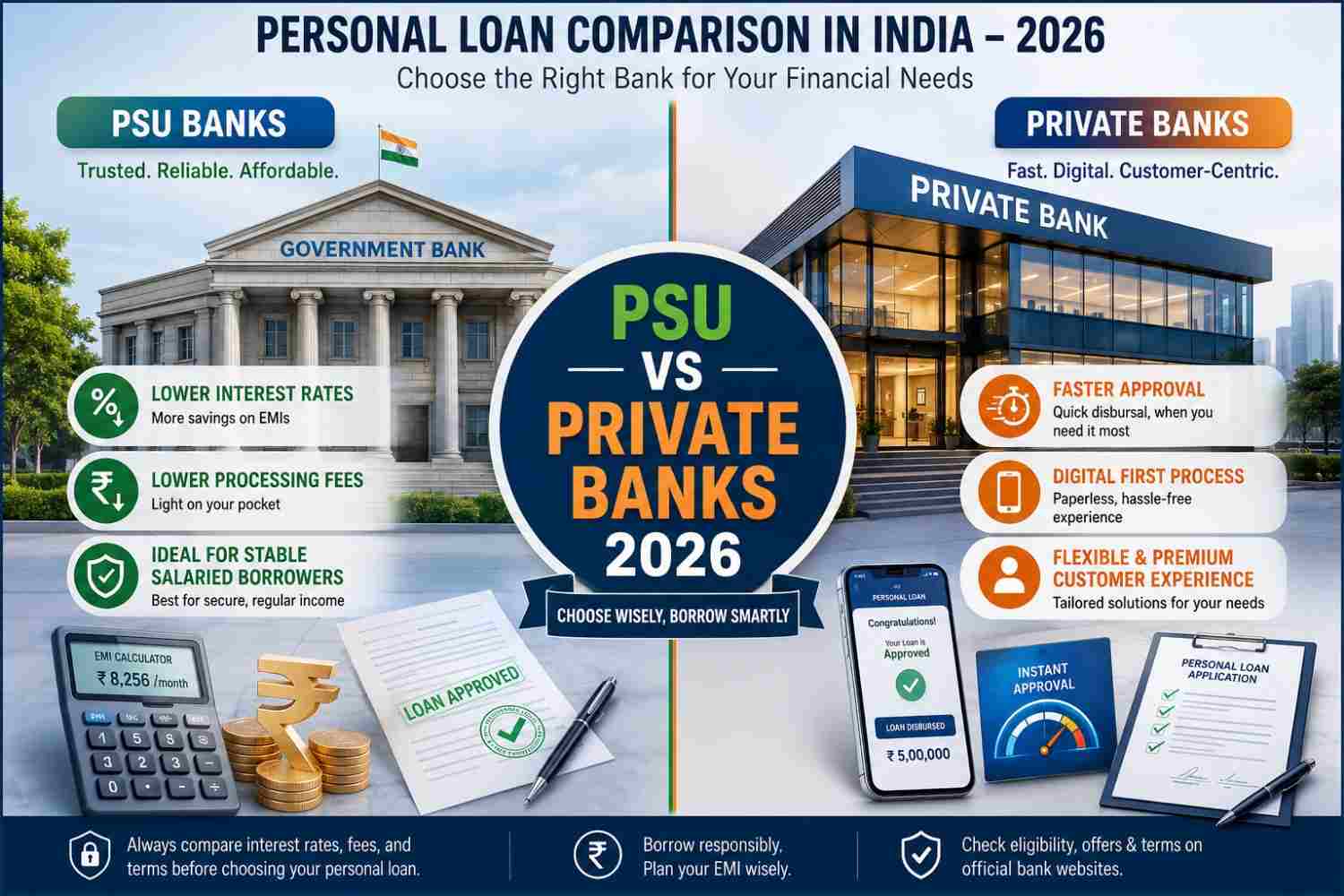
PSU vs Private Banks: A Practical Comparison
| Factor | PSU Banks | Private Banks |
| Lowest advertised rates | Often stronger | Competitive for select profiles |
| Processing fees | Often lower or moderate | Can be higher |
| Government employee benefits | Often excellent | Depends on lender |
| Digital application | Improving | Usually stronger |
| Speed of disbursal | Can vary | Often faster |
| Existing customer offers | Available | Often highly competitive |
| Documentation experience | Can be more traditional | Usually streamlined |
| Best for lowest-cost seekers | Often yes | Sometimes |
| Best for urgent loans | Depends on bank | Often yes |
| Best overall choice | Strong for value | Strong for convenience |
The table should be used as a decision guide, not a fixed rule. A pre-approved private-bank loan at 9.99% may be better than a PSU-bank offer at 11% for the same borrower.
How to Find the Best Personal Loan Interest Rate in 2026
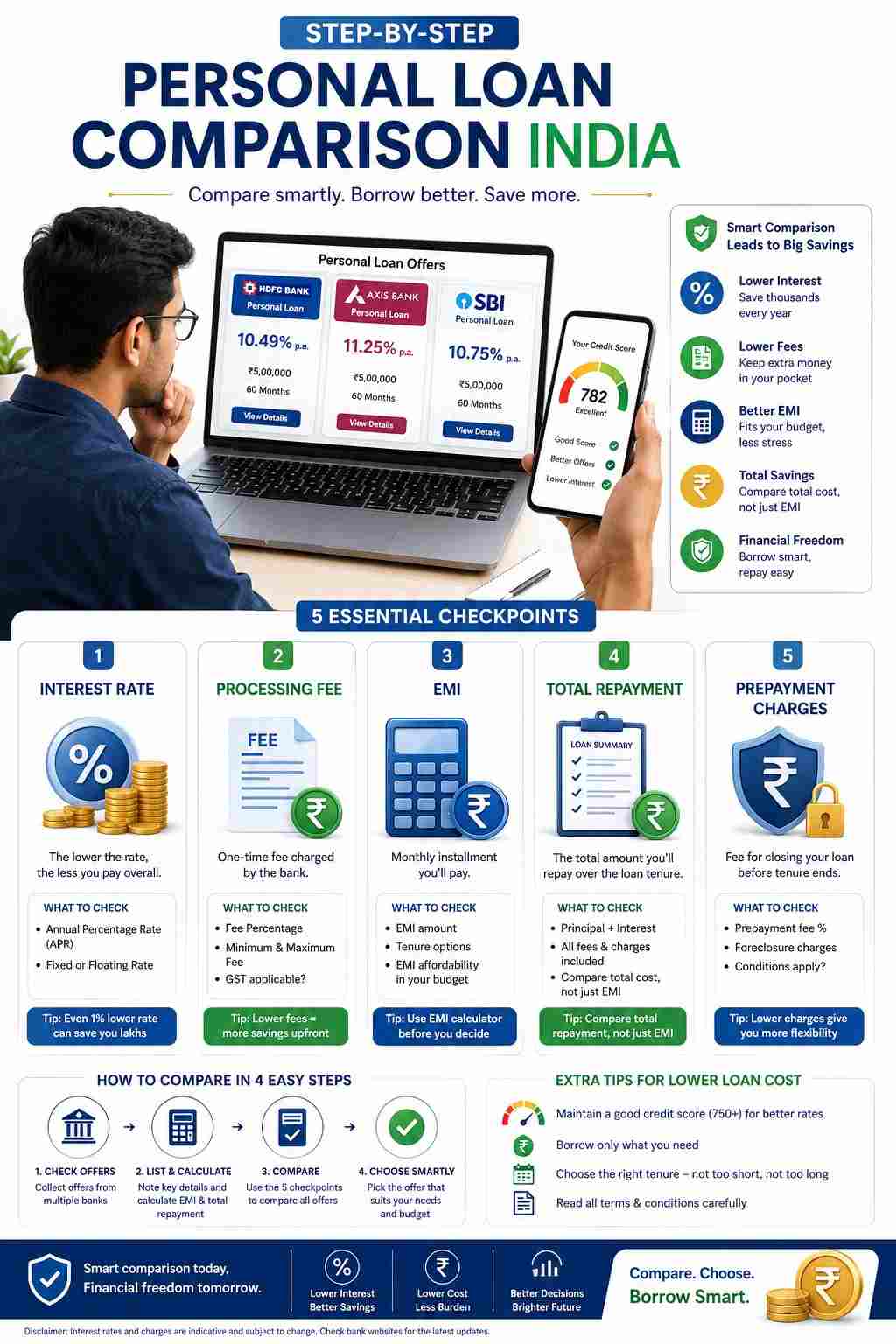
The smartest approach is not to choose a bank category first. Choose based on your profile and compare actual offers.
Check Your Credit Profile First
A strong credit score can improve your chances of receiving a lower rate.
Before applying, review:
- Credit score
- Existing EMIs
- Credit card utilization
- Repayment history
- Number of recent loan enquiries
- Stable monthly income
A good borrower profile gives you more negotiating power.
Compare at Least Three Actual Offers
A practical shortlist could include:
- Your salary-account bank
- One major PSU bank
- One competing private bank
Do not submit multiple unnecessary full applications without understanding the lender's process. Too many hard credit enquiries in a short period may be undesirable for your credit profile.
Compare APR or Effective Cost
The interest rate alone does not show the full picture.
The Annual Percentage Rate or overall effective borrowing cost can provide a better comparison when fees are significant.
For example, HDFC Bank publishes both interest-rate and APR-related disclosures for the period indicated on its official page.
Ask for the Final Sanction Terms
Before accepting the loan, verify:
- Final interest rate
- EMI amount
- Total number of EMIs
- Processing fee
- Net amount credited
- Prepayment conditions
- Foreclosure charges
- Insurance costs, if any
- Penalties for delayed payment
Never assume the advertised starting rate is the rate you will receive.
Who Should Choose a PSU Bank?
A PSU bank may be your best option if:
You Want the Lowest Possible Rate
If your primary objective is minimizing total interest, start with PSU-bank offers. Some public sector lenders currently show lower starting rates than leading private banks.
You Have a Stable Employment Profile
Government employees, PSU employees, and other highly stable salaried borrowers may find attractive pricing with public sector banks.
You Are Taking a Large Loan
For a large loan, even a small interest-rate difference can have a bigger financial impact.
You Are Comfortable With a Less Aggressive Digital Experience
If saving money matters more than getting instant approval, a PSU-bank application may be worth the additional effort.
Who Should Choose a Private Bank?
A private bank may be the better choice if:
You Need Money Quickly
Fast digital approval and disbursal can be a major advantage.
You Already Have a Strong Banking Relationship
Salary-account customers and borrowers with a good internal relationship may receive attractive pre-approved offers.
You Prefer Online Convenience
Digital documentation, application tracking, and faster communication can make the borrowing experience easier.
Your Final Offer Is Competitive
If a private bank offers a rate close to or lower than the PSU-bank offer, compare fees and prepayment terms. The private option may provide better overall convenience without a major cost difference.
The Best Option for Different Borrowers
There is no universal winner, but these general patterns can help.
Best for lowest starting rates: Selected PSU banks
Best for government employees: PSU banks, especially where salary-account benefits apply
Best for urgent loans: Large private banks with digital approval systems
Best for existing salary-account customers: Compare your current bank's pre-approved offer first
Best for low processing costs: Compare actual fee structures; PSU banks often have an advantage, but product-specific terms matter
Best for convenience: Private banks
Best for large loans and long tenures: Compare total interest carefully; even a small rate difference can matter significantly
FAQ
What is the lowest personal loan interest rate in India in 2026?
Among widely compared bank offers, some PSU banks have advertised personal loan rates starting around 8.75% in 2026. However, the lowest rate available to you depends on your credit score, income, employment profile, loan amount, and bank relationship.
Are PSU bank personal loans cheaper than private bank loans?
Often, yes, especially at the lower end of advertised rates. However, private banks can offer competitive rates to high-quality borrowers, existing customers, and those receiving pre-approved offers. Always compare your final sanctioned terms.
Which is better for a personal loan: SBI or HDFC Bank?
SBI may be attractive for borrowers prioritizing competitive pricing, while HDFC Bank may appeal to borrowers who value digital convenience and faster processing. The better choice depends on the actual rate, fee, tenure, and prepayment terms offered to you.
Which private bank has a low personal loan interest rate in 2026?
Axis Bank has been listed with rates starting around 9.60%, while HDFC Bank and ICICI Bank have published starting rates around 9.99%. Eligibility and the final approved rate vary by borrower.
What processing fee is reasonable for a personal loan?
A lower processing fee is generally better, but the interest rate must also be considered. Compare the total cost rather than choosing solely on the basis of a low fee.
Can I negotiate my personal loan interest rate?
In some cases, borrowers with strong credit scores, stable income, and competing loan offers may have room to negotiate or request a better offer. Existing banking relationships can also help.
Should I choose a longer tenure to reduce my EMI?
A longer tenure reduces your monthly EMI but usually increases the total interest paid. Choose the shortest tenure that keeps the EMI comfortably affordable.
Is a pre-approved personal loan always the best deal?
No. Pre-approved means the process may be easier, but you should still compare the interest rate, fees, tenure, and foreclosure conditions before accepting.
Final Verdict: PSU vs Private Banks in 2026
For borrowers whose main goal is the lowest personal loan interest rate, PSU banks deserve serious attention in 2026. Several public sector lenders have competitive starting rates, and stable salaried borrowers may receive particularly attractive pricing.
However, private banks are often stronger on speed, digital convenience, and pre-approved offers. If you need funds urgently or already have a strong relationship with a private lender, the slightly higher headline rate may be worth the convenience—or your actual offer may be just as competitive.
The best personal loan strategy is simple: shortlist one or two PSU banks and one or two private banks, compare the final interest rate, processing fee, EMI, total repayment, and prepayment charges, then choose the loan with the lowest overall cost for your situation.
Do not choose PSU or private banking based on reputation alone. In 2026, the best personal loan is the one that gives your specific profile the best combination of low cost, flexibility, and convenience.



Write a comment