Choosing the right bank for a savings account in India can impact your financial journey significantly. Among the most popular choices are State Bank of India (SBI), HDFC Bank, and ICICI Bank — each offering unique advantages and features. This comparison will help you determine which savings account aligns best with your financial goals, lifestyle, and banking habits.
In this detailed comparison, we’ll break down:
- Interest rates and returns
- Minimum balance requirements and charges
- Digital banking & technology
- Customer service & branch availability
- Additional benefits & perks
- Who each bank is ideal for
Let’s dive in and compare SBI vs HDFC vs ICICI savings accounts across essential factors so you can confidently choose the best one for you.
Understanding the Basics of Savings Accounts
What Is a Savings Account?
Interest earned on your savings balance is one of the most important things to consider when opening an account. A difference of even a few percentage points can become meaningful when you keep a large balance for months or years.
But there is a catch: the bank advertising the highest interest rate is not always the bank that gives you the highest return on your entire balance. Savings accounts often use balance slabs, and some attractive rates apply only to a specific portion of your money.
So, who gives you more interest on your savings? The answer depends on your balance, the applicable rate slab, minimum-balance requirements, and how the bank calculates and credits interest.
What Does a Savings Account Interest Rate Mean?
A savings account interest rate is the percentage a bank pays you for keeping money in your account. It is generally expressed as an annual rate, or per annum (p.a.).
For example, if a bank offers 3% interest and you maintain ₹1 lakh for a full year, a simplified calculation would suggest around ₹3,000 in annual interest before considering the bank's actual daily-balance calculation and applicable taxes.
Most banks calculate savings interest using the balance maintained in the account, often on a daily basis. The amount is then credited according to the bank's stated schedule. For example, Axis Bank says savings interest is computed using the daily closing balance, while Federal Bank states that its savings interest is calculated on the end-of-day balance and credited quarterly.
This is why simply looking at the headline interest rate can be misleading.
Why the Advertised Rate Can Be Misleading
Suppose Bank A offers 2.50% on balances up to ₹1 lakh, while Bank B offers 5% on a particular higher balance slab.
If you have only ₹50,000, the higher headline rate may not be available to you at all.
Likewise, a bank advertising 7% or 8% may apply that rate only to very large balances. Current Indian savings-account comparisons show that some small finance banks offer high rates on specific incremental slabs, while many large traditional banks offer around 2.5% on ordinary balances.
The important question is therefore not "What is the highest rate?" but "What rate will apply to my money?"
Which Banks Offer Higher Savings Interest Rates?
Savings account interest rates vary considerably between banks and balance levels.
As of 2026, many mainstream public and private-sector banks offer relatively modest base savings rates, while some small finance banks offer substantially higher rates on selected balance slabs. A July 2026 comparison, for example, listed rates ranging from around 2.5% at several large banks to significantly higher rates at selected small finance banks, depending on the amount deposited.
Traditional Banks
Large banks often compete on convenience, branch networks, digital services and established customer relationships rather than offering the highest savings rate.
For example, Axis Bank currently lists a 2.50% rate for balances below ₹2,000 crore, with a separate MIBOR-linked structure for exceptionally large balances.
For an ordinary saver, this means the headline rate may be fairly straightforward—but it may not be the highest available in the market.
Small Finance Banks
Small finance banks can be more aggressive with savings rates.
Some current comparisons show rates above 5% for particular balance ranges and even higher rates for large incremental balances. For example, published 2026 comparisons list higher slab-based rates from banks such as ESAF Small Finance Bank, Utkarsh Small Finance Bank, Ujjivan Small Finance Bank and others.
However, a higher rate should not automatically be treated as a better account. You should also examine the bank's conditions, applicable slab, services, fees, accessibility and deposit-insurance coverage.
Digital and Specialised Accounts
Some digital banking products may also use higher interest rates to attract deposits. But rates can change, and eligibility conditions may differ.
Before transferring a large amount simply because of an advertised rate, check the bank's current official rate sheet and understand whether the rate applies to your entire balance or only the incremental amount above a threshold.
Why Balance Slabs Matter So Much
Balance slabs are one of the most important details to understand when comparing savings accounts.
A bank may offer one rate for the first ₹1 lakh, another rate for the next few lakhs, and a different rate above a much higher threshold.
Consider a simplified example:
| Balance | Applicable Rate |
|---|---|
| Up to ₹1 lakh | 2.50% |
| ₹1 lakh–₹5 lakh | 4.00% |
| Above ₹5 lakh | 5.00% |
If you have ₹6 lakh, you cannot necessarily multiply ₹6 lakh by 5%. The bank's calculation may apply each rate to the relevant portion of the balance.
DBS Bank, for example, publishes different rates for balances up to ₹2 lakh, between ₹2 lakh and ₹50 lakh, and above ₹50 lakh. It also states that interest is calculated on the daily available balance.
Incremental Rates vs Entire-Balance Rates
This distinction can make a major difference.
An incremental rate applies the higher rate only to the money that falls into a particular slab.
An entire-balance rate means the stated rate may apply to the whole eligible balance once you meet the relevant condition.
Never assume which method a bank uses. Read the rate table carefully.
A Higher Rate Does Not Always Mean Higher Earnings
Imagine two accounts:
- Account A pays 3% on the entire ₹5 lakh.
- Account B advertises 6%, but only ₹1 lakh qualifies for 6% and the remainder earns 2.5%.
Account B sounds better at first glance. But the actual annual interest could tell a very different story.
This is why comparing effective earnings on your actual balance is more useful than comparing headline percentages.
How Much Interest Can You Earn?
A basic way to estimate savings interest is:
Interest ≈ Balance × Annual Interest Rate × Time
For example, at a simple 3% annual rate, ₹2 lakh maintained for approximately one year would generate about ₹6,000 before considering the bank's actual calculation method and taxes.
But real savings accounts usually calculate interest based on daily balances rather than assuming that the same amount remained untouched for an entire year.
If you deposit ₹2 lakh today, withdraw ₹50,000 next month and then add money again later, your interest will reflect those changing daily balances.
Why Daily Balance Matters
Consider two people who each deposit ₹1 lakh during a month.
Person A keeps the full ₹1 lakh for the entire month.
Person B withdraws ₹50,000 halfway through the month.
Even though their opening balance was identical, Person A generally earns more interest because the average daily balance is higher.
This is one reason to avoid looking only at the account's opening balance when estimating returns.
What Should You Check Besides the Interest Rate?
Interest is important, but it should not be the only deciding factor.
A savings account is primarily designed for liquidity and everyday access. A slightly lower rate may be worthwhile if the account provides significantly better convenience or fewer restrictions.
Minimum Balance Requirements
Check whether the account requires you to maintain a minimum balance.
A higher interest rate is less attractive if you repeatedly incur charges for failing to maintain the required balance.
Fees and Charges
Look for charges related to:
- Debit cards
- Cash withdrawals
- Non-maintenance of balance
- Additional transactions
- Cheque services
- ATM usage
- Account closure or other specialised services
A few hundred or thousand rupees in annual charges can reduce the benefit of a higher interest rate.
Interest Credit Frequency
Banks may credit savings interest monthly, quarterly, half-yearly or according to their account terms.
The calculation method matters more than simply seeing money credited to the account, but more frequent crediting can affect the timing of when interest becomes part of your balance.
Federal Bank, for example, states that savings interest is calculated on daily end-of-day balances and credited quarterly.
Deposit Insurance
Safety should come before chasing an extra percentage point.
In India, eligible bank deposits are insured by the Deposit Insurance and Credit Guarantee Corporation (DICGC), subject to its applicable limits and conditions. Current savings-account comparisons note coverage of up to ₹5 lakh per depositor per bank, including applicable interest.
If you are holding a substantial amount of cash, understanding how deposit insurance works is essential before choosing a bank purely for its interest rate.
Savings Account vs Other Savings Options
A savings account is not necessarily the highest-return place for every rupee you own.
Its biggest advantage is accessibility.
If you may need the money at short notice, keeping it in a liquid savings account can make sense. But money that you know you will not need for a longer period may have other suitable options.
For example, India's small savings schemes currently offer rates such as 7.10% for PPF, 7.70% for NSC and 8.20% for the Senior Citizens Savings Scheme for the July–September 2026 quarter, subject to the specific rules and eligibility of each scheme.
These products should not be treated as direct substitutes for a normal savings account because their liquidity, tenure, tax treatment and eligibility rules differ.
When a Savings Account Makes More Sense
A savings account can be particularly useful for:
- Emergency funds
- Monthly expenses
- Salary credits
- Short-term goals
- Money waiting to be invested
- Easily accessible cash reserves
When You May Want to Compare Other Products
If you do not need immediate access to your money, compare the savings account rate with suitable fixed-income or government-backed savings alternatives.
The objective is not to put every rupee into the highest-rate product. It is to match the product with the purpose of the money.
How to Choose the Best Savings Account Interest Rate
Choosing the right account becomes easier when you follow a simple comparison process.
Start With Your Average Balance
Estimate how much money you realistically keep in the account.
Someone maintaining ₹30,000 has very different requirements from someone maintaining ₹8 lakh.
Check the Exact Rate Slab
Do not stop at the advertised percentage.
Find out:
- What rate applies to your balance?
- Is the rate incremental?
- Does the rate apply to the entire balance?
- Are there special conditions?
- Can the bank change the rate?
Rates can change over time. DBS, for example, explicitly notes that its savings rate is subject to change.
Calculate the Rupee Difference
Suppose your current account earns 2.5% and another account could effectively provide 5%.
On ₹1 lakh, the gross difference at a simple annual comparison is about ₹2,500 per year.
On ₹10,000, the same percentage difference would be only about ₹250.
That calculation helps you decide whether switching banks is worth the effort.
Consider Convenience and Safety
Finally, compare the complete package.
A slightly higher interest rate may not be worth it if you dislike the bank's digital experience, have difficulty accessing branches or ATMs, face inconvenient account conditions, or are uncomfortable with how much money you are keeping at one institution.
Common Mistakes People Make
Many savers focus on the percentage and overlook the details.
Chasing the Highest Advertised Rate
The highest rate may apply only to an unusually large balance.
Always check the amount required to qualify.
Ignoring Fees
A higher interest payment can be cancelled by account fees.
Calculate your net benefit, not just the interest earned.
Keeping Too Much Money in One Bank
If you maintain a large cash balance, understand deposit-insurance limits and consider how you want to distribute your deposits.
Forgetting That Rates Can Change
Savings rates are not necessarily fixed for the lifetime of an account.
Banks can revise rates, subject to applicable rules and their account terms.
Comparing Only Big Banks
Large banks are not automatically the highest-rate banks.
Some smaller institutions offer more aggressive savings rates, although they may have different service models and conditions.
Why Choosing the Right Bank Matters
While all banks offer savings accounts, the benefits, costs, and services vary widely. Differences in interest rates, minimum balance requirements, digital features and customer support can influence your banking experience and the growth of your money.
Interest Rates: Who Gives You More?
Interest earned on your savings balance is one of the most important things to consider when opening an account.
State Bank of India (SBI)
- SBI typically offers interest on savings balances that aligns with or slightly above the national average for large banks.
- Interest may vary based on the amount held (slabs).
- Interest is compounded quarterly.
HDFC Bank
- HDFC Bank often offers competitive savings account interest rates.
- Sometimes attractive for customers with higher account balances.
- Interest credited quarterly.
ICICI Bank
- ICICI Bank also provides competitive interest rates that can be similar to HDFC’s, especially for premium accounts.
- Interest compounding and credit frequency can align with industry norms.
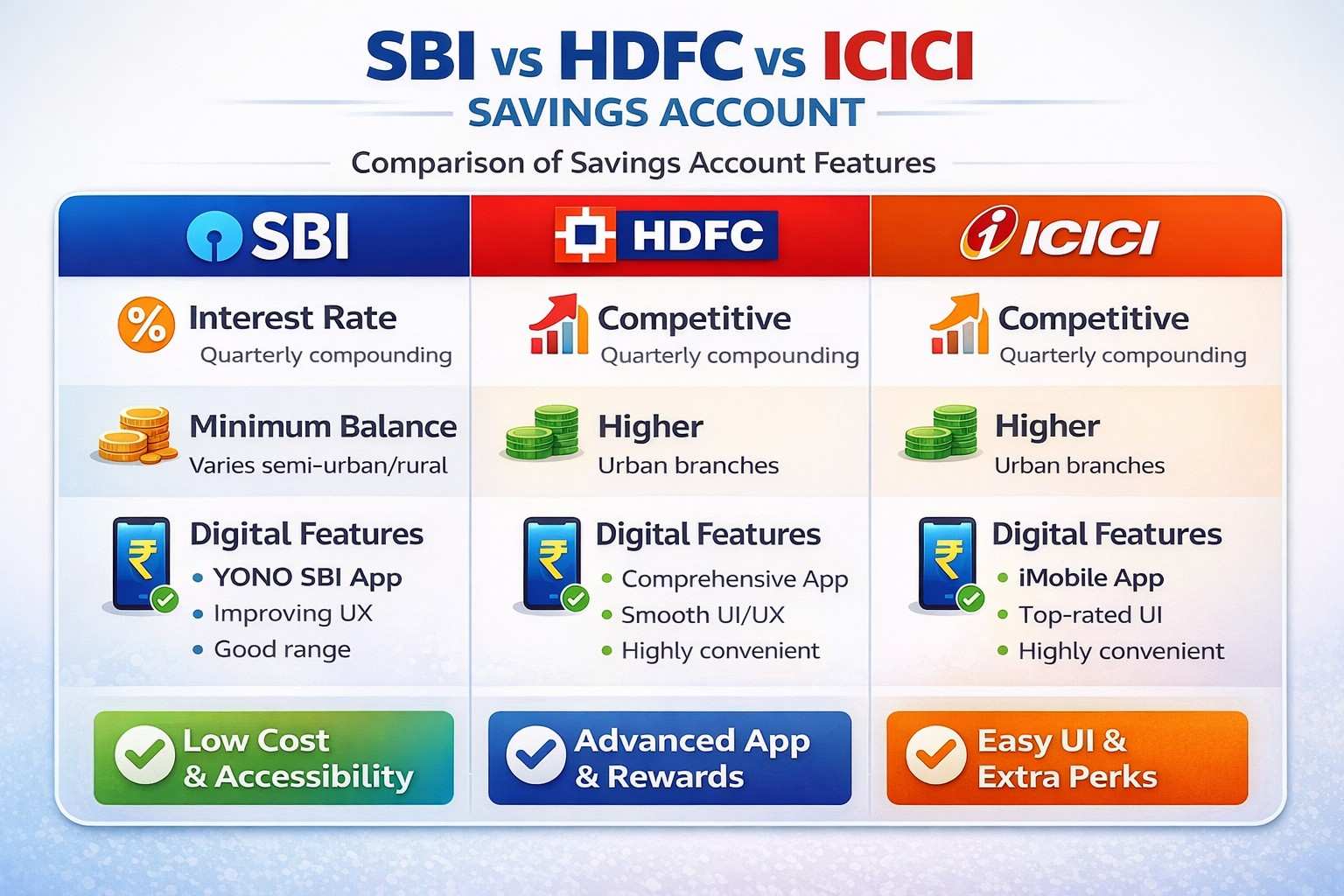
Quick Comparison (Illustrative):
| Bank | Typical Savings Interest | Compounding |
|---|---|---|
| SBI | Moderate | Quarterly |
| HDFC | Competitive | Quarterly |
| ICICI | Competitive | Quarterly |
💡 Note: Exact interest rates change based on RBI guidelines and bank policies. It’s always best to check the latest rates on official bank websites before deciding.
Winner for Interest: Tie between HDFC and ICICI if they lead slightly above SBI at the time of comparison.
Minimum Balance & Charges: Cost of Banking
One of the biggest pain points for bank account holders is maintaining the minimum balance and avoiding charges.
SBI
- Minimum Balance: Lower compared to private banks, especially in semi-urban and rural areas.
- Charges: Less aggressive penal charges for non-maintenance of balance.
- Advantage: Good for students and first-time account holders.
HDFC Bank
- Minimum Balance: Higher amounts required, especially in urban branches.
- Charges: Penal charges for not maintaining the balance can be significant.
- Advantage: Often comes with additional perks for premium tiers.
ICICI Bank
- Minimum Balance: Comparable to HDFC, varies by location and account type.
- Charges: Similar penal charges for breach of minimum balance.
- Advantage: Flexibility in different types of savings accounts.
Quick Comparison:
| Bank | Ease of Maintaining Balance | Charges for Non-Maintenance |
|---|---|---|
| SBI | Easier | Lower |
| HDFC | Harder | Higher |
| ICICI | Harder | Higher |
Winner for Minimum Balance & Charges: SBI — especially for customers prioritizing low cost and flexibility.
Digital Banking & Tech Experience
In today's digital world, the strength of a bank’s mobile app and online services is crucial.
SBI
- YONO SBI app integrates banking, investments, shopping, and payments in one place.
- User experience is improving but occasionally reported as slower compared to private banks.
- Good range of digital services and QR payments.
HDFC Bank
- HDFC MobileBanking App is known for smooth UI, quick functions, and reliable performance.
- Strong online banking features with regular updates and security features.
- Seamless fund transfers and bill payments.
ICICI Bank
- iMobile by ICICI Bank is a highly rated mobile banking platform.
- Offers intuitive navigation, multi-feature dashboard, and easy transactions.
- Often competes neck-to-neck with HDFC’s app.
Digital Experience Summary:
| Bank | App Quality | Ease of Use | Features |
|---|---|---|---|
| SBI | Good | Moderate | Broad |
| HDFC | Excellent | Smooth | Rich |
| ICICI | Excellent | Smooth | Rich |
Winner for Digital Banking: HDFC and ICICI (tie) — both deliver superior mobile and online experiences.
Customer Support & Branch Accessibility
SBI
- Strength: Largest bank in India with thousands of branches everywhere — urban, semi-urban, and rural.
- Customer Service: Branch access makes in-person support easier, but wait times can be longer.
- Phone and Online Support: Available but not always prompt.
HDFC Bank
- Strength: Strong service quality at branches in urban areas.
- Customer Service: Quick digital support and responsive call centers.
- Network: Fewer branches compared to SBI, but good coverage.
ICICI Bank
- Strength: Good branch network in cities and towns.
- Customer Service: Generally fast support via digital channels.
- Network: Comparable to HDFC with reliable coverage.
Winner for Accessibility: SBI — unbeatable physical presence.
Winner for Customer Support Experience: HDFC and ICICI — faster, more responsive digital support.
Additional Features & Benefits
Let’s look at extra features that sweeten the savings account experience.
SBI Savings Account Benefits
- Lower minimum balance.
- Wide ATM network.
- Access to SBI’s ecosystem (loan offers, investments, credit cards).
- YONO app for banking plus lifestyle benefits.
HDFC Savings Account Benefits
- Robust digital banking features.
- Exclusive rewards & offers on debit card spends.
- Wealth management tie-ins.
- Personalized banking for premium customers.
ICICI Savings Account Benefits
- iMobile app with advanced features.
- Attractive onboarding offers via digital sign-up.
- Partner benefits (discounts on lifestyle, entertainment).
- Flexible account variants (e.g., regular, Express).
Bonus Value: Both HDFC and ICICI often offer rewards and cashback on debit transactions, shopping partners, and festival offers.
Feature Winner: HDFC and ICICI for value-added perks; SBI for broad banking ecosystem.
Best for Different Types of Customers
Let’s simplify the choice by personifying the ideal customer for each bank.
Best For Students & Beginners
✅ SBI — Easier balance requirements, wide accessibility, reliable banking basics.
Best For Digital-First Users
✅ HDFC or ICICI — Smooth apps, advanced features, better rewards on online spends.
Best For Frequent Travelers Across India
✅ SBI — Unmatched branch + ATM coverage.
Best for Rewards & Premium Banking
✅ HDFC & ICICI — More perks, lifestyle offers, exclusive deals.
Best for Low Cost & Simple Banking
✅ SBI — Lower charges and easier balance rules.
Short Verdict: Which Bank Is Best?
After comparing SBI vs HDFC vs ICICI savings accounts:
✔ If your priority is low cost, accessibility, and simplicity: SBI Savings Account wins.
✔ If you value seamless digital banking, rewards, and a premium experience: HDFC or ICICI Savings Account is better.
✔ No one-size-fits-all: Your choice depends on your lifestyle and requirements — digital savviness, travel frequency, budget comfort, and spending habits.
How to Choose the Right Savings Account for You
To decide confidently, ask yourself:
- How often will I maintain the minimum balance comfortably?
- Will I use digital banking features frequently?
- Do I want rewards on debit card spending?
- Do I need a bank that’s accessible everywhere?
- Am I planning to link investments, loans, or insurance soon?
Understanding your priorities will help you pick the best savings account among SBI, HDFC, and ICICI.
FAQ
Which bank offers the highest interest on savings accounts?
Interest rates fluctuate, but HDFC and ICICI often offer competitive rates that can be slightly higher than SBI’s. Always check current rates before deciding.
Is SBI better than HDFC or ICICI?
SBI is better for accessibility and low cost, while HDFC and ICICI shine in digital banking and extra perks.
Do these banks charge for non-maintenance of minimum balance?
Yes — all three banks charge penal fees if you don’t maintain the required minimum balance, but SBI’s penalties are usually lower.
Can I open a savings account online with these banks?
Yes — SBI, HDFC, and ICICI all support online savings account opening through apps and their websites.
Which bank’s mobile app is the best?
HDFC’s MobileBanking App and ICICI’s iMobile are both top-rated for ease of use, speed, and features.
Conclusion
Choosing the best savings account between SBI, HDFC and ICICI depends on what matters most to you. If you prefer low cost and wide reach, SBI is ideal. If you value digital convenience and rewards, HDFC or ICICI are strong contenders.
Weigh what matters most — cost, tech features, branch access, and perks — and pick the bank that helps grow and simplify your money.


Write a comment