
Banking customers in India have been hearing more about RBI banking rule changes — new regulations and guidelines issued by the Reserve Bank of India (RBI) that directly impact how banks operate and how account holders experience financial services. Whether it’s updates around digital payments, interest crediting timelines, service charges, or security protocols, these changes are meant to strengthen the banking system, protect customers, and improve efficiency.
In this comprehensive guide, you’ll learn what the key RBI banking rule changes are, why they were introduced, and — most importantly — how they affect you as an account holder.
What Are RBI Banking Rule Changes?
The Reserve Bank of India (RBI) is India’s central bank and financial regulator. Among its key responsibilities are supervising banks, issuing currency, managing monetary policy, and protecting consumer interests. From time to time, RBI updates banking rules to reflect economic shifts, technology advancements, fraud risks, customer feedback, and international standards.
These RBI banking rule changes may include:
- New service standards for customer grievance redressal
- Revised fee and charges norms
- Updated timelines for fund transfers or interest crediting
- Enhanced security guidelines
- Definitions and limits for digital payment services
These rules apply to all scheduled commercial banks, payments banks, small finance banks, and certain non-bank financial institutions.
Why RBI Updates Banking Rules
1. Protect Consumers
The Reserve Bank of India (RBI) works to protect banking customers by promoting fair treatment, transparency, and responsible banking practices. Banks and other regulated entities are expected to clearly communicate important terms, charges, and conditions so customers can make informed financial decisions.
Consumer protection efforts generally focus on:
- Transparent disclosures: Customers should receive clear information about interest rates, fees, charges, and important account terms.
- Fair treatment: Banking services should be provided without unfair or misleading practices.
- Predictable service standards: Customers should know what to expect regarding services, charges, and applicable procedures.
- Grievance redressal: Regulated entities are required to maintain mechanisms through which customers can raise and resolve complaints.
- Responsible communication: Financial products and services should be explained in a manner that helps customers understand their rights and obligations.
These measures help build trust in the banking system and give customers greater clarity when choosing and using financial products.
2. Strengthen Financial Stability
The Reserve Bank of India (RBI) uses banking regulations and supervisory measures to help maintain the stability and resilience of India’s financial system. Strong regulatory standards encourage banks to manage risks carefully, maintain adequate liquidity, and follow responsible lending practices.
Key areas include:
- Sound credit practices: Banks are expected to assess borrowers and manage credit risks responsibly.
- Liquidity management: Banks must maintain sufficient liquidity to meet their financial obligations and withstand periods of stress.
- Capital adequacy: Regulatory capital requirements provide banks with a buffer against unexpected losses.
- Risk management: Banks are required to identify, monitor, and control financial and operational risks.
- Prudential supervision: RBI oversight helps identify weaknesses and address potential threats before they develop into larger systemic problems.
By promoting disciplined banking practices and strengthening financial resilience, these regulations help protect depositors while reducing the risk that problems at individual institutions could spread across the wider financial system.
3. Promote Digital and Financial Inclusion
As digital payments and online banking continue to expand across India, the Reserve Bank of India (RBI) develops and updates regulations to make digital financial services safer, more reliable, and accessible to a wider population.
Key areas of focus include:
- Secure digital payments: Regulations encourage stronger security measures to protect customers from fraud and unauthorized transactions.
- Interoperability: Payment systems are designed to work across participating banks and platforms, making digital transactions more convenient.
- Financial inclusion: Regulatory initiatives aim to extend formal banking and payment services to underserved and remote communities.
- Customer protection: Guidelines address issues such as transaction disputes, unauthorized payments, and grievance redressal.
- Digital innovation: RBI's regulatory framework allows new financial technologies and payment solutions to develop while maintaining appropriate safeguards.
These efforts support the broader adoption of digital payments while helping create a banking environment that is secure, inclusive, and accessible to both urban and rural customers.
4. Combat Fraud and Cyber Risks
As banking becomes increasingly digital, the Reserve Bank of India (RBI) strengthens its regulatory framework to help banks and financial institutions manage fraud, cybersecurity threats, and unauthorized transactions. These measures are designed to protect both customers and the wider financial system.
Important areas include:
- Stronger authentication: Additional security measures can help verify customers during digital transactions and reduce unauthorized access.
- Transaction monitoring: Banks use monitoring systems to identify unusual or potentially fraudulent transaction patterns.
- Cybersecurity controls: Regulated entities are expected to maintain appropriate safeguards for customer information, digital infrastructure, and payment systems.
- Fraud reporting and prevention: Regulatory requirements encourage banks to detect, report, investigate, and respond to suspected fraud more effectively.
- Customer awareness: Banks are encouraged to educate customers about phishing, fake links, unauthorized calls, and other common digital-banking scams.
These measures help create a safer digital banking environment, although customers should also follow basic security practices such as never sharing OTPs, PINs, passwords, or banking credentials with anyone.
Major Recent RBI Banking Rule Changes
Below are key areas where the RBI has recently introduced or updated banking rules that affect account holders.
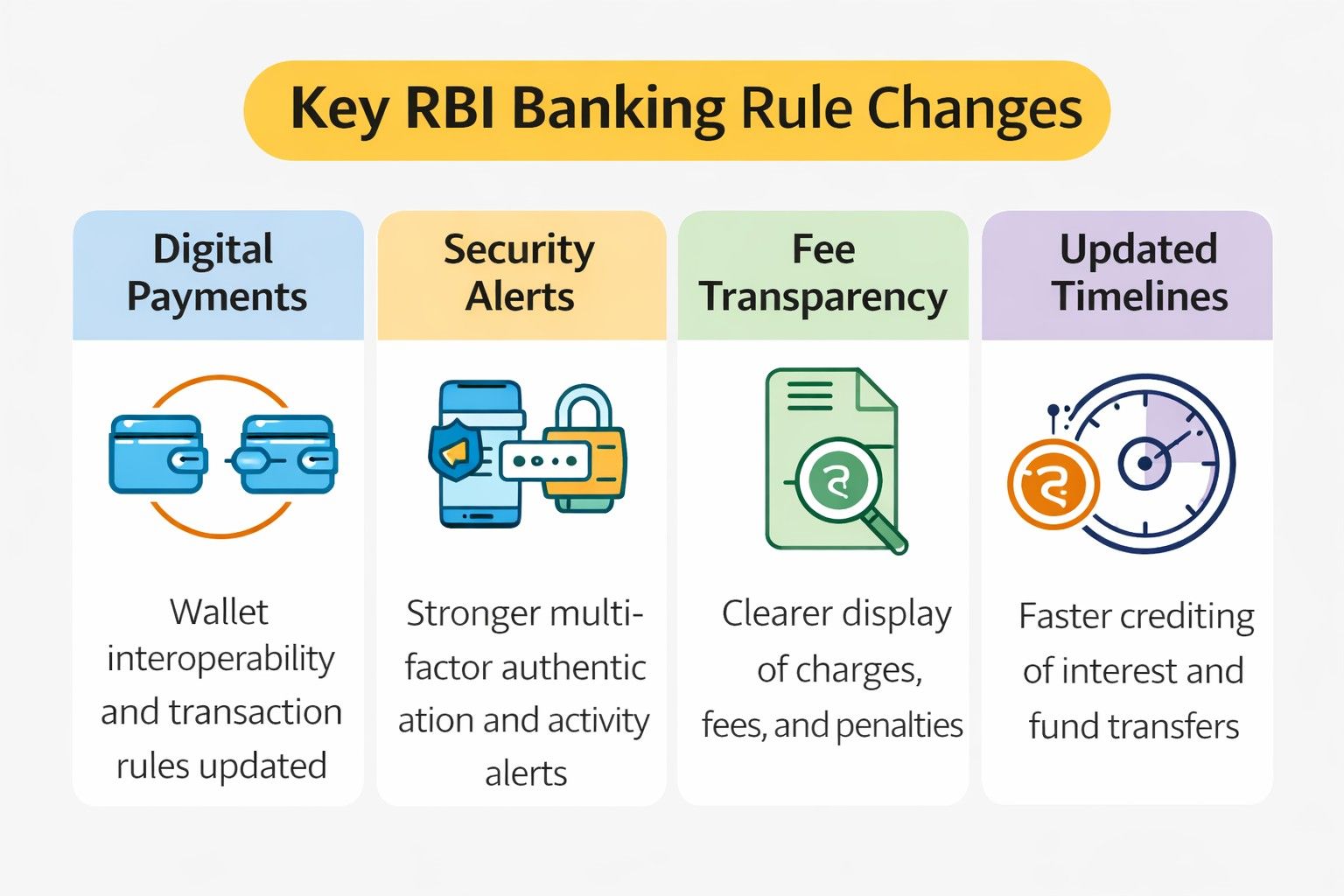
Updated Timelines for Interest and Charges
Faster Interest Credit on Deposits
RBI has recommended clearer timelines within which banks must credit interest to savings and term deposit accounts, ensuring customers receive what is due without unnecessary delay.
Transparent Fee Structures
Banks are now expected to publish service charges and penalties in a standardized, easy-to-understand format. This helps customers avoid surprise fees on:
- ATM withdrawals
- Cheque returns
- Passbook updates
- Electronic transfer failures
Digital Payments and Wallets — New Rules
Interoperability Standards
RBI has encouraged interoperability between different digital wallets and payment systems. This means your mobile wallet can work with multiple bank accounts and services without restriction.
Transaction Limits and KYC Upgrades
To curb fraud, certain transaction limits require completed Know Your Customer (KYC) documentation. Non-KYC wallets may continue but with lower limits on load and transfer values.
Enhanced Security and Fraud Protection
Multi-Factor Authentication (MFA)
RBI mandates multi-factor authentication for most digital banking transactions. You may now see additional OTP (one-time password), biometric prompts, or token-based authentication during transactions.
Alerts and Monitoring
Banks must send SMS/email alerts for specific activities — for example:
- Large withdrawals
- Login from a new device
- Unusual transaction patterns
These alerts help customers spot potential fraud early.
Customer Service and Grievance Redressal Rules
Faster Issue Resolution
The RBI has prioritized faster turnaround times for resolving customer complaints. Banks are required to acknowledge complaints quickly and provide clear timelines for redressal.
Escalation Mechanisms
If your complaint is unresolved beyond RBI guidelines, you can escalate it to:
- The bank’s nodal officer
- The banking ombudsman appointed by RBI
The ombudsman is a free service to resolve disputes between you and the bank.
Impact on Loans and Credit
Standardization of Loan Charges
RBI directives now require banks to clearly disclose processing fees, prepayment penalties, and interest reset triggers before loan disbursal.
Faster Sanction & Disbursal Processes
RBI encourages digitized loan applications and approvals to reduce processing times, especially for standard personal, home, and auto loans.
New Rules for KYC and Account Opening
Simplified Account Opening
RBI has allowed for easier onboarding of customers through digital KYC processes — such as video KYC and Aadhaar-based verification — while maintaining safeguards against fraud.
Periodic KYC Updates
To keep your account active and up-to-date, RBI requires banks to periodically refresh your KYC details, especially if your contact information or address changes.
WhatsApp and UPI Integration Guidelines
Banking on Chat Platforms
RBI has permitted banks to offer services like balance enquiry or mini statements via secure messaging platforms like WhatsApp, subject to strict security protocols.
Unified Payments Interface (UPI) Enhancements
UPI is continuously being upgraded with rules around transaction limits, merchant payments, and additional authentication measures to protect users.
What These Changes Mean for You
To help you understand your rights, responsibilities, and how to adapt, here’s what RBI rule changes mean for common banking scenarios:
1. Everyday Banking
Faster Value Credit
Interest and fund transfer timelines are now more regulated, so expect less delay in crediting your account.
Clear Charges
You’ll see clearer disclosures of fees — helping you choose lower-cost services.
Alerts & Notifications
You’ll receive real-time alerts on important account activity, boosting your awareness and security.
2. Digital Payments
More Wallet Flexibility
With interoperability, moving funds between wallets and bank accounts is easier.
Higher Safety
Stronger authentication reduces the odds of unauthorized transactions, especially on mobile apps.
3. Loans and Credit Cards
Transparent Costs
You’ll know the total cost of borrowing up front, including processing fees and prepayment charges.
Faster Approval
Digitized application processes mean some loans can be approved quicker than before — especially for low-risk profiles.
4. Security and Fraud Protection
Safer Banking
Multi-layer authentication and heightened monitoring make digital banking safer.
Monitoring Alerts
You’ll be notified of suspicious activities sooner, letting you act quickly if something goes wrong.
5. Complaint Resolution
Faster Response Times
RBI-backed timelines for addressing complaints mean you’re more likely to see quicker resolutions.
Ombudsman Access
If your issue is unresolved, you have a clear escalation path that’s free and governed by an impartial authority.
Tips to Make the Most of RBI Banking Rule Changes
To take full advantage of the improved protections and services, here are practical tips:
1. Keep Your KYC Updated
Update address, mobile number, email, and Aadhaar details so you don’t face transaction limits or account blocks.
2. Opt-In for Alerts
Enable SMS and email notifications for transactions, due dates, and unusual activities.
3. Review Bank Charges
Check your bank’s published fee schedule and choose the most cost-effective service.
4. Use Digital Banking Securely
Always update your banking app, use strong passwords and biometric locks, and avoid public Wi-Fi for transactions.
5. Know Your Escalation Paths
If a grievance isn’t resolved, use the bank’s nodal officer or the RBI banking ombudsman service.
Common Myths About RBI Banking Rule Changes
Here are a few misconceptions cleared up:
Myth 1: RBI Controls My Money
Reality: RBI sets rules for banks to protect you, but your money remains with your bank. RBI doesn’t access individual accounts.
Myth 2: All Fees Will Be Lower
Reality: RBI mandates transparency, not universal fee cuts. It helps you understand and compare charges.
Myth 3: Digital Payments Are Risk-Free
Reality: Rules increase security, but customers must still follow safe practices.
Frequently Asked Questions (FAQ)
What is the purpose of RBI bank rules?
RBI bank rules protect consumer interests, ensure robust banking operations, and minimize financial risks by setting standards for transparency, security, and efficiency.
Do these RBI changes affect all banks?
Yes, RBI regulations apply to all scheduled commercial banks and other regulated entities unless specified otherwise.
Can the RBI directly withdraw money from my account?
No, RBI cannot directly withdraw funds from your account. Only your bank — with your authorization or due legal process — can debit your account.
How do I know when new RBI banking rules are introduced?
Banks usually notify customers via email, SMS, or updates on their official website. RBI also publishes circulars on its official site.
What should I do if my bank is not following RBI guidelines?
You can lodge a complaint with your bank’s grievance redressal unit. If unresolved, escalate to the banking ombudsman appointed by RBI.
Conclusion
Understanding RBI banking rule changes is essential for every bank account holder in India. These rules are designed to make banking safer, more transparent, and customer-centric. From improved digital payment security to clearer fee disclosures and faster complaint resolutions, you stand to benefit — as long as you stay informed and proactive.
Stay aware, secure your digital banking practices, and don’t hesitate to ask questions or raise concerns with your bank. The RBI’s rules are there to protect you and make your everyday banking simpler and safer.



Write a comment