
Buying a home, renovating your property, or managing a major financial expense often requires borrowing money. However, one of the biggest dilemmas borrowers face is choosing between a home loan and a personal loan.
While both financing options provide access to funds, they differ significantly in terms of interest rates, repayment tenure, eligibility criteria, tax benefits, and overall financial impact. Selecting the wrong loan can lead to higher costs and unnecessary financial stress.
This detailed comparison of home loan vs personal loan will help you understand the key differences, advantages, disadvantages, and ideal use cases, enabling you to make an informed financial decision.
Understanding Home Loan vs Personal Loan
1. What Is a Home Loan?
A home loan is a secured loan that helps individuals purchase, construct, renovate, or extend a residential property. The lender provides the required funds, and the borrower repays the loan through Equated Monthly Instalments (EMIs) over an agreed tenure.
Because the property is offered as security against the loan, home loans generally come with lower interest rates and longer repayment periods than many unsecured loans. The exact interest rate, loan amount, tenure, and eligibility depend on factors such as the borrower's income, credit profile, property value, and lender's policies.
Key characteristics of a home loan include:
- Lower interest rates: Secured loans generally have more competitive interest rates than unsecured borrowing.
- Long repayment tenure: Borrowers can often choose a longer tenure, making the monthly EMI more manageable.
- Higher loan amounts: Depending on income, creditworthiness, and property value, lenders may provide substantial financing.
- Tax benefits: Eligible borrowers may receive tax deductions on home-loan interest and principal repayment, subject to applicable tax laws and conditions.
- Property as security: The financed property serves as collateral until the loan is fully repaid.
A home loan can therefore make property ownership more affordable by spreading the cost of a home over several years instead of requiring the entire purchase price upfront. However, borrowers should compare interest rates, processing fees, prepayment terms, tenure, and total repayment cost before choosing a lender.
2. What Is a Personal Loan?
A personal loan is an unsecured loan that individuals can use to meet a wide range of personal financial needs. Unlike a home loan, it does not usually require the borrower to pledge a property or other asset as collateral. The lender approves the loan primarily based on factors such as income, credit score, employment profile, and repayment capacity.
Personal loans can be used for various purposes, including medical emergencies, weddings, travel, education expenses, home renovation, major purchases, or debt consolidation. Since the loan is generally unsecured, borrowers have greater flexibility in how they use the funds.
Key characteristics of personal loans include:
- No collateral required: Borrowers generally do not need to pledge property or other assets to secure the loan.
- Faster approval: Many lenders offer a relatively quick application and approval process, particularly for eligible existing customers.
- Flexible usage: The loan amount can typically be used for a wide range of personal expenses without restricting the borrower to a specific purpose.
- Higher interest rates: Since there is no collateral to reduce the lender's risk, personal loans generally carry higher interest rates than secured loans such as home loans.
- Shorter repayment period: Personal loans usually have shorter repayment tenures, which can result in higher monthly EMIs.
The flexibility and speed of a personal loan can make it useful when funds are needed quickly. However, borrowers should consider the interest rate, processing charges, EMI amount, repayment tenure, and total cost of borrowing before taking one.
Key Differences Between Home Loan and Personal Loan
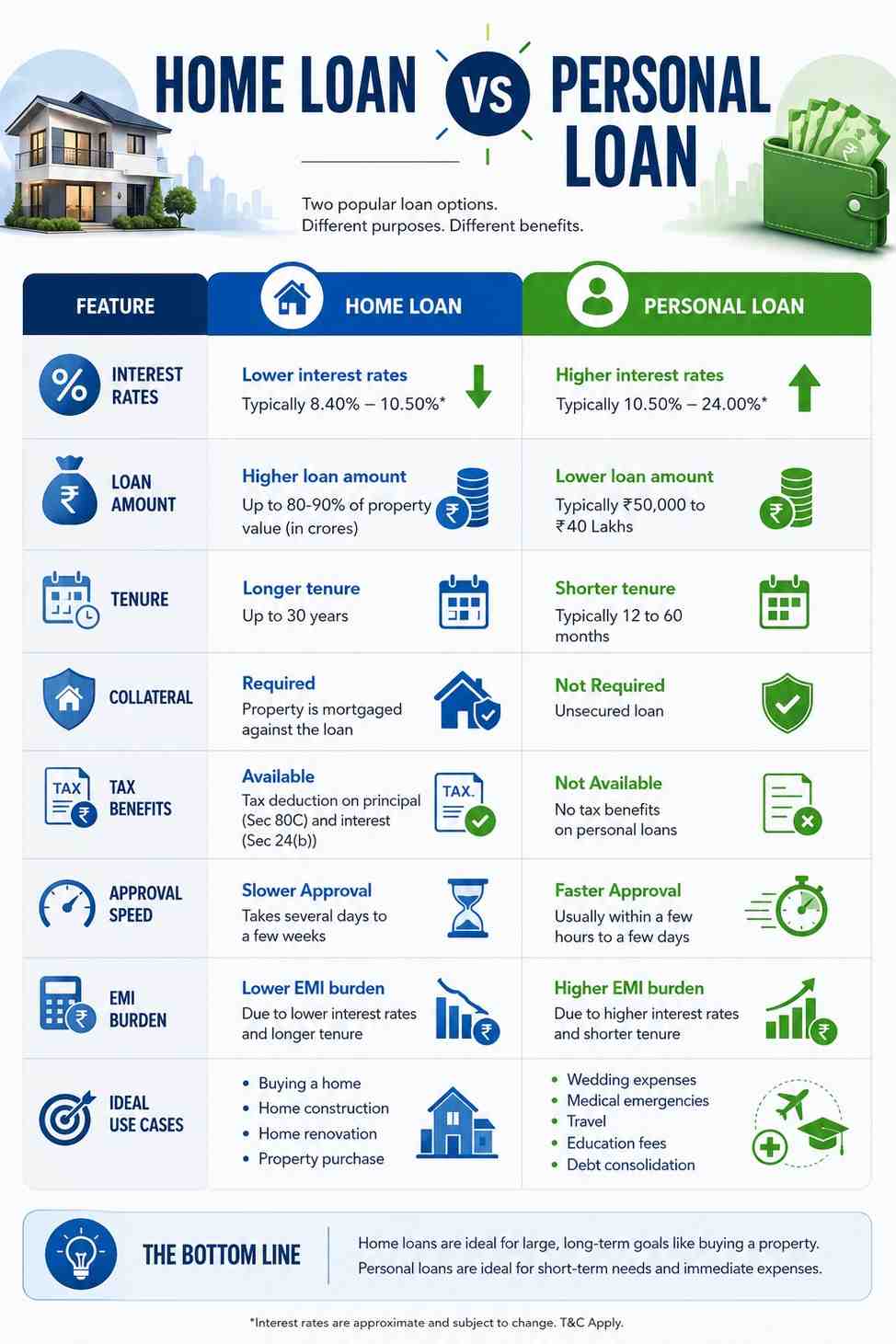
1. Interest Rate Comparison
Interest rates significantly affect the total borrowing cost.
| Feature | Home Loan | Personal Loan |
|---|---|---|
| Security | Secured | Unsecured |
| Interest Rate | Usually lower | Usually higher |
| Risk for lender | Low | High |
| Monthly EMI | Lower | Higher |
Because home loans are backed by property, financial institutions consider them less risky and offer more affordable rates.
2. Loan Amount Eligibility
The amount you can borrow differs considerably.
| Criteria | Home Loan | Personal Loan |
|---|---|---|
| Loan Amount | Higher | Moderate |
| Based On | Property value + income | Income + credit score |
| Maximum Tenure | Long | Short |
Home loans are ideal when large amounts of financing are required.
Home Loan Benefits
1. Lower Interest Costs
One of the biggest advantages of home loans is their comparatively lower interest rates. Since a home loan is secured against the property being financed, lenders generally face less risk and may offer more competitive rates than unsecured borrowing options such as personal loans.
A lower interest rate can significantly reduce the overall cost of borrowing, especially when the loan amount is substantial and the repayment tenure extends over several years. Even a small difference in the interest rate can affect the total interest paid throughout the loan.
However, borrowers should not compare lenders based on interest rates alone. Processing fees, loan tenure, prepayment charges, and other applicable costs can also influence the total repayment amount. Comparing the overall cost of different home-loan offers can help borrowers make a more informed decision.
2. Tax Benefits
One of the key financial advantages of a home loan is the potential for tax benefits. Eligible borrowers may be able to claim deductions on both the principal repaid and the interest paid on their home loan, subject to applicable tax laws, property conditions, and the tax regime they choose.
The interest component may qualify for a deduction under applicable provisions, while eligible principal repayments may also provide tax benefits within the prescribed limits. Additional benefits may apply in certain situations, such as when the property is jointly owned or qualifies under specific housing-related provisions.
However, tax rules can change, and the benefits available to a borrower depend on individual circumstances. Therefore, borrowers should check the current income-tax rules and applicable deduction limits before factoring tax savings into their home-loan decision.
3. Longer Repayment Period
One of the major advantages of home loans is the availability of longer repayment tenures. Depending on the lender and the borrower's eligibility, a home loan can typically be repaid over several years, helping spread the cost of the property across a longer period.
A longer tenure can make the monthly EMI more manageable, which may help borrowers maintain better control over their monthly budget. This can be particularly useful when financing a high-value property where a shorter repayment period could result in substantially higher EMIs.
However, a longer tenure also means paying interest for a longer period, potentially increasing the total cost of the loan. Borrowers should therefore balance affordable monthly EMIs with the overall interest payable before selecting a repayment tenure.
4. Higher Loan Eligibility
Home loans can offer higher borrowing amounts because the property serves as security for the lender. Since the loan is backed by an asset, financial institutions may be willing to finance a significant portion of the property's eligible value, subject to their lending policies.
The amount a borrower can qualify for depends on several factors, including income, credit score, existing financial obligations, age, employment stability, property value, and repayment capacity. A strong financial profile can improve the chances of qualifying for a larger loan amount.
However, higher eligibility does not necessarily mean a borrower should take the maximum amount available. Choosing a loan that keeps the EMI comfortably within the monthly budget can reduce financial stress and make long-term repayment more sustainable.
Personal Loan Benefits
1. Faster Processing
One of the key advantages of personal loans is their relatively fast application and approval process. Since personal loans are generally unsecured, borrowers do not need to provide property documents or complete a lengthy collateral-verification process.
Many lenders offer online applications, digital document submission, and quick eligibility checks, allowing eligible borrowers to receive approval and disbursement faster than with many secured loans. This can make personal loans particularly useful when funds are needed for urgent expenses or unexpected financial requirements.
However, processing times vary by lender and borrower. Factors such as credit score, income, employment profile, documentation, and loan amount can influence how quickly the loan is approved and disbursed.
2. No Collateral Requirement
A major advantage of a personal loan is that it is generally unsecured, meaning borrowers do not need to pledge property, investments, or other assets as collateral. This makes personal loans accessible to individuals who may not own a suitable asset to offer as security.
Instead, lenders typically assess factors such as the borrower's credit score, income, employment history, existing debts, and repayment capacity when evaluating the application.
However, the absence of collateral also means that personal loans generally carry higher interest rates than secured loans. Borrowers should therefore compare the interest rate, fees, EMI, and total repayment cost before choosing a personal loan.
3. Flexible Usage
One of the biggest advantages of personal loans is their flexibility. Unlike home loans, which are generally intended for specific property-related expenses, personal loans can typically be used for a wide range of legitimate personal financial needs.
Borrowers may use the funds for expenses such as medical emergencies, weddings, travel, education, home renovation, major purchases, or debt consolidation, depending on the lender's terms.
This flexibility allows borrowers to address different financial requirements without applying for a separate loan for every purpose. However, taking a personal loan for discretionary expenses should be carefully considered, as the higher interest rates and shorter repayment tenure can make borrowing more expensive.
Before applying, borrowers should assess whether the expense is necessary and whether the resulting EMI comfortably fits within their monthly budget.
4. Simple Documentation
Another advantage of personal loans is their relatively simple documentation process. Since these loans are generally unsecured, borrowers do not need to submit property-related documents, valuation reports, or collateral paperwork.
Depending on the lender and the applicant's profile, the required documents may include identity proof, address proof, income documents, bank statements, and employment-related information. Many lenders also offer digital application and document-upload facilities, making the process more convenient.
However, documentation requirements can vary based on the lender, loan amount, employment type, and borrower profile. Providing accurate and complete information can help avoid unnecessary delays during the personal loan application and approval process.
When Should You Choose a Home Loan?
1. Buying a House
A home loan is the most suitable choice when purchasing residential property due to lower interest rates and higher borrowing limits.
2. Constructing or Renovating Property
Many lenders offer specialized home loans for construction, renovation, and home improvement projects.
3. Seeking Tax Savings
Individuals looking for long-term tax advantages may benefit significantly from a home loan.
When Should You Choose a Personal Loan?
1. Handling Emergencies
Medical emergencies or urgent financial needs often require immediate access to funds, making personal loans ideal.
2. Small Home Renovation Projects
For minor repairs or interior upgrades, a personal loan may be more practical than a lengthy home loan process.
3. Avoiding Collateral
If you prefer not to mortgage your property, a personal loan provides a convenient alternative.
Eligibility Criteria Comparison
1. Home Loan Eligibility Requirements
Home loan approval generally depends on:
- Age
- Income
- Employment status
- Property valuation
- Credit score
- Existing liabilities
2. Personal Loan Eligibility Requirements
Personal loan eligibility typically depends on:
- Monthly income
- Credit score
- Employment history
- Debt-to-income ratio
- Repayment capacity
Documentation Requirements
1. Documents Required for Home Loan
Common documents include:
- Identity proof
- Address proof
- Income proof
- Bank statements
- Property documents
- Tax returns
2. Documents Required for Personal Loan
Usually required documents are:
- Identity proof
- Address proof
- Salary slips
- Bank statements
- PAN card
- Employment details
Risks of Choosing the Wrong Loan
1. Higher Financial Burden
Selecting a personal loan for large, long-term expenses may result in significantly higher interest costs.
2. Asset Risk
Failure to repay a home loan can lead to legal action and potential loss of the property.
3. Cash Flow Problems
Short repayment tenures in personal loans may create financial pressure due to higher EMIs.
Factors to Consider Before Choosing
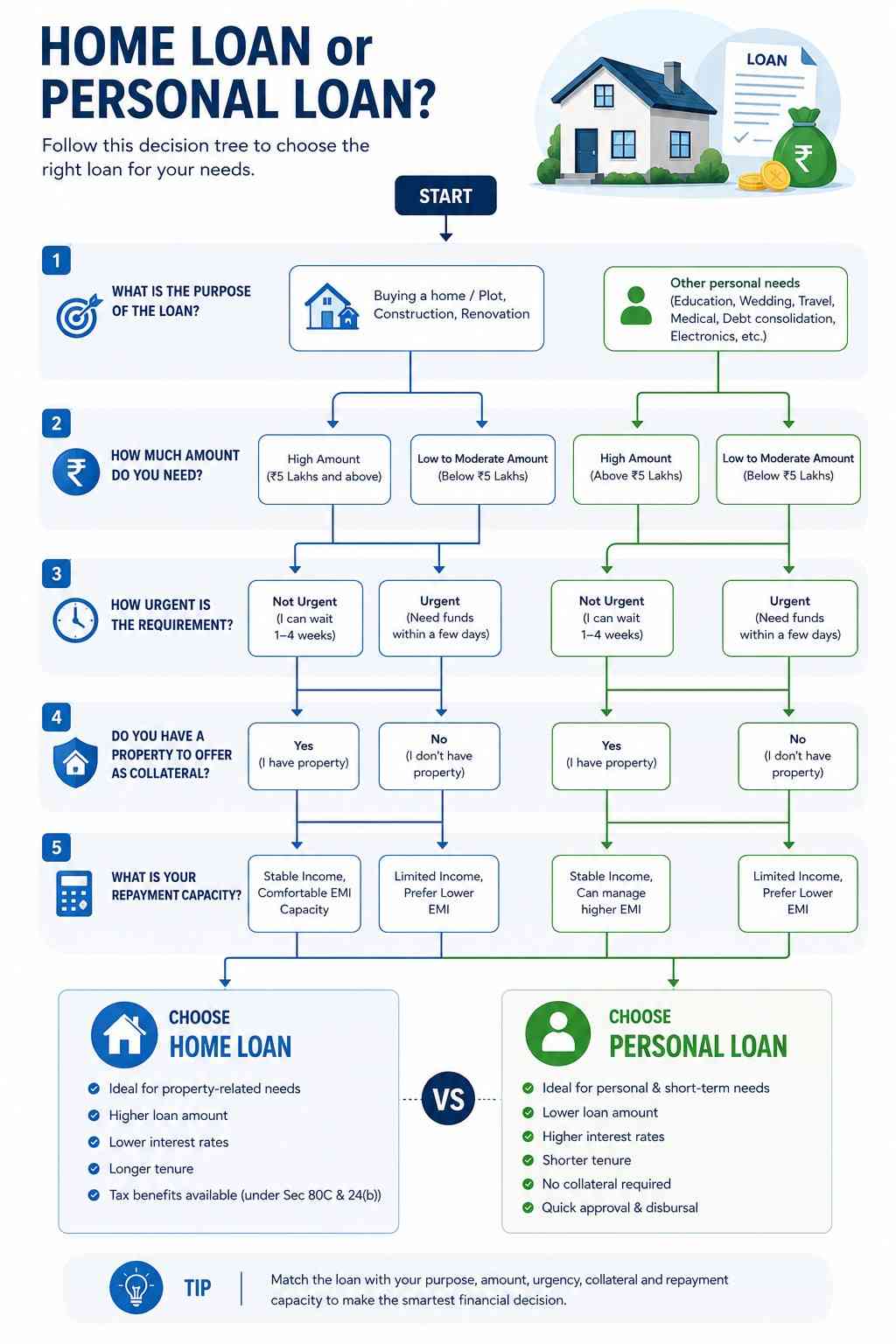
1. Purpose of Borrowing
Always identify whether the expense is property-related or a general financial need.
2. Loan Amount Required
Large financial requirements generally favor home loans.
3. Repayment Capacity
Evaluate your monthly cash flow and long-term financial commitments before borrowing.
4. Credit Score
A strong credit score improves loan approval chances and helps secure better interest rates.
FAQ
1. Which is cheaper: a home loan or a personal loan?
A home loan is generally cheaper because it is secured by property, resulting in lower interest rates compared to personal loans.
2. Can I use a personal loan to buy a house?
Technically yes, but it is usually not advisable due to higher interest rates, lower loan limits, and shorter repayment periods.
3. Which loan is easier to get approved?
Personal loans often have faster approval processes because they involve less documentation and no property verification.
4. Does a home loan provide tax benefits?
Yes. Home loans typically offer tax benefits on both principal repayment and interest payments, subject to applicable tax regulations.
5. Which loan should I choose for home renovation?
For major renovations, a home loan or home improvement loan is often preferable. For smaller projects, a personal loan may be more convenient.
Conclusion
Choosing between a home loan and a personal loan depends entirely on your financial goals, borrowing needs, repayment capacity, and long-term plans.
If you are purchasing, constructing, or significantly renovating a property, a home loan usually offers better value through lower interest rates, longer repayment periods, and tax benefits. On the other hand, if you require quick funds without collateral for short-term or emergency needs, a personal loan can be the right solution.
Before applying, compare interest rates, processing fees, repayment tenure, and your ability to manage monthly installments. A well-informed decision today can save you substantial money and financial stress in the future.



Write a comment