
Investing in 2026 isn't about choosing the product with the highest advertised returns. It's about selecting an investment that matches your financial goals, risk tolerance, time horizon, and tax situation. Three of the most popular investment options in India are the Public Provident Fund (PPF), Fixed Deposits (FDs), and Systematic Investment Plans (SIPs).
Each serves a different purpose. PPF offers government-backed safety and tax benefits, Fixed Deposits provide predictable returns, while SIPs offer the potential for wealth creation through equity mutual funds. Understanding their strengths and limitations can help you make smarter financial decisions.
Understanding PPF vs Fixed Deposit vs SIP
1. What is Public Provident Fund (PPF)?
PPF is a government-backed long-term savings scheme designed for wealth creation with guaranteed returns.
Key features include:
- Government-backed security
- 15-year lock-in period
- Tax-free maturity
- Annual investment between ₹500 and ₹1.5 lakh
- Interest rate revised quarterly
It is ideal for conservative investors planning retirement or long-term wealth accumulation.
2. What is a Fixed Deposit (FD)?
A Fixed Deposit is a bank or NBFC investment where money is deposited for a fixed period at a predetermined interest rate.
Features include:
- Guaranteed returns
- Flexible tenure from 7 days to 10 years
- Premature withdrawal available (with penalty)
- Interest taxable according to income tax slab
FDs are suitable for emergency funds and short to medium-term goals.
3. What is SIP?
A Systematic Investment Plan (SIP) is a disciplined way to invest regularly in mutual funds, particularly equity-oriented funds. Instead of investing a large lump sum at once, you contribute a fixed amount at regular intervals, such as monthly or quarterly.
Key benefits include:
- Rupee cost averaging: Regular investing helps you buy more units when prices are lower and fewer when prices are higher.
- Power of compounding: Returns can potentially generate further returns over a long investment period.
- High long-term growth potential: Equity mutual funds may offer stronger growth potential, although returns are market-linked and not guaranteed.
- Flexible investment amounts: You can generally start, increase, decrease, pause, or stop SIP contributions, subject to the fund platform and scheme rules.
- No universal lock-in: Most open-ended mutual funds do not have a mandatory lock-in period, although ELSS funds have a three-year lock-in.
For investors with long-term goals, SIPs can make regular investing easier and help build wealth gradually through consistency and time in the market.
Benefits include:
- Rupee cost averaging
- Compounding
- High long-term growth potential
- Flexible investment amount
- No fixed lock-in (except ELSS)
SIPs are ideal for long-term wealth creation.
PPF vs Fixed Deposit vs SIP: Detailed Comparison
| Feature | PPF | Fixed Deposit | SIP |
|---|---|---|---|
| Risk | Very Low | Low | Moderate to High |
| Returns | Moderate (Government-set) | Moderate | Market-linked |
| Capital Safety | 100% | High (depends on bank) | No guarantee |
| Liquidity | Low | Medium | High |
| Lock-in | 15 Years | Chosen tenure | No lock-in (mostly) |
| Tax Benefits | EEE Tax Benefit | Limited | ELSS only under Section 80C |
| Wealth Creation | Moderate | Low | High |
| Inflation Beating | Moderate | Usually Low | High (Long-term) |
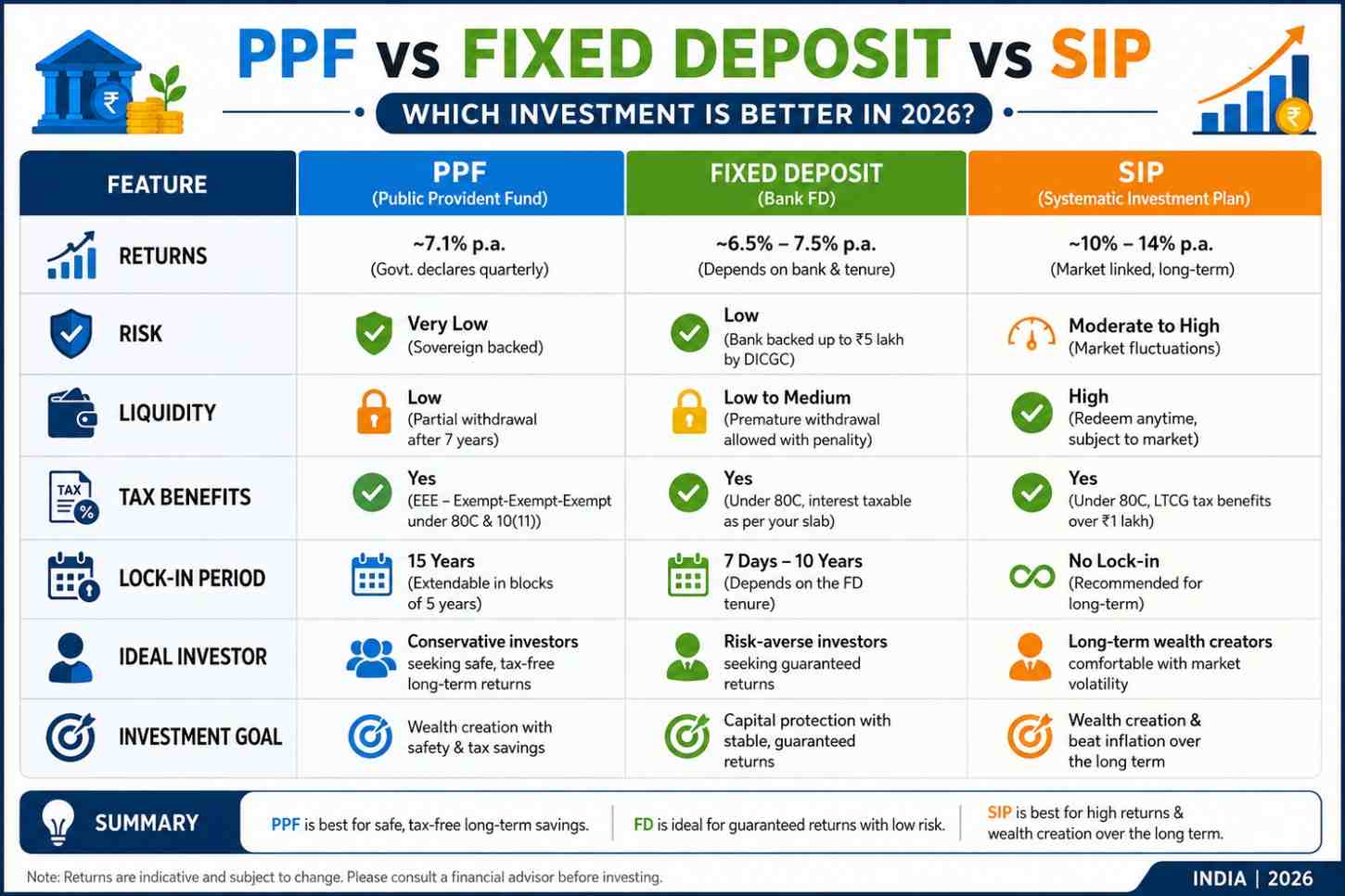
Returns Comparison in 2026
1. PPF Returns
The interest rate on the Public Provident Fund (PPF) is reviewed and revised quarterly by the Government of India.
Expected annual return:
- Around 7–8%
- Guaranteed
- Completely tax-free
The biggest advantage is certainty.
2. Fixed Deposit Returns
FD interest depends on:
- RBI policy rates
- Bank
- Tenure
Typical returns in 2026 may range between:
- 6%–8.5%
Senior citizens often receive slightly higher rates.
Fixed Deposit (FD) interest rates vary depending on several factors, including:
- RBI policy rates: Changes in the interest-rate environment can influence the rates offered by banks and other deposit-taking institutions.
- Bank or financial institution: Different institutions may offer different rates for similar tenures.
- Deposit tenure: Short-, medium-, and long-term FDs can have different interest rates.
In 2026, FD rates may typically fall within the 6% to 8.5% range, depending on the institution and tenure. Senior citizens often receive slightly higher interest rates than regular customers.
Before investing, compare current rates, premature-withdrawal rules, and deposit insurance coverage, as rates can change over time.
3. SIP Returns
SIP returns are market-linked, which means they are not fixed or guaranteed. The actual return depends on the performance of the underlying mutual fund and the market over time.
Historically, long-term equity mutual funds have often delivered returns in the range of:
- 10%–15% per year over long investment periods, depending on the fund, market conditions, and investment horizon.
- Higher or lower returns are possible, especially over shorter periods.
For SIP investors, a longer investment horizon can help manage the impact of market volatility and allow the potential benefits of compounding to work over time.
- 10%–15% annually over long investment horizons
However:
- Returns are not guaranteed.
- Markets fluctuate in the short term.
Risk Comparison
1. PPF Risk
PPF is among the safest investments in India because it is backed by the Government.
Risk Level:
Very Low
2. Fixed Deposit Risk
FDs carry low risk.
Scheduled commercial banks are generally considered safe, though returns are fixed and may not outpace inflation.
Risk Level:
Low
3. SIP Risk
SIPs invest in mutual funds whose value depends on market performance.
Risk Level:
- Equity SIP: High
- Hybrid SIP: Moderate
- Debt SIP: Low
Longer investment periods typically reduce the impact of market volatility.
Liquidity and Withdrawal Rules
1. PPF Liquidity
PPF has a 15-year maturity.
Partial withdrawals are allowed only after specific eligibility conditions are met.
Not suitable for emergency funds.
2. Fixed Deposit Liquidity
Most FDs allow premature withdrawal.
However:
- Penalty charges may apply.
- Interest may be reduced.
Suitable for medium-term financial needs.
3. SIP Liquidity
Open-ended mutual fund SIPs offer high liquidity.
Investors can:
- Pause SIPs
- Increase investment
- Reduce investment
- Redeem units anytime (subject to exit load where applicable)
Tax Benefits
1. PPF Taxation
PPF follows the Exempt-Exempt-Exempt (EEE) regime.
Benefits include:
- Investment eligible under Section 80C (subject to prevailing tax rules)
- Interest is tax-free
- Maturity amount is tax-free
2. FD Taxation
Tax-saving FDs may qualify under Section 80C.
However:
- Interest earned is taxable.
- TDS may apply based on prevailing rules.
3. SIP Taxation
Tax depends on the type of mutual fund.
For equity mutual funds:
- Capital gains tax applies based on holding period and prevailing tax laws.
ELSS funds additionally offer tax-saving benefits under Section 80C, subject to current regulations.
Which Investment Is Best for Different Financial Goals?
1. Retirement Planning
Best Choice: PPF + SIP
PPF provides stability while SIPs help build inflation-beating wealth over the long term.
2. Emergency Fund
Best Choice: Fixed Deposit
Fixed Deposits are a suitable choice for an emergency fund because they offer capital protection and relatively easy access to money. For better liquidity, consider keeping a portion in a short-term or flexible FD that can be withdrawn when needed.
3. Wealth Creation
Best Choice: SIP
For long-term goals that are more than 10 years away, equity SIPs can offer stronger wealth-creation potential through the power of compounding and market growth. However, returns are market-linked and not guaranteed.
4. Child Education
A balanced combination of PPF and SIP can work well for a child’s education fund:
- PPF: Provides relatively stable, government-backed long-term savings.
- SIP: Offers higher long-term growth potential through market-linked investments.
Using both can help balance capital stability and growth potential for education expenses that are many years away.
5. Buying a House
Depending on the timeline:
- Less than 5 years: Fixed Deposit
- More than 7 years: SIP
- Long-term conservative savings: PPF
Common Mistakes Investors Make
1. Chasing Only High Returns
Higher potential returns usually come with higher levels of risk. Focusing only on returns can lead investors to choose unsuitable investments or take risks they may not be prepared to handle.
Always evaluate your risk tolerance, investment horizon, and financial goals before investing.
2. Ignoring Inflation
Guaranteed returns may feel safe, but they do not always protect your purchasing power. If inflation remains higher than the return earned on an investment, the real value of your money can gradually decline over time.
Always consider inflation-adjusted returns, especially when planning for long-term financial goals.
3. Investing Without Goals
Choose investments based on:
- Time horizon
- Risk appetite
- Liquidity needs
- Tax planning
4. Depending on One Investment
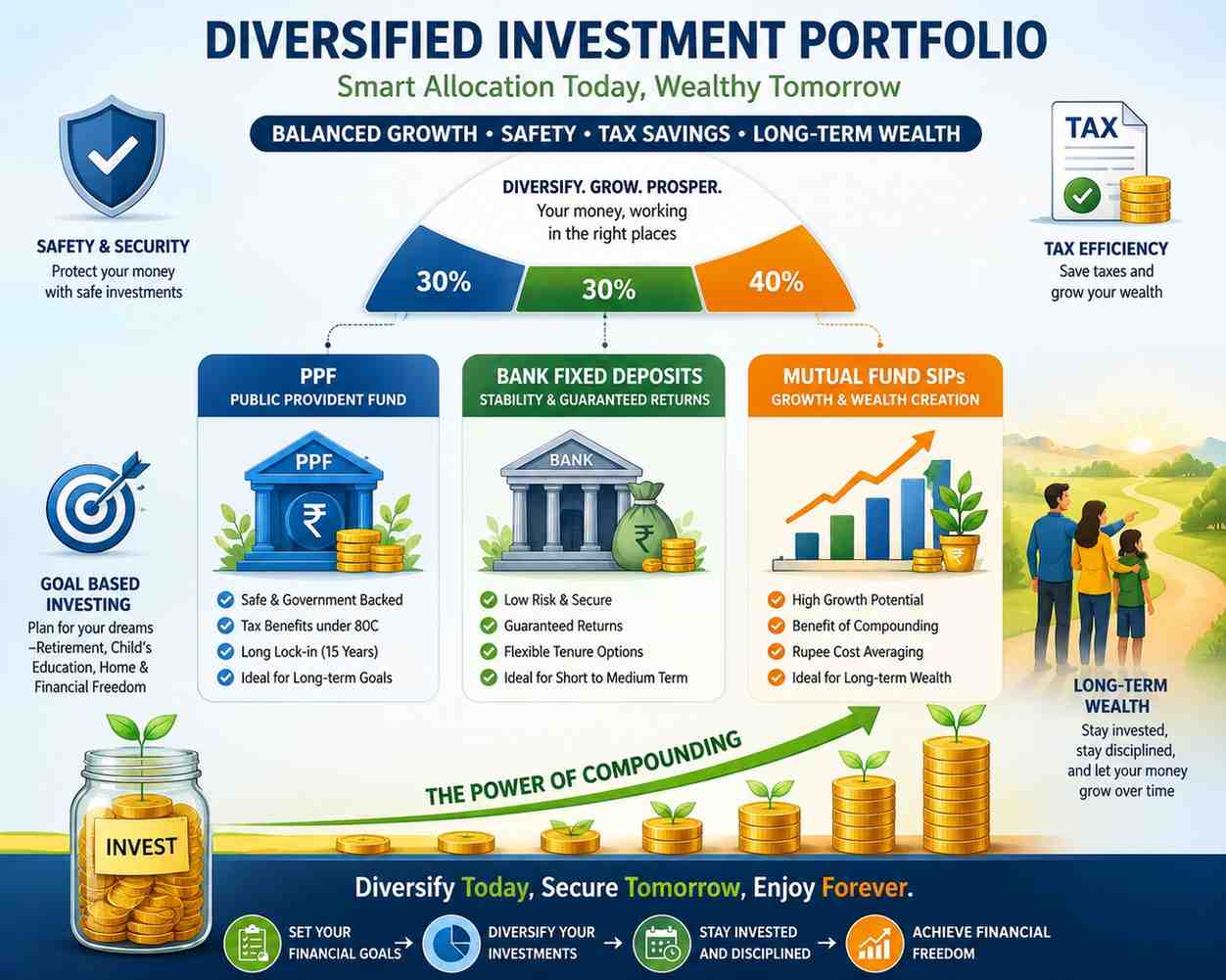
Relying on a single investment can increase financial risk and limit flexibility. Diversification helps improve financial resilience by spreading money across investments with different risk levels and purposes.
A combination of PPF for long-term stability, Fixed Deposits for safety and liquidity, and SIPs for growth potential can help create a more balanced portfolio aligned with different financial goals.
Expert Recommendation for 2026
Rather than asking which investment is universally "best," consider which is best for your objective:
- Choose PPF if safety, tax efficiency, and retirement savings are your priorities.
- Choose Fixed Deposits if you need predictable returns and access to funds within a few years.
- Choose SIPs if your goal is long-term wealth creation and you're comfortable with market fluctuations.
For many investors, a combination of all three can provide stability, liquidity, and growth.
FAQ
Is SIP better than PPF in 2026?
For long-term wealth creation, SIPs have the potential to generate higher returns because they invest in market-linked assets. PPF, however, offers guaranteed, tax-efficient returns with virtually no credit risk.
Which investment is safest?
PPF is generally considered the safest because it is backed by the Government of India. Fixed Deposits are also relatively safe, especially with well-established banks, while SIPs carry market risk.
Can I invest in PPF, FD, and SIP together?
Yes. Many financial planners recommend combining these investments to balance growth, stability, liquidity, and tax efficiency.
Which is better for beginners?
If preserving capital is the primary concern, PPF or a Fixed Deposit can be a suitable starting point. Beginners with long investment horizons may also consider SIPs after understanding market risks.
Is SIP guaranteed like an FD?
No. SIP returns depend on the performance of the underlying mutual fund and are not guaranteed.
Conclusion
There is no single investment that fits every investor. PPF excels in safety and tax benefits, Fixed Deposits offer predictable income and moderate liquidity, while SIPs provide the strongest potential for long-term wealth creation through disciplined investing.
The smartest investment strategy in 2026 is often not choosing one over the others but allocating your money according to your financial goals. Use PPF for retirement and tax planning, FDs for short-term needs and emergencies, and SIPs for building wealth over the long run. A diversified approach can help you manage risk while working toward financial security.



Write a comment