
Senior Citizen Fixed Deposit Rates in India (2026 Updated)
If you are a senior citizen looking for predictable income without exposing your retirement corpus to market swings, a bank fixed deposit can still be one of the simplest choices. The key, however, is not merely finding the highest advertised rate.
As of August 8, 2026, senior citizen FD rates across Indian banks broadly range from around 3% on very short deposits to 8.50% at some small finance banks. Large private and public-sector banks generally offer lower maximum rates, but may appeal to depositors prioritising familiarity and scale.
What Are Senior Citizen FD Rates in 2026?
1. Who qualifies for senior citizen FD rates?
Most banks provide preferential FD rates to resident customers aged 60 years or above. The additional rate is commonly around 0.50 percentage points, although the premium and eligibility rules can vary by bank and product.
For example, HDFC Bank currently shows an additional 0.50% for senior citizens, while ICICI Bank also states that senior citizens can receive an additional 0.50% on eligible domestic FDs.
2. Why does the rate matter so much after retirement?
For someone living primarily from savings, even a 0.50% difference can become meaningful over several years.
On a ₹10 lakh deposit, a simple annual-rate comparison looks like this:
| FD rate | Approx. annual interest |
|---|---|
| 6.50% | ₹65,000 |
| 7.00% | ₹70,000 |
| 7.50% | ₹75,000 |
| 8.00% | ₹80,000 |
| 8.50% | ₹85,000 |
These are before tax and assume the stated rate applies for the relevant tenure. Actual monthly payout can differ because banks may discount monthly interest payouts.
Latest Senior Citizen FD Rates: Top Banks
1. SBI senior citizen FD rates
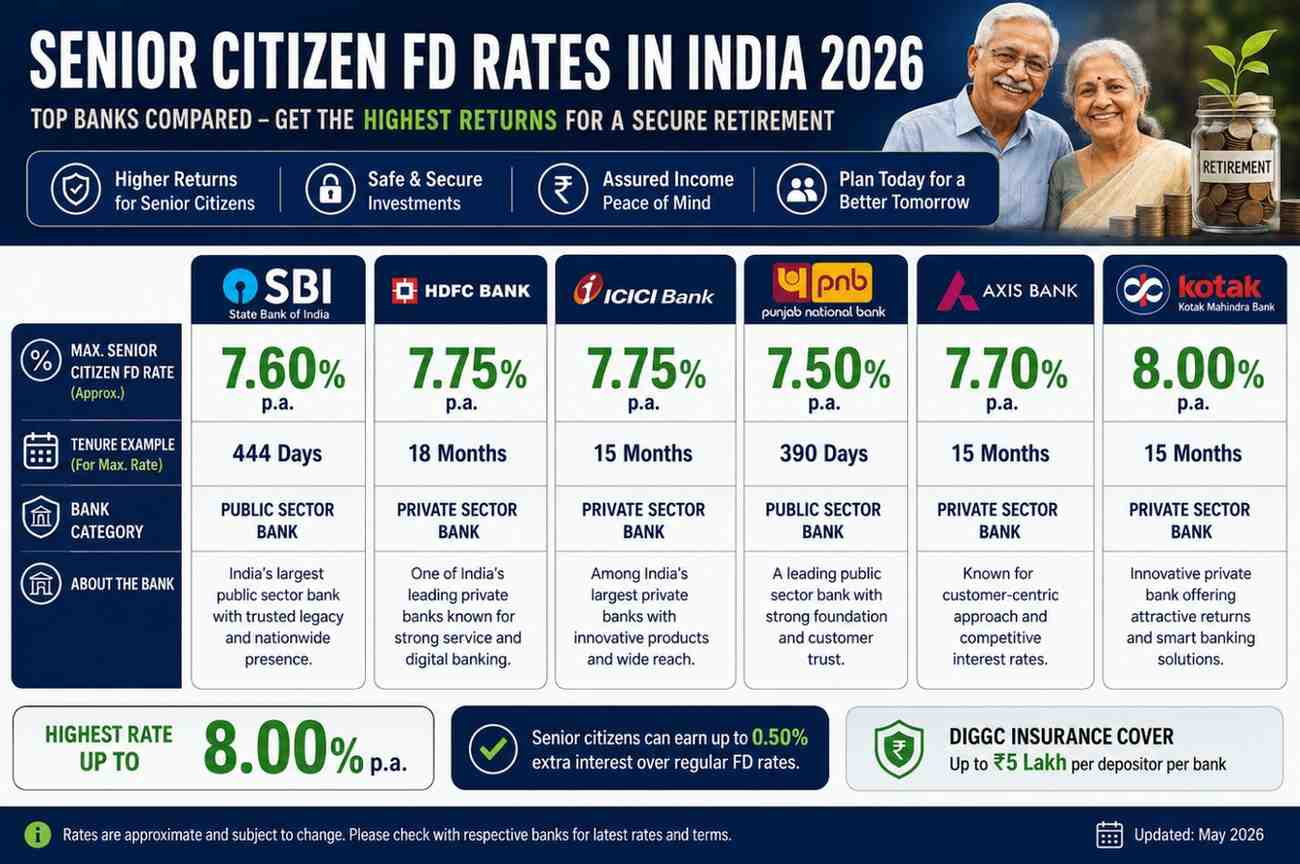
State Bank of India currently offers senior citizen rates ranging from 3.55% to 7.05%, depending on tenure. Its published schedule shows 6.75% for one year to less than two years, 6.95% for two to less than three years, and 7.05% for five to ten years under the applicable senior-citizen benefit.
SBI can therefore suit retirees who value a large public-sector bank and do not want to chase the highest small-finance-bank rate.
2. HDFC Bank and ICICI Bank
HDFC Bank's current published rate card shows senior citizen rates up to 7.00% for selected longer tenures below ₹3 crore. Its 3-year-1-day to 4-year-7-month range carries a 7.00% senior-citizen rate.
ICICI Bank's latest rate information, effective July 24, 2026, shows senior citizen rates up to 7.10%. The 3-year-1-day to 5-year category is listed at 7.10%, while the 5-year-1-day to 10-year category is 7.00%.
3. PNB, Axis Bank and Kotak Mahindra Bank
Punjab National Bank's June 2026 rate card shows senior citizen rates of 7.20% on its 444-day deposit, while super senior citizens can receive 7.50% on that specific product.
Axis Bank's published rate information and current market comparisons put its senior-citizen maximum around 7.30%, depending on the tenure and product.
Kotak Mahindra Bank's June 10, 2026 card shows 7.30% for senior citizens on deposits of less than ₹3 crore for the two-years-to-less-than-three-years category.
| Bank | Senior citizen rate — selected/highest reported rate | Useful for |
|---|---|---|
| SBI | Up to 7.05% | Large PSU bank preference |
| HDFC Bank | Up to 7.00% | Private-bank convenience |
| ICICI Bank | Up to 7.10% | Flexible payout choices |
| PNB | Up to 7.20% | Special-tenure deposits |
| Axis Bank | Up to about 7.30% | Competitive private-bank rates |
| Kotak Mahindra Bank | Up to 7.30% | 2–3 year deposits |
Rates depend on tenure, deposit size and product. Always verify the rate on the bank's rate card immediately before booking.
Small Finance Banks Offer the Highest FD Rates
1. Which small finance banks currently lead?
Small finance banks are currently where senior citizens can find some of India's highest bank FD rates.
Recent 2026 comparisons show Equitas Small Finance Bank and Shivalik Small Finance Bank at up to 8.50% for eligible senior citizen deposits. Jana Small Finance Bank and Ujjivan Small Finance Bank are reported at up to 8.30%, while ESAF, Suryoday and Utkarsh are around 8.25% at their respective peak tenures.
Unity Small Finance Bank has also offered 8.50% to senior citizens on a special 501-day FD, making it another notable high-rate option.
| Small Finance Bank | Maximum senior citizen rate reported |
|---|---|
| Equitas SFB | Up to 8.50% |
| Shivalik SFB | Up to 8.50% |
| Unity SFB | Up to 8.50% |
| Jana SFB | Up to 8.30% |
| Ujjivan SFB | Up to 8.30% |
| ESAF SFB | Up to 8.25% |
| Suryoday SFB | Up to 8.25% |
| Utkarsh SFB | Up to 8.25% |
2. Is the highest FD rate automatically the best?
No. This is where retirement investing becomes psychological.
A headline rate creates the feeling that you are "winning" by choosing the highest number. But a retiree should first protect the money that must remain available for medical expenses, emergencies and essential living costs.
Small finance banks are regulated banks, and eligible deposits are covered by DICGC insurance. However, the insurance ceiling is ₹5 lakh per depositor per bank, including principal and accrued interest, subject to the applicable ownership rules. Deposits held in the same capacity at the same bank are aggregated.
That makes diversification particularly important when using high-rate small finance bank FDs.
Which FD Tenure Is Best for Senior Citizens?
1. Short-term versus medium-term FDs
Short-term FDs provide flexibility but often sacrifice interest income.
Medium-term deposits of roughly one to three years can be attractive because they balance yield, liquidity and reinvestment risk. For example, Kotak's current card gives senior citizens 6.85% for 365 days to less than 15 months, 7.05% for 18 months to less than two years, and 7.30% for two to less than three years.
The best tenure is therefore not necessarily the one carrying the highest rate. It is the one that matches when you expect to need the money.
2. Should you lock money for five or ten years?
Long-term FDs can make sense when the money is genuinely not required for many years.
But locking everything away can create a different problem: liquidity risk.
Interest rates can change. Your expenses can change. Medical or family requirements can suddenly appear. A five-year FD may look attractive today but can become inconvenient if you need the principal earlier.
A better approach for many retirees is to create an FD ladder rather than one giant deposit.
How to Generate Monthly Income From an FD
1. Choose the monthly payout option
Most major banks allow FD interest to be paid periodically rather than only at maturity.
ICICI Bank, for example, explicitly provides monthly and quarterly payout choices, while Axis Bank also states that customers can select a monthly payout option when opening an FD.
This can turn a lump sum into a predictable income stream.
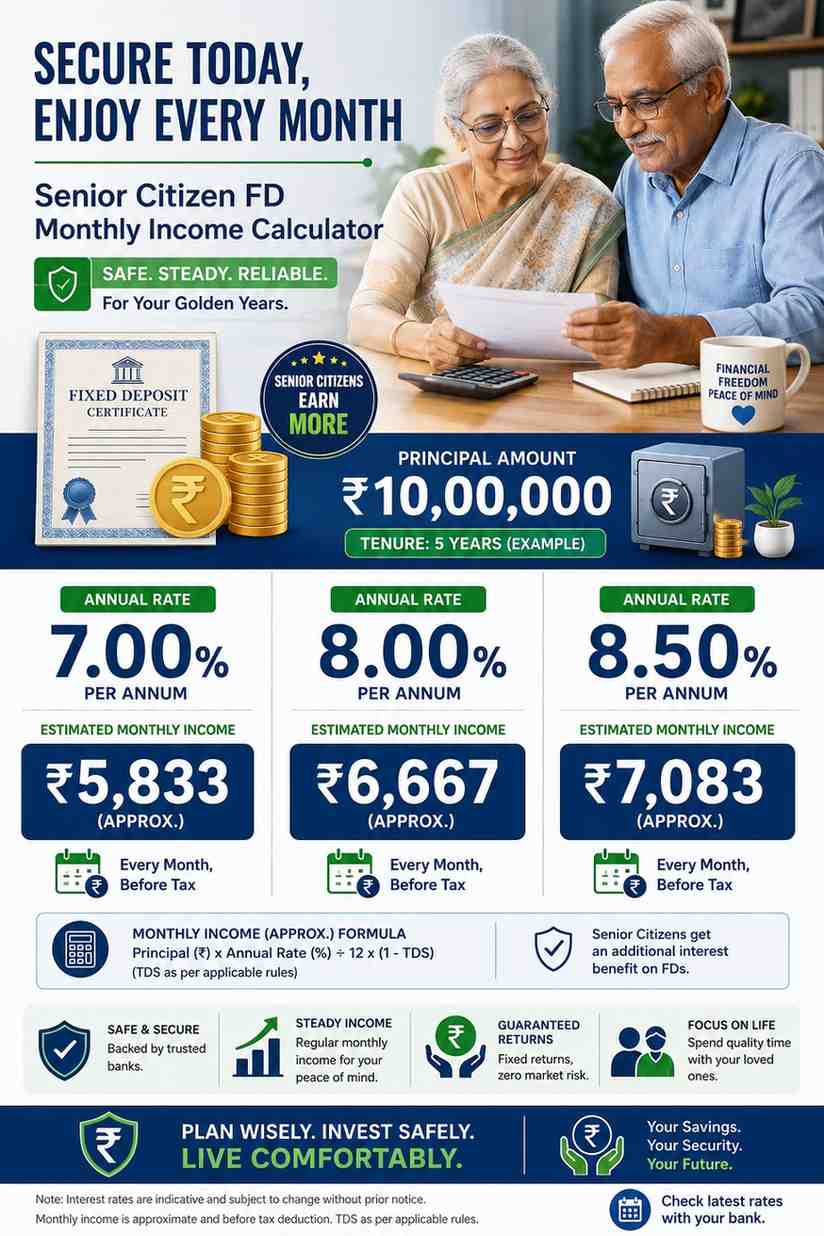
For example, at a nominal annual rate of 7%:
₹10 lakh × 7% ÷ 12 ≈ ₹5,833 per month
At 8.50%:
₹10 lakh × 8.50% ÷ 12 ≈ ₹7,083 per month
These are simple illustrations. Actual monthly payouts can be lower because banks may calculate and discount the periodic interest payment.
2. Use an FD ladder for a more reliable cash flow
Instead of putting ₹20 lakh into one FD, a retiree could split it into several deposits with different maturity dates.
For example:
| Deposit | Purpose |
|---|---|
| ₹5 lakh | Emergency/near-term liquidity |
| ₹5 lakh | 1-year maturity |
| ₹5 lakh | 2-year maturity |
| ₹5 lakh | 3-year maturity |
The exact allocation should depend on expenses and other income.
The psychological advantage is significant: you are not forced to break the entire FD when one unexpected expense appears.
Tax Benefits and TDS on Senior Citizen FDs
1. Is FD interest taxable?
Yes. FD interest is generally taxable as income according to the applicable tax rules.
Senior citizens do receive a specific benefit under Section 80TTB. The Income Tax Department states that eligible senior citizens can claim a deduction of up to ₹50,000 on interest earned from deposits with banks, post offices and eligible cooperative banks.
The important distinction is that a tax deduction is not the same as tax-free interest. The interest is still income; the deduction can reduce taxable income where the taxpayer qualifies.
2. How does TDS work for senior citizens?
The Income Tax Department currently states that under Section 194A, banks, post offices and cooperative banks do not deduct TDS on interest payments up to ₹50,000 to a senior citizen, subject to the applicable conditions.
Tax rules and thresholds can change, so retirees should check the applicable rules for the relevant financial year before making a large deposit.
If your income is below the taxable level, eligible senior citizens may also use the prescribed declaration mechanism, such as Form 15H, where applicable.
Safety: Should You Choose a Big Bank or Small Finance Bank?
1. Understand the ₹5 lakh insurance limit
DICGC deposit insurance covers eligible deposits up to ₹5 lakh per depositor per bank, including principal and interest.
Importantly, keeping ₹5 lakh in five different branches of the same bank does not create five separate insurance limits. The deposits are aggregated when they are held in the same right and capacity.
Depositing across different banks can provide separate insurance coverage.
2. Why diversification matters more for retirees
Imagine a retiree has ₹25 lakh.
Putting the entire amount into a single high-interest FD because it pays 8.50% may maximise the headline return, but it also concentrates the banking exposure.
A more thoughtful strategy can divide the money among multiple insured banks and different maturities.
The objective is simple:
Do not optimise only for interest. Optimise for safety + liquidity + income.
How to Choose the Best Senior Citizen FD in 2026
1. Compare the rate against your actual tenure
Never compare two FD rates without checking their tenures.
An 8.50% rate for a special 501-day deposit is not directly comparable with a 7.10% rate available for five years.
The higher rate may be ideal if the maturity date fits your financial plan. Otherwise, the lower rate with better flexibility can be more useful.
2. Check these seven factors before booking
Before opening an FD, check:
- Senior citizen eligibility and additional rate
- Exact tenure required for the quoted rate
- Monthly, quarterly or cumulative payout options
- Premature withdrawal rules and penalties
- TDS implications
- DICGC insurance eligibility and total exposure to the bank
- Whether the deposit is callable, non-callable or a special FD
This checklist prevents a common mistake: choosing an FD because of its advertised rate without reading the conditions attached to it.
FAQ
What is the highest senior citizen FD rate in India in 2026?
As of August 2026, some small finance banks are offering senior citizens rates of up to 8.50% per annum on selected deposits. Equitas, Shivalik and Unity Small Finance Bank are among the banks associated with rates at this level. The exact rate depends on the tenure and applicable scheme.
Which is better for senior citizens: SBI FD or small finance bank FD?
It depends on the priority. SBI may appeal to someone prioritising a large public-sector bank and established banking network. Small finance banks can provide materially higher rates, but depositors should pay close attention to the ₹5 lakh DICGC insurance limit and diversify larger amounts across banks.
Can senior citizens receive monthly income from an FD?
Yes. Many banks provide monthly-interest payout options. The depositor normally selects the payout frequency while booking the FD. Monthly income is useful when the FD is being used as a retirement cash-flow tool rather than simply for wealth accumulation.
Is senior citizen FD interest tax-free?
No. Senior citizen FD interest is generally taxable. However, eligible senior citizens can claim a deduction of up to ₹50,000 under Section 80TTB on qualifying deposit interest.
How much does a ₹10 lakh FD earn per month?
At a simple annual rate of 7%, ₹10 lakh produces approximately ₹5,833 per month before tax. At 8.50%, it is approximately ₹7,083 per month. Actual monthly payout can differ because banks may apply a discounted rate for monthly interest payments.
Is ₹5 lakh fully safe in a bank FD?
Eligible deposits are covered by DICGC insurance up to ₹5 lakh per depositor per bank, including principal and accrued interest. The limit applies according to ownership capacity, and deposits in different branches of the same bank are aggregated.
Should a senior citizen choose cumulative or monthly payout FD?
Choose cumulative FD when you do not need regular income and want the interest to accumulate toward maturity. Choose monthly or quarterly payout when the FD is intended to support recurring living expenses.
Should retirees put all their money into FDs?
Not necessarily. FDs can provide stability and predictable interest, but retirement planning also requires liquidity, inflation protection and diversification. A practical structure can combine emergency cash, staggered FDs and other suitable income-generating assets according to the retiree's needs.
Conclusion
Senior citizen FD rates in India remain attractive in 2026, but the highest number should not automatically decide where your retirement money goes.
Large banks currently offer senior citizen rates broadly around the 7% range, while selected small finance banks can reach 8.50% on specific tenures.
For a retiree, the smarter question is not simply “Which bank pays the most?” It is “Which combination gives me enough income without putting my essential capital at unnecessary risk?”
For monthly income, consider periodic-interest FDs. For flexibility, consider an FD ladder. For higher rates, compare small finance banks carefully while respecting the DICGC insurance limit.
Finally, check the bank's latest rate card immediately before booking because FD rates can change without much notice. The rate available on the day you invest—not the rate seen in an older comparison—is the rate that matters.



Write a comment