Banking has become mostly digital, but many common users still get confused when asked to enter an IFSC code or MICR code. These terms appear on cheques, bank passbooks, and online transfer forms, yet their purpose often remains unclear.
This article explains the difference between IFSC and MICR code in a simple, practical way. By the end, you’ll know what each code means, when it is required, and why banks still use both.
Introduction to IFSC and MICR Code in Banking
1. Why banks use identification codes
Banks process millions of transactions every day, making accurate identification essential for smooth and secure fund transfers. Bank identification codes help distinguish one bank branch from another and ensure that payments are routed to the intended destination.
These codes help:
- Prevent transaction errors: Unique codes reduce the risk of sending funds to the wrong branch.
- Speed up payments: Automated banking systems can identify the destination without extensive manual intervention.
- Ensure accurate routing: The code helps payment systems determine the correct bank and branch for a transaction.
- Improve transaction security: Standardized identification reduces ambiguity during electronic fund transfers.
- Support digital banking: Identification codes allow online banking and payment systems to process transfers efficiently.
For customers, using the correct bank and branch identification code is important when initiating certain types of fund transfers, as even a small error can result in a failed or incorrectly processed transaction.
2. How IFSC and MICR help common users
For everyday banking customers, IFSC and MICR codes make financial transactions more accurate, efficient, and secure. Although both codes are used to identify bank branches, they serve different purposes within the banking system.
- IFSC: The Indian Financial System Code (IFSC) is primarily used for electronic fund transfers such as NEFT, RTGS, and IMPS. Customers typically need the beneficiary's IFSC when adding a bank account for an online transfer.
- MICR: The Magnetic Ink Character Recognition (MICR) code is mainly associated with cheque processing and clearing. It helps banking systems identify the relevant bank and branch during automated cheque processing.
- Faster processing: Standardized codes allow banking systems to route transactions electronically with less manual intervention.
- Greater accuracy: Unique branch identification reduces the possibility of funds or cheques being directed to the wrong location.
- Convenient digital banking: IFSC codes make it easier for customers to initiate electronic transfers through mobile and internet banking.
In simple terms, IFSC is primarily associated with electronic fund transfers, while MICR is mainly used for cheque processing and clearing. Using the correct code is essential for smooth and accurate banking transactions.
What is IFSC Code and How It Works
1. Meaning and full form of IFSC
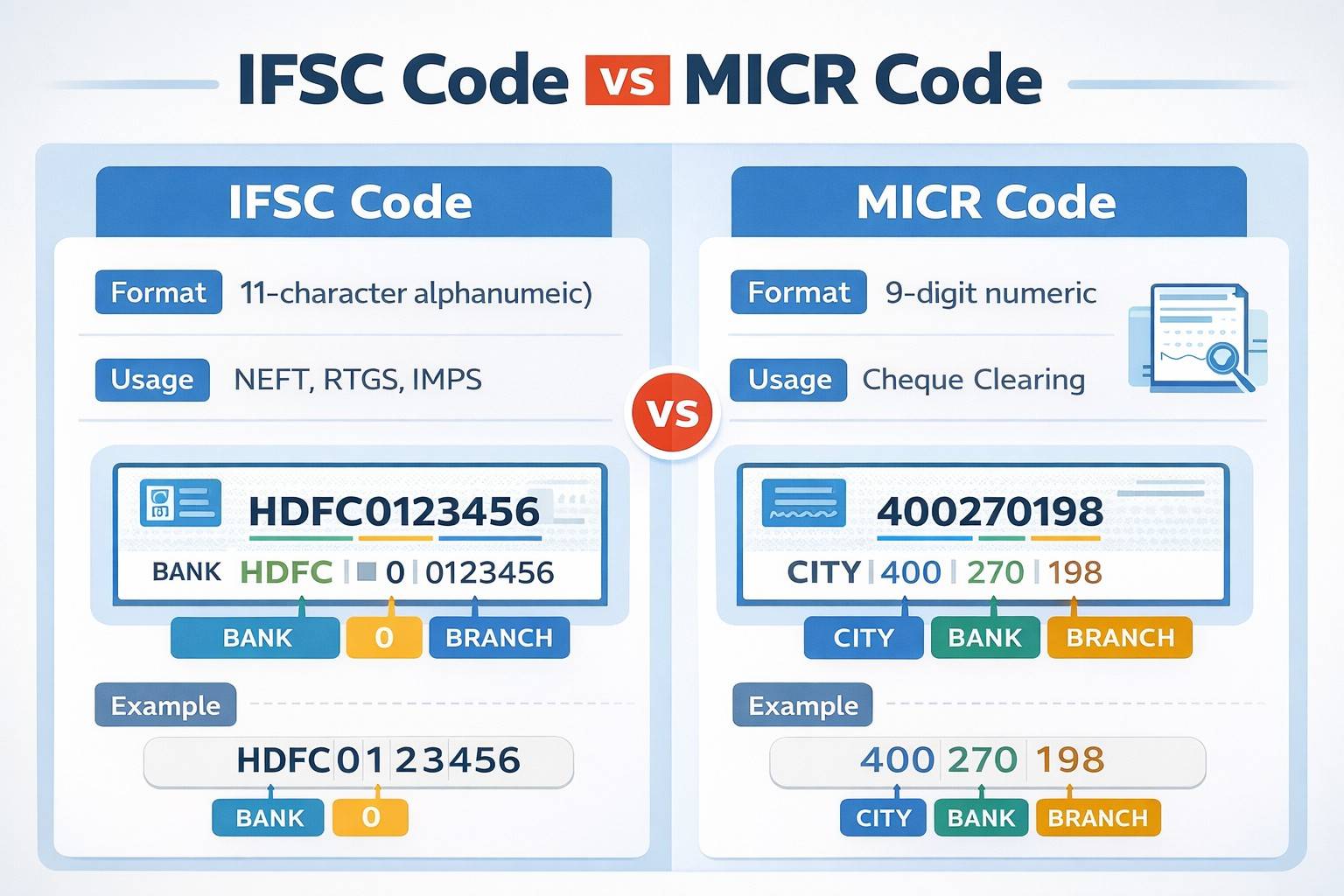
IFSC stands for Indian Financial System Code. It is an 11-character alphanumeric code assigned to every bank branch by the Reserve Bank of India.
2. Structure of an IFSC code
An IFSC code follows a fixed pattern:
- First 4 letters represent the bank
- Fifth character is always “0”
- Last 6 characters identify the specific branch
Example format: ABCD0XXXXXX
3. Where IFSC code is used
IFSC is mainly used for electronic fund transfers such as NEFT, RTGS, and IMPS. Without the correct IFSC, online transfers cannot be processed successfully.
What is MICR Code and Why It Exists
1. Meaning and full form of MICR
MICR stands for Magnetic Ink Character Recognition. It is a 9-digit numeric code printed at the bottom of cheque leaves.
2. Structure of a MICR code
The MICR code is divided into three parts:
- First 3 digits represent the city
- Next 3 digits represent the bank
- Last 3 digits represent the branch
3. Where MICR code is used
MICR is used mainly in cheque processing. It allows machines to read cheque details quickly and reduces errors during clearing.
Difference Between IFSC and MICR Code
1. Purpose and functionality
IFSC is primarily used for electronic fund transfers, whereas MICR is mainly used for cheque processing and clearing. IFSC enables digital banking transactions such as NEFT, RTGS, and IMPS, while MICR helps banks identify and process cheques efficiently. In simple terms, IFSC supports digital banking, while MICR supports traditional cheque-based transactions.
2. Format and length
IFSC is an 11-character alphanumeric code that identifies a specific bank branch for electronic fund transfers. In contrast, MICR is a 9-digit numeric code used primarily for cheque processing and clearing. Their different formats are designed to support the distinct banking systems in which they are used.
3. Usage for common users
You typically need an IFSC code when transferring money online through banking services such as NEFT, RTGS, or IMPS. In contrast, MICR is mainly relevant when dealing with cheques and is generally used by banks during cheque processing, so customers usually do not need to enter it manually.
IFSC vs MICR Code Comparison Table
| Feature | IFSC Code | MICR Code |
|---|---|---|
| Full Form | Indian Financial System Code | Magnetic Ink Character Recognition |
| Length | 11 characters | 9 digits |
| Type | Alphanumeric | Numeric |
| Main Use | Online fund transfers | Cheque clearing |
| Used By | Customers and banks | Mainly banks |
| Printed On Cheque | Sometimes | Always |
Where You Can Find IFSC and MICR Codes
1. On cheque books
Both IFSC and MICR codes are commonly printed on cheque leaves. The MICR code appears at the bottom of the cheque, typically as part of the machine-readable line, while the IFSC code is generally printed elsewhere on the cheque leaf, often near the bank and branch details.
2. On passbooks and bank statements
Most banks provide the IFSC code on passbooks and bank statements, making it easy for customers to find the details needed for online fund transfers. The MICR code may also be listed, but its inclusion varies from one bank and document to another.
3. Through online banking platforms
You can usually find both IFSC and MICR codes online through your bank’s official website, mobile banking app, or branch locator. These platforms make it convenient to verify the correct code before making a transaction or handling cheque-related requirements.
Common Mistakes Users Make With IFSC and MICR
1. Entering MICR instead of IFSC
A common mistake is entering the MICR code instead of the IFSC code when making an online fund transfer. Since online banking systems require the IFSC to identify the recipient’s bank branch, using a MICR code can result in an invalid entry or transaction failure. Always verify the required code before submitting a transfer.
2. Using outdated IFSC codes
Bank mergers, branch changes, or restructuring can sometimes result in IFSC codes being updated or replaced. Using an outdated IFSC code may cause an online transfer to be delayed, rejected, or routed incorrectly. Before making a payment, verify the current IFSC code through your bank’s official website, app, or branch.
3. Assuming both codes are interchangeable
Although both IFSC and MICR codes help identify bank branches, they serve different purposes and are used in different banking systems. IFSC is meant for electronic fund transfers, while MICR is primarily used for cheque processing. Therefore, one code cannot be used as a substitute for the other.
Do You Still Need MICR Code in Digital Banking Era
1. Decline of cheque usage
With the rapid adoption of UPI, mobile banking, and online bank transfers, cheque usage has declined significantly, particularly for everyday personal banking transactions. Consumers increasingly prefer instant digital payments because they are faster, more convenient, and easier to track.
2. Continued relevance for businesses
Despite the decline in personal cheque usage, cheques remain relevant for businesses, government offices, and certain legal and institutional payments. Many organizations continue to use cheques for high-value transactions, vendor payments, refunds, and other formal financial processes. As a result, MICR technology remains important for efficient and secure cheque processing.
3. Why banks haven’t removed MICR
Banks have not completely phased out MICR because cheque-clearing infrastructure is still operational. MICR helps banks process cheques quickly and accurately by enabling automated reading of essential cheque details. As long as cheques remain part of the banking system, MICR continues to support efficient clearing and reduce processing errors.
How to Use IFSC Correctly for Online Transfers
1. Double-check branch details
Always verify the beneficiary’s bank branchAlways verify the beneficiary’s bank name, branch, and location before entering the IFSC code. Even a small error in the code can cause a transaction to be delayed, rejected, or sent to an unintended account. Checking the details carefully before confirming the transfer helps ensure the payment reaches the correct bank branch. before entering the IFSC code.
2. Copy IFSC from official sources
Always obtain the IFSC code from trusted sources, such as the bank’s official website, mobile banking app, cheque book, or account statement. Avoid relying on random websites or unverified online listings, as bank branch details can change over time. Verifying the code through an official source helps prevent transaction errors and ensures your money is routed correctly.
3. Save verified beneficiaries
Once you have successfully verified a beneficiary’s bank account and IFSC code, save the payee in your banking app or internet banking account. This reduces the need to enter the details repeatedly and lowers the risk of typing errors during future transfers. Always review the saved information periodically, especially if the beneficiary changes their bank or branch.
FAQ
What happens if I enter wrong IFSC code
If the IFSC code is invalid, the transaction usually fails. If the code exists but belongs to a different branch, funds may be delayed or returned.
Is MICR code required for NEFT or RTGS
No, MICR code is not required for NEFT, RTGS, or IMPS. Only IFSC code is needed for these transfers.
Can two bank branches have same IFSC code
No, each bank branch has a unique IFSC code to avoid confusion in fund transfers.
Is MICR code still printed on new cheque books
Yes, banks continue to print MICR codes on cheque leaves for clearing purposes.
Can I find IFSC code using account number
Indirectly, yes. Bank apps and customer support can help identify IFSC based on account details.
Conclusion
Understanding the difference between IFSC and MICR code makes banking smoother and stress-free. IFSC is essential for digital payments, while MICR supports cheque-based transactions. Both serve specific purposes and continue to coexist in the Indian banking system.
Knowing when and where to use each code helps you avoid transaction errors and makes you a more confident banking user.



Write a comment