A cheque may look like a simple banking document, but several hidden systems help banks process it accurately and quickly. One of the most important is the MICR code. If you have ever looked at the bottom of a cheque leaf and noticed a special string of numbers, you have already seen part of the MICR-based banking system in action.
Understanding the MICR code is useful when filling banking forms, verifying cheque details, or learning how banks process paper-based payments. This guide explains the MICR code meaning, its format, where to find it on a cheque, and how it differs from other banking codes such as IFSC.
What Is a MICR Code?
MICR stands for Magnetic Ink Character Recognition. A MICR code is a special banking code printed on cheques using characters designed to be read accurately by machines.
The main purpose of MICR technology is to help banks process cheques faster and reduce errors during clearing. Instead of relying only on manual reading, specialized machines can recognize the printed information.
In India, the MICR code associated with a bank branch is commonly represented as a 9-digit number. The code helps identify the location and branch involved in cheque processing.
Why MICR Technology Was Introduced
Cheque processing can involve large volumes of documents. Reading every cheque manually would be slow and could increase the risk of human error.
MICR technology was introduced to make the process more efficient. The specially printed characters can be read by machines even when a cheque has normal marks, stamps, or handling-related wear.
The system helps with:
- Faster cheque sorting
- Better branch identification
- Reduced manual data entry
- More accurate processing
- Efficient cheque clearing operations
What Does MICR Stand For?
The full form of MICR is:
Magnetic Ink Character Recognition
The term describes both the technology and the characters used for machine-readable banking information.
MICR Code Meaning in Banking
The MICR code meaning in banking is closely connected with cheque identification and processing. A MICR code helps banking systems identify the relevant bank and branch.
Think of it as a location-based identifier used in cheque processing. While the exact banking workflow may involve several systems, the MICR code provides a standardized way to recognize important branch information.
For customers, the code may be required in certain banking forms or cheque-related processes.
How Banks Use the MICR Code
When a cheque enters the banking system, its details need to be identified and routed correctly. MICR technology allows machines to read coded information efficiently.
The process broadly involves:
- A cheque is deposited or presented for processing.
- The cheque is scanned and examined.
- Machine-readable information is identified.
- Banking systems use the available details for routing and clearing.
- The cheque moves through the appropriate clearing process.
The exact process can vary depending on banking systems and current clearing arrangements, but MICR technology historically played an important role in making cheque handling more efficient.
Why Accuracy Matters
A small error in bank or branch identification can delay processing. Standardized codes reduce ambiguity and make automated sorting easier.
That is especially important when banks handle large numbers of cheques from different branches and locations.
MICR Code Format Explained
A common MICR code format in India contains 9 digits.
These digits are generally understood in three parts:
XXXYYYZZZ
The groups help represent location, bank, and branch-related information.
First Three Digits: City or Location Code
The first three digits are associated with the city or location identifier used in the MICR system.
For example, major banking centres historically have distinct numerical identifiers. These codes help distinguish one clearing location from another.
Middle Three Digits: Bank Code
The next three digits identify the bank.
This portion helps the cheque-processing system determine which bank is associated with the cheque.
Last Three Digits: Branch Code
The final three digits identify the specific bank branch.
This makes the complete MICR code more precise because a bank may operate many branches within the same city or region.
Example of a MICR Code Structure
Consider a sample format:
123 456 789
This can be understood as:
| MICR Code Section | General Meaning |
|---|---|
| 123 | Location or city identifier |
| 456 | Bank identifier |
| 789 | Branch identifier |
This example is only meant to explain the structure. Actual MICR codes should always be verified through official banking records.
Where Is the MICR Code on a Cheque?
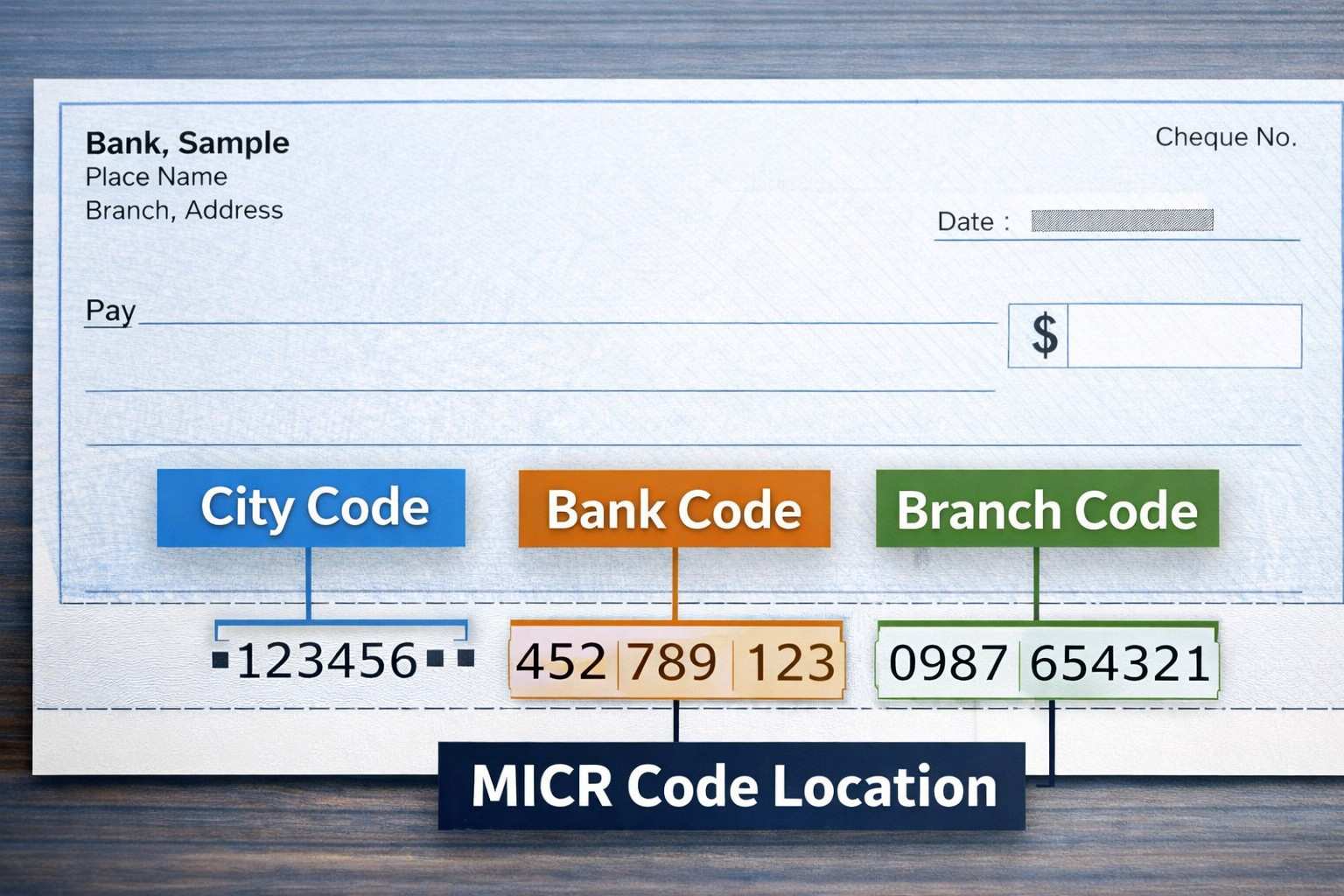
The MICR-related information is typically printed at the bottom portion of a cheque.
Look for the specially printed line containing machine-readable characters and banking numbers. The exact visual appearance can vary depending on the bank and cheque design.
When checking a cheque, you may also find other information such as:
- Bank name
- Branch name
- Account number
- Cheque number
- IFSC code
- MICR code
The MICR code is usually identified separately and may be printed clearly on the cheque leaf.
MICR Code Cheque Example
Imagine the bottom section of a cheque containing information arranged like this:
Cheque Number | MICR-related details | Account-related details
A sample branch MICR code might appear as:
110002345
In this example:
- The first three digits relate to the MICR location structure.
- The next three digits identify the bank.
- The final three digits identify the branch.
The actual position and formatting may differ between banks, so customers should look for the label MICR Code or verify the details through official banking channels.
Why the Bottom of the Cheque Is Important
The bottom area is designed for machine processing. The specialized printing and character recognition system allow equipment to read key information quickly.
This is one reason you should avoid damaging or unnecessarily writing over the machine-readable area of a cheque.
How Does MICR Technology Work?
MICR technology combines specialized printing with machine recognition.
The characters are printed using magnetic ink or a magnetic printing process. When a cheque passes through compatible processing equipment, the characters can be recognized electronically.
Magnetic Properties Help Recognition
The magnetic properties of the printed characters help machines identify them.
This makes the system useful for financial documents because cheques can be:
- Handled by multiple people
- Stamped during processing
- Sorted through machines
- Subjected to normal physical wear
A machine-readable system needs to remain reliable despite these conditions.
Specialized Fonts and Characters
MICR systems use specially designed characters rather than ordinary printed text.
These characters are created to support reliable recognition. Traditional MICR standards have used specialized fonts, including formats such as E-13B in many banking environments.
The exact technical implementation can depend on the country's banking infrastructure and document standards.
Why Is the MICR Code Important?
The importance of the MICR code comes from its role in improving cheque processing.
Although digital payments have become increasingly common, cheques continue to be used for many financial purposes. Where cheque-based processing is involved, standardized identification remains valuable.
Faster Cheque Processing
Machine-readable information reduces the need to manually interpret every document.
This can improve the speed of sorting and processing.
Reduced Processing Errors
Manual entry creates opportunities for typing and reading mistakes.
Standardized machine recognition can improve accuracy when the document is properly printed and processed.
Easier Bank and Branch Identification
A complete MICR code helps identify the relevant banking location and branch.
This can be useful when banking systems need to distinguish between multiple branches of the same bank.
Better Operational Efficiency
Banks handle large volumes of financial documents.
Automation can make these operations more efficient by reducing repetitive manual work.
MICR Code vs IFSC Code
People often confuse the MICR code with the IFSC code because both are related to bank branches. However, they serve different purposes.
The MICR code is primarily associated with cheque processing and machine-readable banking identification.
The IFSC code is used to identify bank branches for electronic fund transfers through systems such as NEFT, RTGS, and IMPS.
| Feature | MICR Code | IFSC Code |
| Full form | Magnetic Ink Character Recognition | Indian Financial System Code |
| Common use | Cheque processing | Electronic fund transfers |
| Typical format | 9-digit numeric code | 11-character alphanumeric code |
| Branch identification | Yes | Yes |
| Used for NEFT/RTGS/IMPS | No | Yes |
| Commonly found on cheque | Yes | Often printed on modern cheque leaves |
Which Code Should You Use?
Use the code required by the transaction.
If a form asks for an IFSC code, do not enter a MICR code. If the form specifically requests a MICR code, use the branch's correct MICR details.
Always read the field name carefully before entering banking information.
How to Find Your Bank's MICR Code
There are several ways to locate a MICR code.
Check Your Cheque Book
The easiest method is often to inspect a cheque leaf from your cheque book.
Look for the MICR code printed with the branch and banking details.
Check Official Bank Documents
Some account-related documents may include branch information and relevant banking identifiers.
However, document formats can vary.
Use Your Bank's Official Website or App
Banks may provide branch search tools that display relevant branch information.
This can be particularly useful if you do not currently have a cheque book.
Contact the Bank Branch
If you are unsure which MICR code applies to your account branch, contact the bank directly.
This is safer than copying a code from an unofficial website, especially when completing an important financial form.
Common Mistakes When Using a MICR Code
MICR codes are simple to understand, but mistakes can happen when customers enter or copy them.
Confusing MICR With IFSC
This is one of the most common errors.
Both codes identify banking information, but they are used for different purposes. Always check whether the form requests MICR or IFSC.
Using a Code From the Wrong Branch
A bank can have multiple branches in the same city.
Do not assume that every branch uses the same branch identifier.
Copying Information From an Unofficial Source
Third-party websites may contain outdated or incorrect information.
For important transactions or forms, verify details using the bank's official channels.
Entering an Incorrect Number of Digits
A standard MICR code in India is commonly represented by nine digits.
If the number you entered has missing or extra digits, check the source again.
MICR Code and Cheque Clearing
Cheque clearing is the process through which banks exchange and settle cheque-based payments.
MICR technology historically improved this process by making sorting and identification more automated.
The Role of MICR in Clearing Operations
When banks process large numbers of cheques, they need reliable ways to identify relevant banking information.
MICR characters help machines read standardized details efficiently.
This reduces dependence on fully manual sorting.
Modern Changes in Cheque Processing
Banking technology continues to evolve. Many cheque systems now use advanced imaging, electronic clearing, and digital transmission methods.
However, MICR remains an important concept because it represents a major development in the automation of cheque processing.
For customers, the practical lesson is simple: understand the difference between banking codes and use the correct one for the transaction or form.
Practical Example: Understanding a Cheque's Banking Details
Suppose you have a cheque and see the following information:
- Bank name: Example Bank
- Branch: Main City Branch
- IFSC: ABCD0123456
- MICR: 123456789
- Cheque number: A separate cheque identifier
Each item serves a different purpose.
The bank name tells you the financial institution. The branch name identifies the account location. The IFSC code is used for electronic transfers, while the MICR code is associated with cheque processing and machine-readable branch identification.
The cheque number identifies the individual cheque leaf rather than the bank branch.
Understanding these differences can prevent mistakes when filling forms or providing account details.
When Do You Need a MICR Code?
You may need a MICR code in situations such as:
- Completing certain banking forms
- Providing cheque-related details
- Verifying branch information
- Processing financial documents that specifically request MICR information
In many everyday digital payments, the MICR code is not required because electronic transfers generally rely on other identifiers.
The key is to follow the requirements of the specific banking process.
Tips for Safely Using Banking Codes
Banking information should always be handled carefully.
Verify Before Submitting
Check every digit before submitting a MICR code on an official form.
A single incorrect digit can create confusion or delays.
Use Official Sources
Prefer your bank's official website, branch, mobile application, or cheque book.
Avoid relying solely on random online lists.
Do Not Share Sensitive Information Unnecessarily
A MICR code alone is not the same as a password, but banking details should still be shared only when genuinely required.
Never share PINs, OTPs, passwords, or confidential login information while trying to verify banking codes.
Keep Your Cheques in Good Condition
Do not unnecessarily damage the bottom machine-readable section of a cheque.
A clean and properly completed cheque is easier to process.
FAQ
What is the MICR code full form?
MICR stands for Magnetic Ink Character Recognition. It refers to technology used to help machines recognize specially printed characters on banking documents, particularly cheques.
What is a MICR code used for?
A MICR code is mainly associated with cheque processing and branch identification. It helps banking systems process and sort cheque-related information more efficiently.
How many digits are in a MICR code?
In India, a MICR code is commonly represented as a 9-digit number. The digits generally provide information related to the location, bank, and branch.
Where can I find the MICR code on a cheque?
You can usually find the MICR-related information near the bottom of the cheque. The exact layout can vary depending on the bank and cheque design.
Is the MICR code the same as the IFSC code?
No. A MICR code and an IFSC code are different banking identifiers. MICR is associated primarily with cheque processing, while IFSC is used for electronic fund transfers.
Can two branches have the same MICR code?
Different branches generally have distinct branch-related identifiers within the MICR structure. You should always verify the code for your specific branch instead of assuming another branch's code will apply.
Do I need a MICR code for online money transfers?
Usually, electronic transfers require the appropriate electronic payment identifiers, such as an IFSC code for relevant Indian banking transfers. A MICR code should only be provided when specifically requested.
How can I verify my MICR code?
Check your cheque book or use your bank's official website, mobile app, customer service, or branch. Official sources are the safest way to confirm banking details.
Conclusion
The MICR code is an important banking identifier connected with the efficient processing of cheques. By using machine-readable characters and standardized coding, MICR technology helped banks improve sorting, reduce manual work, and process cheque information more accurately.
The easiest way to remember it is this: MICR is mainly linked to cheque processing, while IFSC is used for electronic fund transfers. If you need to provide a MICR code, verify the correct 9-digit code for your specific bank branch through an official source before submitting any financial form.



Write a comment