
A current account is more than a place to receive business payments. For a startup, freelancer, trader, or MSME, the right account can reduce banking costs, simplify collections, and make everyday cash flow easier to manage.
The best current account for your business depends on how you operate. A freelancer may prioritize low balances and digital banking, while an MSME may care more about cash deposits, transaction limits, bulk payments, and business services.
Introduction: Best Current Accounts for Small Businesses in India
1. Why the right current account matters
Business banking becomes expensive when an account does not match your transaction pattern. High balance requirements, cash-deposit charges, and excess transaction fees can quietly increase operating costs.
That is why the cheapest-looking account is not always the best choice. A better approach is to compare the total banking experience, including digital payments, cash handling, transaction limits, and business tools.
2. Who should use a current account?
Current accounts are designed primarily for businesses and professionals with regular financial transactions. They are suitable for sole proprietors, partnerships, companies, traders, service providers, startups, and many MSMEs.
Freelancers who operate as proprietors may also benefit when business income and expenses become frequent enough to justify dedicated business banking.
Best Current Accounts at a Glance
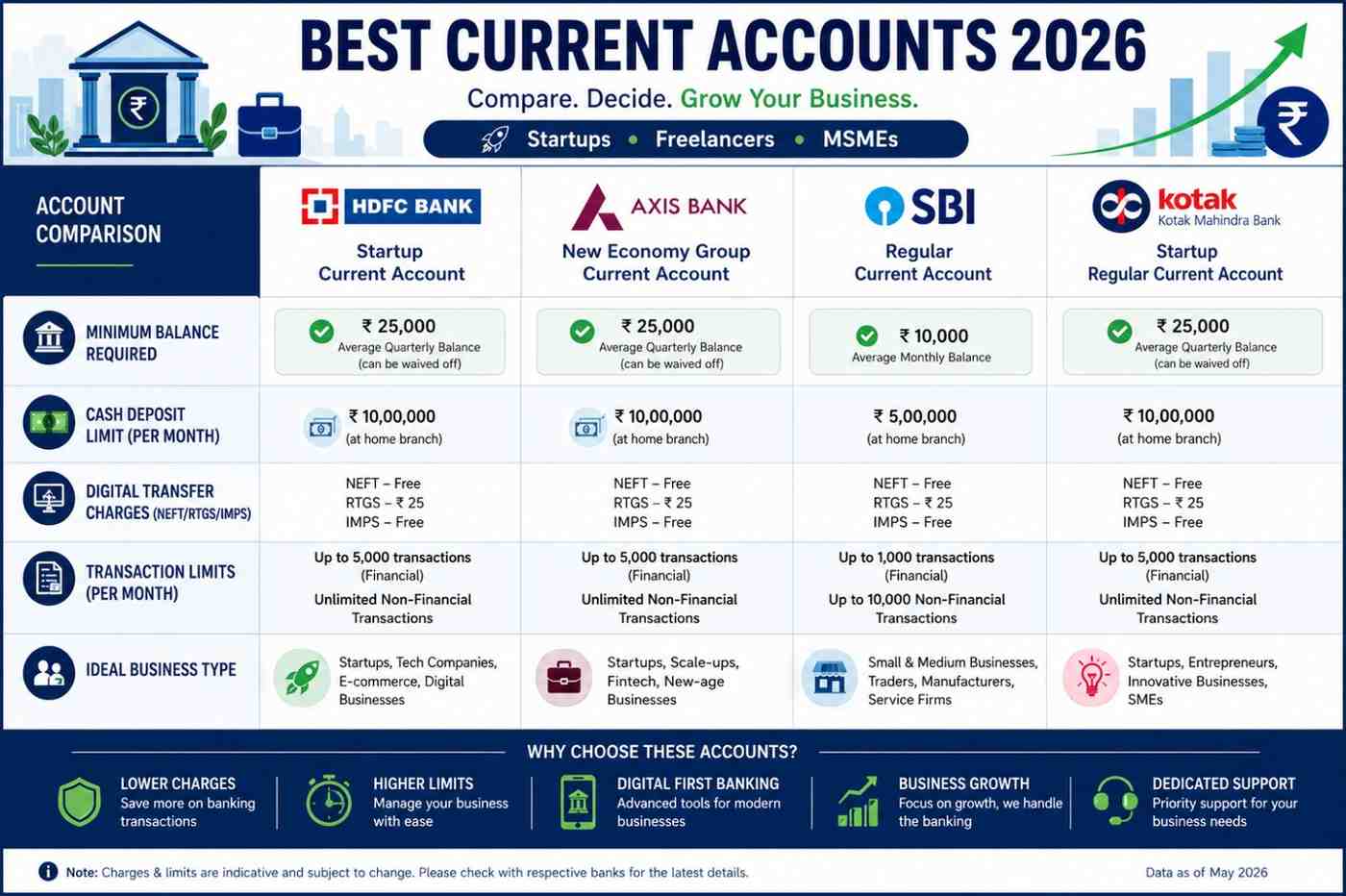
1. HDFC Bank Startup Current Account
HDFC Bank offers a startup-focused current account with an AQB of ₹50,000, although the AQB is waived for the first year according to its current product information. The bank also offers a waiver of non-maintenance charges when quarterly digital credit transactions reach ₹5 lakh.
Its transaction structure is attractive for growing businesses. HDFC states that free transactions can reach 150 transactions for every ₹1 lakh of current-month AMB, subject to a maximum of 3,000 transactions.
2. Axis Bank New Economy Group Current Account
Axis Bank has a New Economy Group current account specifically positioned for startups. Its published schedule lists zero MAB requirements and zero non-maintenance charges, which can make it particularly interesting for early-stage businesses managing limited idle cash.
The account also provides unlimited free transactions and unlimited free NEFT/RTGS in the cited schedule. Home-branch cash deposits are free up to 10 times MAB, capped at ₹50 lakh under the published structure.
3. SBI Regular Current Account
State Bank of India offers a Regular Current Account aimed at small businessmen, professionals, and traders. Its listed MAB is only ₹5,000, making it one of the more accessible options for smaller operations.
SBI also provides free NEFT and RTGS through internet and mobile banking, free corporate internet banking, and 50 free multicity cheque leaves per month under the cited product information.
4. Kotak Mahindra Bank Startup Regular Current Account
Kotak Mahindra Bank offers a Startup Regular Current Account with a ₹50,000 average quarterly balance requirement. Its current schedule, effective from May 1, 2026, provides free RTGS and NEFT through digital and branch channels.
The account also provides free cash deposits up to 10 times the previous month's average credit balance, subject to a ₹1 crore monthly maximum.
Current Account Comparison: Charges and Transaction Limits
1. Balance requirements
Balance requirements can have a bigger impact than individual transaction charges.
| Bank / Account | Indicative balance requirement | Best suited for |
|---|---|---|
| HDFC Startup Current Account | ₹50,000 after initial waiver period | Startups and growing businesses |
| Axis New Economy Group | Nil MAB in published schedule | Early-stage startups |
| SBI Regular Current Account | ₹5,000 MAB | Small businesses and professionals |
| Kotak Startup Regular | ₹50,000 AQB | Startups with regular cash flow |
HDFC's startup account currently waives the ₹50,000 AQB for the first year. Axis's New Economy Group schedule lists nil MAB and nil non-maintenance charges. SBI's regular account has a ₹5,000 MAB, while Kotak's Startup Regular requires ₹50,000 AQB.
The psychological trap here is focusing only on the headline balance. If your business regularly keeps ₹50,000 or more in the bank, a higher-AQB account may still offer better value because it can unlock larger transaction allowances.
2. Cash deposit and transaction limits
Cash-heavy businesses should examine limits carefully before opening an account.
HDFC's Startup Current Account provides free combined home and non-home cash deposits up to 12 times the current-month AMB, with a stated upper cap of ₹75 crore. Amounts beyond the free limit attract charges.
Axis's New Economy Group account provides a home-branch cash deposit limit based on 10 times MAB, capped at ₹50 lakh under its published schedule.
SBI's Regular Current Account offers free cash deposits up to 100 times the previous month's MAB, subject to a ₹5 lakh monthly maximum.
Kotak's Startup Regular account allows cash deposits without charges up to 10 times the previous month's average credit balance, subject to a ₹1 crore monthly maximum.
For a cash-heavy shop, distributor, restaurant, or offline retailer, these differences can matter more than mobile-app features.
Digital Banking and Business Payment Features
1. Online transfers and mobile banking
Digital banking should be treated as a core business tool rather than a convenience.
HDFC's Startup Current Account offers free NEFT and RTGS through branch and NetBanking.
SBI's Regular Current Account also offers unlimited free NEFT and RTGS through internet and mobile banking, along with corporate internet banking.
Axis's New Economy Group schedule lists unlimited free NEFT/RTGS and unlimited free transactions.
Kotak's Startup Regular account similarly lists free NEFT and RTGS and free fund transfers.
For businesses that make many vendor payments, salaries, refunds, or customer settlements, digital transfer costs should be part of the comparison.
2. Collections and payment infrastructure
The strongest business accounts go beyond sending money.
HDFC's Startup Current Account includes collection solutions covering multiple wholesale and retail payment modes, along with payment-gateway pricing and salary or bulk-payment capabilities.
HDFC's Biz-Pro account also uses transaction-volume structures tied to AMB and provides business insurance benefits, illustrating how current accounts can increasingly connect banking with business operations.
SBI offers broader SME infrastructure through its current-account ecosystem, including collection products and digital business banking. Its YONO Business platform also supports digital lending and MSME financing workflows.
Best Current Account for Startups
1. Best for an early-stage startup
For a startup trying to preserve cash, Axis New Economy Group deserves serious attention because its published structure shows nil MAB and nil non-maintenance charges. It also lists unlimited transactions and free NEFT/RTGS.
That combination addresses a common early-stage problem: founders often need business banking before the company has predictable cash reserves.
2. Best for a scaling startup
HDFC's Startup Current Account becomes attractive when transaction volume and digital collections increase. Its 150-transactions-per-₹1-lakh AMB structure, capped at 3,000 transactions, gives growing businesses a framework that scales with account activity.
The ₹5 lakh quarterly digital-credit condition for zero non-maintenance charges can also encourage businesses to route more payment activity through the account.
Best Current Account for Freelancers and Professionals
1. What freelancers should prioritize
Freelancers usually have a different banking pattern from retailers. They may receive fewer but larger payments, make digital vendor payments, pay subscriptions, and transfer money for taxes or business expenses.
A low-balance account can therefore be more valuable than an account designed for heavy cash handling.
SBI's ₹5,000 MAB Regular Current Account is particularly accessible for smaller professionals, while Axis's nil-MAB New Economy Group account may be attractive where eligibility permits.
2. Digital banking matters more than branch perks
A freelancer may rarely visit a branch. What matters is reliable online transfers, statements, payment tracking, debit-card access, and straightforward account management.
Axis also offers a Digital Current Account category, while SBI provides online and mobile banking access with its Regular Current Account.
The practical lesson is simple: choose an account based on your actual workflow, not on a long list of features you will never use.
Best Current Account for MSMEs and Cash-Heavy Businesses
1. Why cash limits matter for MSMEs
MSMEs frequently have mixed payment channels. Customers may pay through UPI or cards, while suppliers, transporters, employees, or local vendors may still involve cash.
For such businesses, cash-deposit and withdrawal limits can quickly become the biggest banking-cost variable.
SBI offers several current-account tiers. Its comparison page shows that higher-tier accounts can provide substantially larger cash-deposit limits, more cheque leaves, and broader business-payment benefits.
2. Choosing a higher-tier account
A higher-tier account makes sense when your business has predictable transaction volume. Paying for a premium account without using its limits can be wasteful.
For example, SBI's published comparison shows increasing MAB requirements alongside higher cash-deposit limits and transaction-oriented benefits across Silver, Gold, Diamond, Platinum, and Rhodium variants.
The correct question is not, “Which account has the highest limits?”
It is, “Which account gives me enough limits without forcing me to maintain unnecessary idle capital?”
Charges That Small Businesses Should Watch
1. Non-maintenance charges
Balance penalties are among the easiest costs to overlook.
HDFC's regular current account, for example, lists an AQB of ₹10,000 for non-metro locations and non-maintenance charges of ₹1,500 per quarter.
Axis also uses different balance requirements and non-maintenance charges across its current-account tiers. For example, its Business Classic and Business Privilege variants have materially different balance thresholds and penalties.
2. Cash and transfer charges
Even a low-maintenance account can become expensive if your business frequently deposits cash.
Look at:
- Monthly free cash-deposit value
- Home versus non-home branch limits
- Cash withdrawal limits
- NEFT, RTGS and IMPS charges
- Cheque-leaf allowances
- DD/PO charges
- Debit-card fees
- Cash-pickup charges
- Statement and account-service fees
For example, Kotak's Startup Regular account currently charges ₹5 for IMPS up to ₹1 lakh and ₹15 above ₹1 lakh, while NEFT and RTGS are free.
HDFC's Startup account uses different IMPS slabs and provides free NEFT/RTGS.
How to Choose the Right Current Account
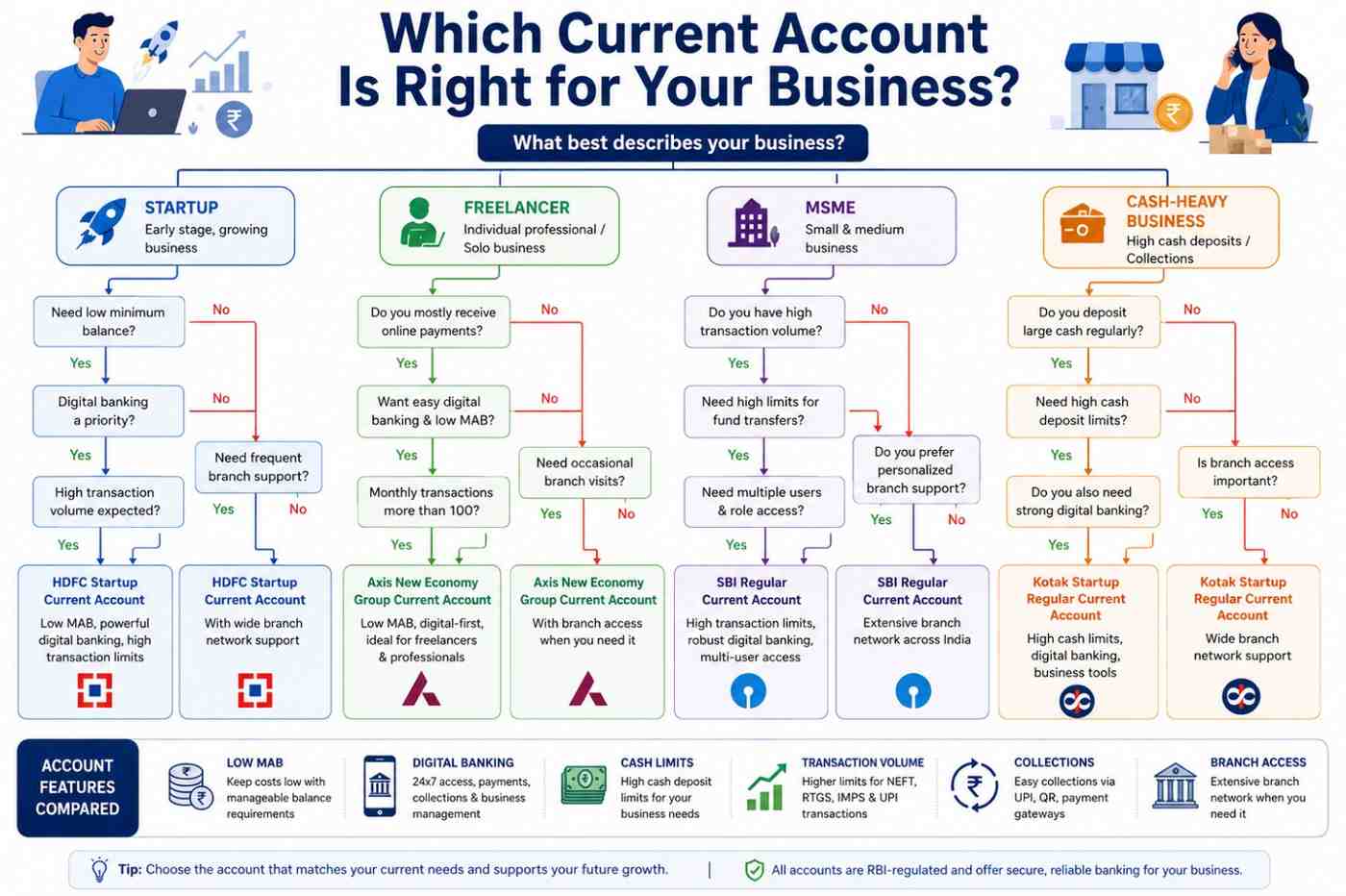
1. Match the account to your monthly cash flow
Start with five numbers:
- Average monthly incoming payments
- Average monthly outgoing payments
- Monthly cash deposits
- Average balance you can comfortably maintain
- Number of digital and non-digital transactions
These numbers reveal which account structure actually fits your business.
A freelancer receiving ₹3 lakh digitally each month has different needs from a retailer depositing ₹15 lakh in cash.
2. Calculate the real annual cost
Do not compare only the advertised maintenance fee.
Estimate:
Annual cost = balance-related charges + transaction charges + cash charges + service fees + card fees
Then compare that amount with the benefits you genuinely use.
An account with a ₹50,000 balance requirement may be cheaper overall if it eliminates large transaction charges. Conversely, maintaining ₹50,000 unnecessarily has an opportunity cost for a cash-constrained startup.
Common Mistakes When Opening a Business Current Account
1. Choosing based only on zero balance
Zero-balance or low-balance requirements look attractive, but they are not the entire story.
A business may save on balance requirements but lose more through cash deposits, payment charges, or limited transaction allowances.
2. Ignoring future transaction growth
A startup that makes 30 payments today may make 300 payments after hiring employees and vendors.
Choose an account with room to scale. HDFC, SBI, Axis, and Kotak all offer account structures designed around different business sizes and transaction patterns.
FAQ
What is the best current account for a small business in India?
There is no universal winner. HDFC is strong for scaling startups and digital collections, Axis can be attractive for eligible startups seeking low balance requirements, SBI suits smaller businesses needing broad branch access, and Kotak offers a startup-oriented structure with competitive digital-transfer features.
Which current account is best for freelancers?
Freelancers should prioritize low balance requirements, digital banking, inexpensive transfers, easy statements, and minimal cash-handling charges. SBI's low-MAB Regular Current Account and eligible Axis startup-oriented options are worth comparing.
Which bank is best for startup current accounts?
HDFC and Axis are particularly worth considering for startups because both offer dedicated startup-oriented current-account structures. HDFC focuses strongly on digital collections and scalable transaction limits, while Axis's New Economy Group account has a published nil-MAB structure.
How much money should I keep in a current account?
Keep enough to satisfy the account's balance requirements and cover expected payments, but avoid unnecessarily large idle balances. Your working-capital needs should determine the amount.
Is SBI current account good for MSMEs?
SBI can be a strong choice for MSMEs that value extensive branch access, relatively low entry-level balance requirements, digital banking, and multiple account tiers. Its Regular Current Account is positioned for small businesses and professionals, while higher tiers support larger transaction requirements.
Are current accounts better than savings accounts for freelancers?
Not automatically. A freelancer with limited transactions may find a suitable savings account simpler, subject to applicable banking and tax considerations. Once business transactions become frequent, a dedicated current account can provide a cleaner separation between personal and business finances.
Can startups open a current account without DPIIT recognition?
Yes, at least for HDFC's Startup Current Account, DPIIT recognition is not mandatory to open the account. HDFC notes that DPIIT recognition is relevant for accessing benefits under the Startup India framework.
Conclusion
The best current accounts for small businesses in India are not necessarily the ones with the lowest headline charges. The real winner is the account that fits your cash flow, transaction volume, balance capacity, and digital-payment habits.
For startups, compare Axis New Economy Group and HDFC Startup Current Account first. For smaller professionals and traditional businesses, SBI's Regular Current Account offers a low entry balance and strong digital-transfer facilities. Kotak's Startup Regular account is another useful option for businesses that want generous cash-deposit capacity and free NEFT/RTGS.
Before opening an account, check the bank's latest schedule of charges and eligibility rules. Banks revise fees, limits, and product conditions, so the published terms at the time of application should always take priority.



Write a comment