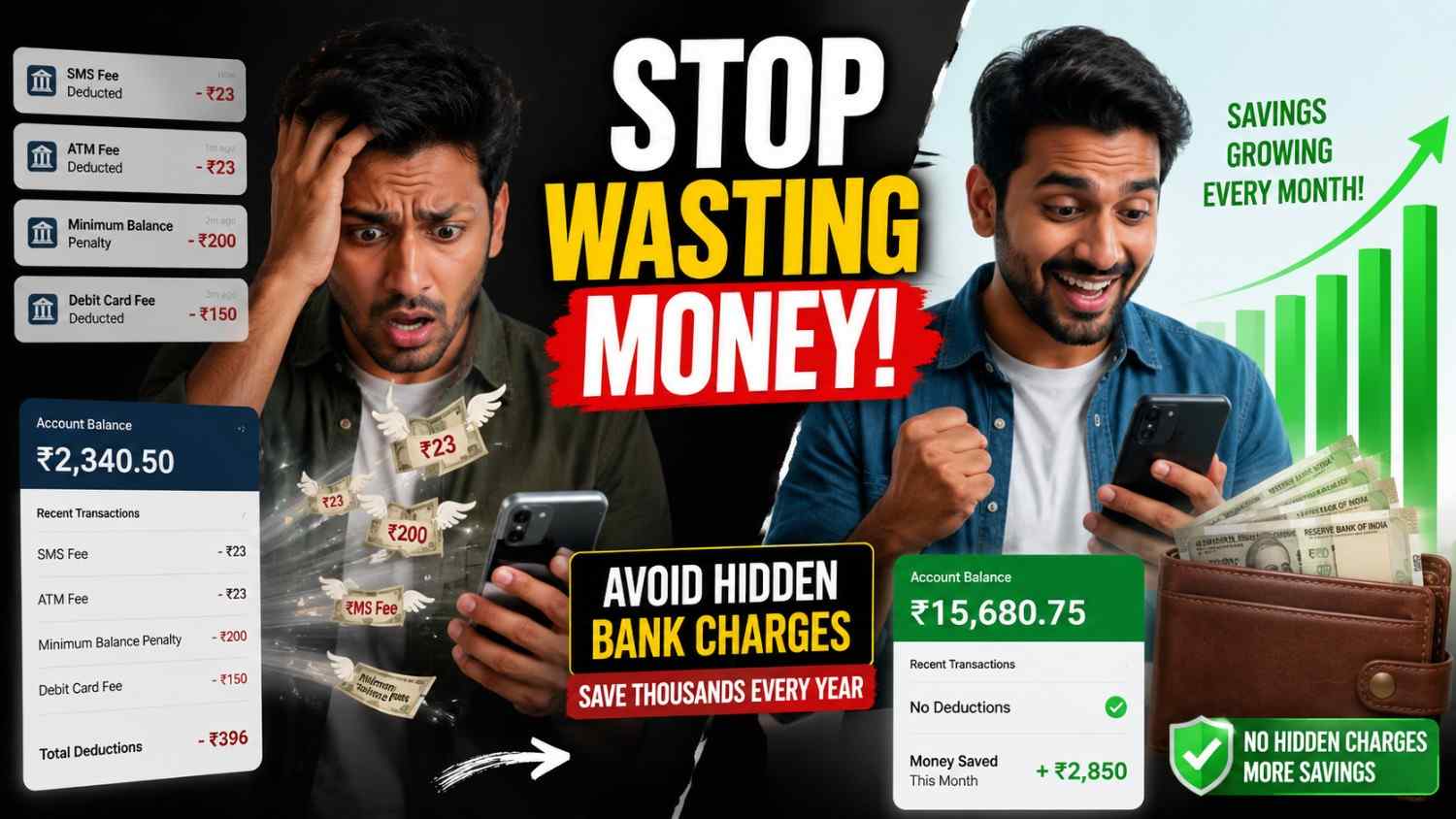
Bank charges can quietly reduce your savings without feeling like a major expense. A small ATM fee here, an SMS charge there, or a debit card fee once a year may seem harmless. Together, however, these deductions can become a surprisingly expensive habit.
The good news is that many common banking charges are avoidable. By understanding your account's fee structure, choosing the right banking services, and changing a few everyday habits, you can keep more of your money every year.
Understanding Common Bank Charges
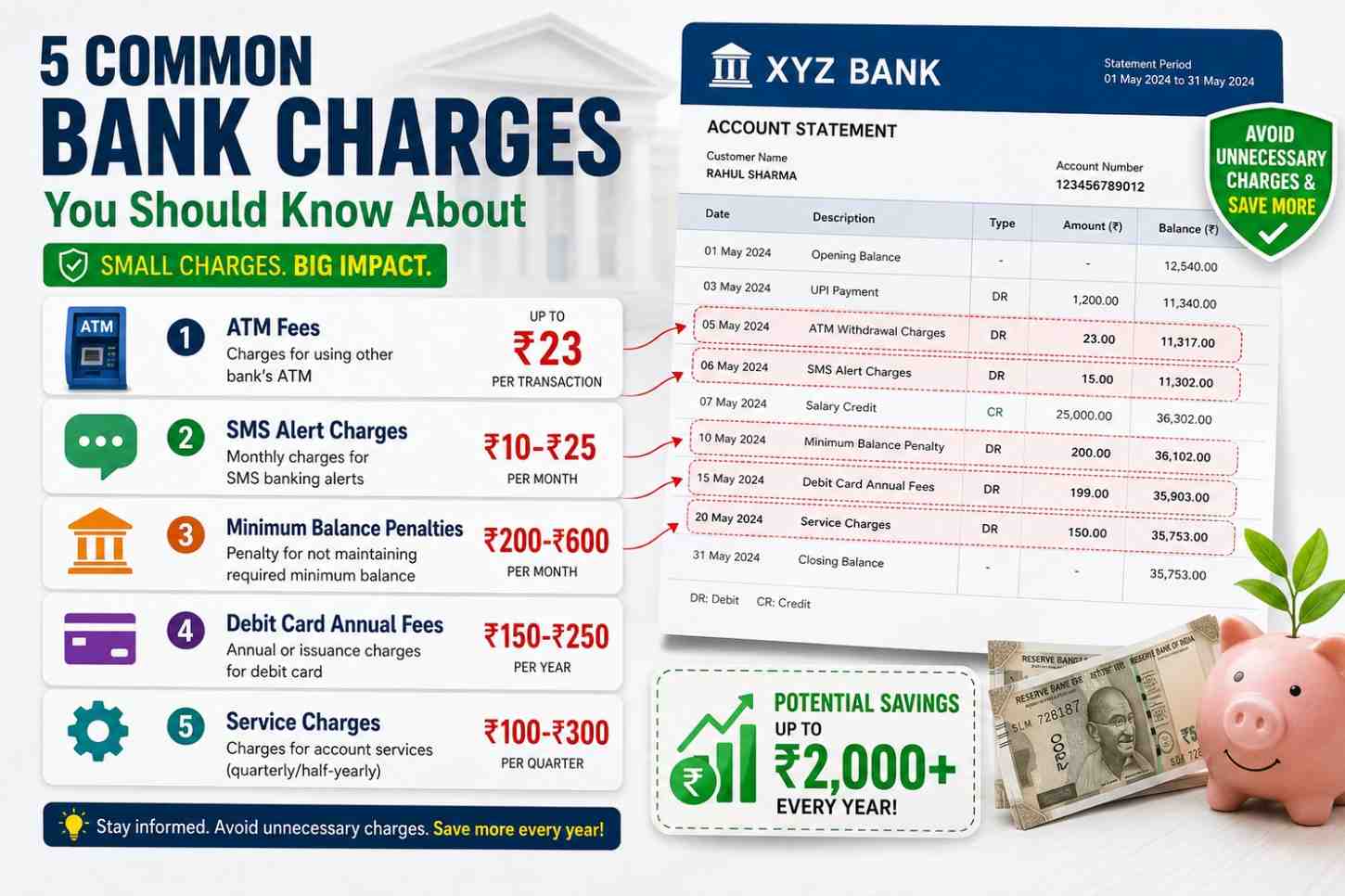
Bank charges are fees deducted by a financial institution for specific services, transactions, or account-related conditions. Some are obvious, while others appear only after you cross a transaction limit or fail to meet an account requirement.
The first step toward saving money is knowing what you are actually paying for.
1. Why Small Bank Charges Add Up
A ₹20 or ₹25 charge may not attract attention when it appears on a statement. The problem starts when similar fees occur repeatedly.
For example, suppose you pay ₹23 for several chargeable ATM transactions and ₹150 or ₹200 annually for a debit card. Add SMS charges, cheque-related fees, and occasional penalties, and your yearly banking cost can become significant.
The psychological trap is simple: individual charges feel too small to challenge. This makes people less likely to review them.
2. Why Banks Charge Customers
Banks charge fees to recover the costs associated with maintaining accounts, processing transactions, providing cards, operating ATMs, sending alerts, and offering additional services.
However, charges differ considerably between banks, account types, card variants, and customer segments. That is why you should never assume that a fee charged by one bank applies universally.
Your bank's current schedule of charges should be your first reference point.
How to Avoid ATM Fees
ATM charges are among the easiest banking costs to control because your withdrawal behavior is largely within your control.
RBI rules provide savings account customers with a minimum number of free ATM transactions, while banks may offer additional free transactions depending on their policies. At present, RBI states that charges for transactions beyond the mandated free limit cannot exceed ₹23 per transaction, plus applicable taxes.
1. Use Your Bank's ATM Strategically
Whenever practical, use your own bank's ATM rather than repeatedly withdrawing cash from another bank's machine.
For savings accounts, RBI requires banks to provide at least five free transactions each month at their own ATMs. At other banks' ATMs, the minimum free allowance differs between metro and non-metro locations.
The exact number of free transactions offered by your bank may be higher, so check your account's terms.
2. Reduce Unnecessary ATM Visits
Frequent small withdrawals can push you toward chargeable transactions.
Instead of withdrawing ₹1,000 several times, consider planning your cash requirements and making fewer withdrawals when appropriate. You should still avoid carrying excessive cash simply to save a small fee.
Also remember that some ATM transactions count toward your monthly limit. RBI specifies that certain off-us transactions include both financial and non-financial transactions.
A useful habit is to check your account's ATM transaction counter or monthly statement before making another withdrawal.
3. Don't Panic Over Failed ATM Transactions
A failed ATM transaction caused by technical problems, unavailable cash, communication issues, or certain bank/service-provider failures should not be counted as a valid free transaction under RBI guidelines. Such transactions should not attract a charge.
If you are charged incorrectly, save the transaction details and raise a complaint with your bank.
How to Avoid Minimum Balance Penalties
Minimum balance requirements can be particularly frustrating because you may not realize you are falling short until a charge appears.
Banks must communicate minimum balance requirements and applicable charges transparently. RBI guidelines also state that penal charges should be proportionate to the shortfall and that the account should not become negative solely because of minimum-balance charges.
1. Know Your Actual Balance Requirement
Don't rely on what you remember from when you opened the account.
Your bank may have different requirements depending on the account type, branch location, customer category, or product. Some accounts may require an average monthly balance rather than a simple end-of-month balance.
Check your bank's latest account terms and fee schedule.
2. Maintain a Safety Buffer
If your account requires a minimum balance, don't aim to maintain exactly that amount.
Suppose the required average balance is ₹10,000. Keeping ₹10,000 exactly leaves no room for unexpected debits. A debit card fee, automatic payment, or other charge could cause your balance to fall below the required level.
Maintaining a reasonable buffer makes accidental shortfalls less likely.
3. Consider a Different Account
If maintaining the required balance is consistently difficult, ask whether your bank offers a lower-requirement or no-minimum-balance account that fits your needs.
Basic banking products can be useful for customers who primarily need deposits, withdrawals, digital payments, and essential account services.
The cheapest account is not automatically the best one. Choose based on your actual usage.
How to Reduce SMS and Banking Alert Charges
SMS alerts can feel like an invisible expense because the individual amounts are usually small. Yet frequent transactions can increase usage-based charges where applicable.
RBI has directed banks to ensure that SMS alert charges are based on actual usage, with the objective of making such charges reasonable and equitable.
1. Understand What You Are Being Charged For
Look at your statement for descriptions such as SMS charges, alert charges, or notification fees.
Don't assume every communication from your bank is necessarily chargeable. Your bank's current tariff will explain the applicable fee structure.
For example, SBI's published service-charge information lists SMS alert charges alongside other account and debit-card services.
2. Keep Alerts Active for Security
Saving money should never mean disabling important transaction alerts.
Transaction notifications are an important fraud-detection tool. RBI requires banks to provide transaction alerts for electronic banking transactions, and customers are advised to report unauthorized transactions as quickly as possible.
If your bank provides free email or app notifications alongside SMS, use those options where appropriate while keeping essential security alerts enabled.
The goal is not to eliminate alerts. It is to understand their cost and use the available channels intelligently.
How to Avoid Debit Card Fees
A debit card can have several possible charges, including issuance, annual maintenance, replacement, and certain specialized services.
These fees depend on the bank and card variant. For example, SBI currently lists different annual maintenance charges for different debit-card categories.
1. Choose the Right Card
Don't automatically select a premium debit card because it looks more attractive.
If you mainly use your card for ATM withdrawals, UPI, online purchases, and everyday payments, a basic card may provide everything you need.
Compare the annual fee with the actual benefits before choosing a premium variant.
2. Avoid Unnecessary Card Replacement
Lost, damaged, or replacement cards may carry a fee.
Keep your physical card secure, avoid bending or damaging it, and store your card details safely. If you rarely use the physical card because most payments happen digitally, there is even more reason to avoid unnecessary replacement or upgrades.
3. Review Your Card Every Year
An annual card fee can continue for years simply because customers stop noticing it.
Once a year, ask yourself:
- Do I use this card regularly?
- Does the card provide benefits I actually need?
- Is there a cheaper variant?
- Would another account better suit my usage?
A five-minute review can prevent years of unnecessary fees.
Other Hidden Banking Charges to Watch
ATM, SMS, minimum balance, and debit card fees receive the most attention, but they are not the only costs that can appear in a bank account.
A better approach is to review the entire fee structure rather than focusing on one charge.
1. Cheque and Cash-Handling Charges
Cheque books, returned cheques, cash deposits, cash withdrawals, and certain branch transactions may carry charges depending on the account and transaction.
If you rarely use cheques, don't order more cheque leaves than necessary.
Similarly, check your bank's cash transaction limits if you regularly deposit or withdraw large amounts.
2. Statement, Replacement, and Service Fees
Duplicate statements, duplicate passbooks, card replacement, PIN regeneration, account closure, and other special requests can attract fees.
These charges often occur only when you request a particular service, which makes them easy to overlook.
Before requesting a non-routine service, check the price.
3. International and Foreign-Currency Charges
International ATM withdrawals and foreign-currency transactions can involve additional costs, including bank fees, network charges, and currency-conversion costs.
Never assume that a transaction is free simply because your debit card works internationally.
Check the applicable foreign transaction and ATM terms before travelling.
Practical Ways to Save More on Banking
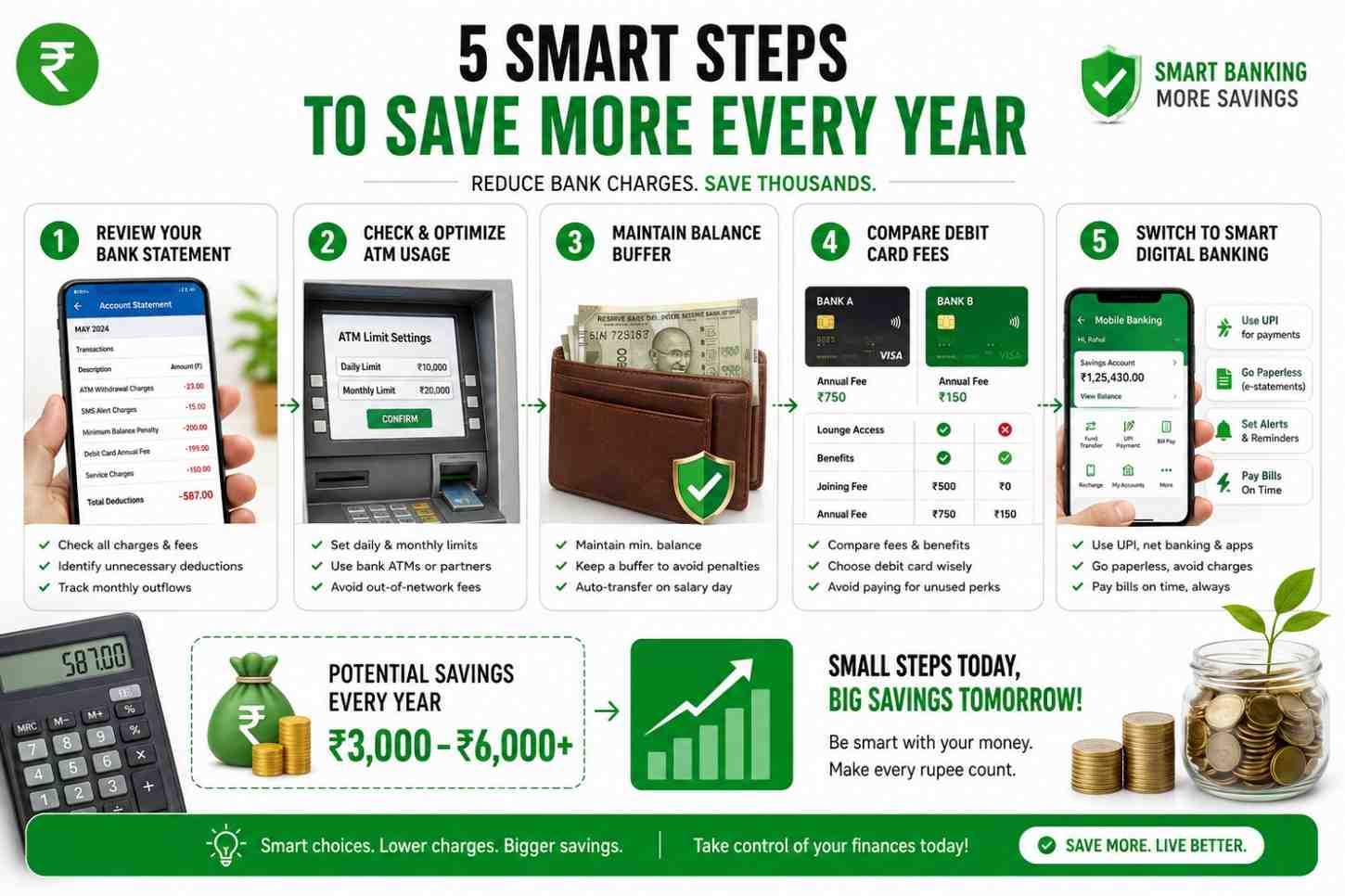
Avoiding fees is easier when you build a simple banking system instead of trying to remember every individual charge.
The objective is to make the cheaper choice automatic.
1. Choose Accounts Based on Your Behavior
Your banking needs should determine your account choice.
Someone who maintains a large balance but rarely uses cash may value different features from someone who frequently withdraws money or uses branch services.
Compare:
- Minimum balance requirements
- ATM transaction limits
- Debit card annual fees
- SMS alert charges
- Cash transaction limits
- Cheque facilities
- Digital banking features
- International transaction charges
The lowest advertised fee is not necessarily the lowest total cost.
2. Use Digital Banking Where It Makes Sense
Digital banking can reduce dependence on branch-based services and physical paperwork.
Online statements, mobile banking, UPI payments, and electronic fund transfers can make routine transactions more convenient.
However, always check whether a particular service is genuinely free under your account.
3. Review Your Statement Monthly
Your bank statement is effectively a financial health report.
Spend five minutes each month looking for unfamiliar deductions. Search for repeated descriptions such as:
- ATM charges
- SMS charges
- Debit card fees
- Minimum balance charges
- Service charges
- Cash handling charges
- Cheque return charges
One unexplained ₹50 charge may reveal a recurring problem worth hundreds of rupees annually.
4. Keep a Personal Bank-Charge Checklist
Once every six or twelve months, review your account using a simple checklist:
- Know the minimum balance requirement.
- Check your ATM transaction allowance.
- Review debit card fees.
- Check SMS and alert charges.
- Review cash transaction limits.
- Look for recurring service fees.
- Compare your account with alternatives.
- Question unfamiliar deductions.
The psychological advantage is powerful: once fee checking becomes a routine, you stop treating bank charges as unavoidable.
How to Challenge an Incorrect Bank Charge
Not every deduction is necessarily correct. Banks can make processing mistakes, and customers sometimes discover charges that do not match the applicable tariff.
The key is to act quickly and keep evidence.
1. Check the Bank's Current Tariff
Before complaining, identify the exact charge and compare it with the bank's current schedule of charges.
Save a copy or screenshot of the relevant fee information if possible.
This turns a vague complaint into a specific question: “Why was this amount charged when the applicable tariff says otherwise?”
2. Contact the Bank With Details
Provide the transaction date, amount, account details requested by the bank, and the description shown on your statement.
If the issue involves an ATM transaction, retain the ATM location, date, time, and transaction reference.
Be specific rather than simply saying, “I was charged too much.”
3. Escalate Unresolved Complaints
If your bank does not resolve a legitimate complaint through its normal grievance process, use the escalation mechanism provided by the bank.
For eligible complaints that remain unresolved, customers can also explore the RBI's Integrated Ombudsman Scheme and complaint process.
The important lesson is simple: don't ignore an incorrect charge merely because the amount looks small. Repeated errors can become expensive.
A Simple Annual Plan to Save on Bank Charges
You don't need to monitor every transaction obsessively. A short annual review, combined with monthly statement checks, can eliminate many unnecessary costs.
1. Do a Five-Minute Monthly Review
At the end of each month, scan your statement for fees and penalties.
Identify anything unfamiliar immediately.
This prevents small recurring charges from remaining invisible for years.
2. Perform a Yearly Account Audit
Once a year, review your entire banking setup.
Calculate how much you paid in ATM, debit card, SMS, minimum balance, and other service charges.
Then ask whether the benefits you received justified the cost.
If not, consider changing your account, card variant, or banking habits.
3. Turn Savings Into an Automatic Habit
Suppose you discover that changing your ATM habits can save ₹500 per year.
That amount may not feel life-changing. But the real benefit comes from repeating the same discipline across multiple financial areas.
The goal is not to obsess over every rupee. It is to stop paying for services you don't need.
FAQ
Are bank charges the same for every customer?
No. Charges can vary according to the bank, account type, debit card variant, transaction type, location, and customer relationship. Always check the latest fee schedule applicable to your specific account.
Can banks charge for ATM transactions?
Yes. Banks can charge for transactions beyond the applicable free ATM transaction limits. RBI currently states that such customer charges cannot exceed ₹23 per transaction, plus applicable taxes.
How can I avoid minimum balance penalties?
Know your account's required balance, maintain a reasonable buffer, monitor automatic debits, and consider an account with a lower or zero minimum-balance requirement if it better matches your needs.
Are SMS banking charges allowed?
Banks may levy SMS alert charges subject to applicable rules. RBI has directed banks to levy such charges on an actual-usage basis to promote reasonable and equitable pricing.
Can I avoid debit card annual fees?
It depends on your bank and card. Some account or card variants may have no annual fee, while others charge a yearly maintenance fee. Compare the available variants before choosing or upgrading a card.
What should I do if I find an incorrect bank charge?
First compare the deduction with your bank's current tariff. If it appears incorrect, contact the bank and provide the transaction details. Keep written records of your complaint and escalate it through the bank's grievance process if necessary.
Is it better to keep more money in my bank account to avoid charges?
Only if the account's requirements and benefits justify it. Keeping excess money idle solely to avoid a fee may not always be financially efficient. Compare the cost of the fee with the opportunity cost of maintaining a larger balance.
How often should I review my bank charges?
Check your statements monthly and perform a more detailed fee audit at least once a year. A monthly scan helps identify recurring charges before they become expensive.
Conclusion
Learning how to avoid bank charges is less about finding loopholes and more about understanding how your account works. ATM fees, SMS charges, minimum balance penalties, debit card fees, and service costs become easier to control once you know when they apply.
Start with the charges you can influence immediately. Use ATMs strategically, maintain the required balance, choose an appropriate debit card, review statements, and question unfamiliar deductions.
Most importantly, don't accept every fee as an unavoidable cost of banking. A few minutes of review each month can protect your money year after year.


Write a comment