Choosing the right savings account in 2026 is no longer just about avoiding minimum balance penalties. Today's best zero balance savings accounts offer high interest rates, seamless UPI payments, digital onboarding, cashback rewards, and premium banking features.
Whether you're a student, salaried professional, freelancer, homemaker, or simply looking for a secondary bank account, this comparison guide will help you identify the best zero balance savings account in India based on your needs.
Introduction to Zero Balance Savings Accounts
A zero balance savings account is a bank account that does not require you to maintain a mandatory minimum balance. Unlike traditional savings accounts, where falling below a specified balance may result in charges, these accounts provide greater flexibility for managing your money.
Zero balance savings accounts can be particularly useful for students, salaried individuals, first-time account holders, and people who want access to essential banking services without worrying about maintaining a fixed balance.
Depending on the bank and account type, you may get services such as debit cards, internet banking, mobile banking, UPI transactions, fund transfers, and ATM access. However, certain features, transaction limits, or service charges can vary between accounts, so it is important to check the specific terms before opening one.
1. Why Zero Balance Accounts Have Become Popular
Several factors have contributed to the growing popularity of zero balance savings accounts, especially among customers who want simple and flexible banking without the pressure of maintaining a minimum balance.
- No minimum balance requirement: Account holders can keep a low or even zero balance without incurring minimum-balance penalties, subject to the account's terms and conditions.
- Greater financial flexibility: Customers can use their available funds when needed instead of keeping a fixed amount idle in the account.
- Easy digital banking: Many zero balance accounts offer mobile banking, internet banking, UPI payments, and other convenient digital services.
- Accessible for different income groups: These accounts can be useful for students, new earners, low-income customers, and individuals opening their first bank account.
- Convenient everyday transactions: Depending on the bank, customers may receive access to services such as debit cards, ATM withdrawals, fund transfers, and bill payments.
- Growing financial inclusion: Zero balance accounts can make formal banking more accessible to people who may find traditional minimum-balance requirements difficult to manage.
The combination of convenience, accessibility, and lower balance-related restrictions has made zero balance accounts an increasingly attractive option for everyday banking.
2. Who Should Open a Zero Balance Account?
Zero balance savings accounts can be a practical choice for people who want everyday banking facilities without the obligation of maintaining a minimum balance. They may be particularly suitable for:
- Students: Useful for managing allowances, education-related expenses, and digital payments without maintaining a large balance.
- First-time account holders: A simple option for people opening their first savings account and becoming familiar with formal banking.
- Salaried individuals: Helpful for managing monthly income and expenses when most funds are regularly used for bills, transfers, and other commitments.
- Low-income earners: Suitable for customers who may find minimum-balance requirements difficult to maintain.
- Freelancers and gig workers: Can provide a convenient account for receiving payments and handling regular business or personal transactions.
- People with irregular income: Useful when deposits and withdrawals vary from month to month.
- Anyone seeking a secondary account: A zero balance account can also be used alongside a primary savings account for specific spending or payment needs.
Before opening one, compare the account's transaction limits, debit card charges, ATM rules, interest rate, and other applicable fees, as these can vary by bank and account type.
Best Zero Balance Savings Accounts in India (2026 Comparison)
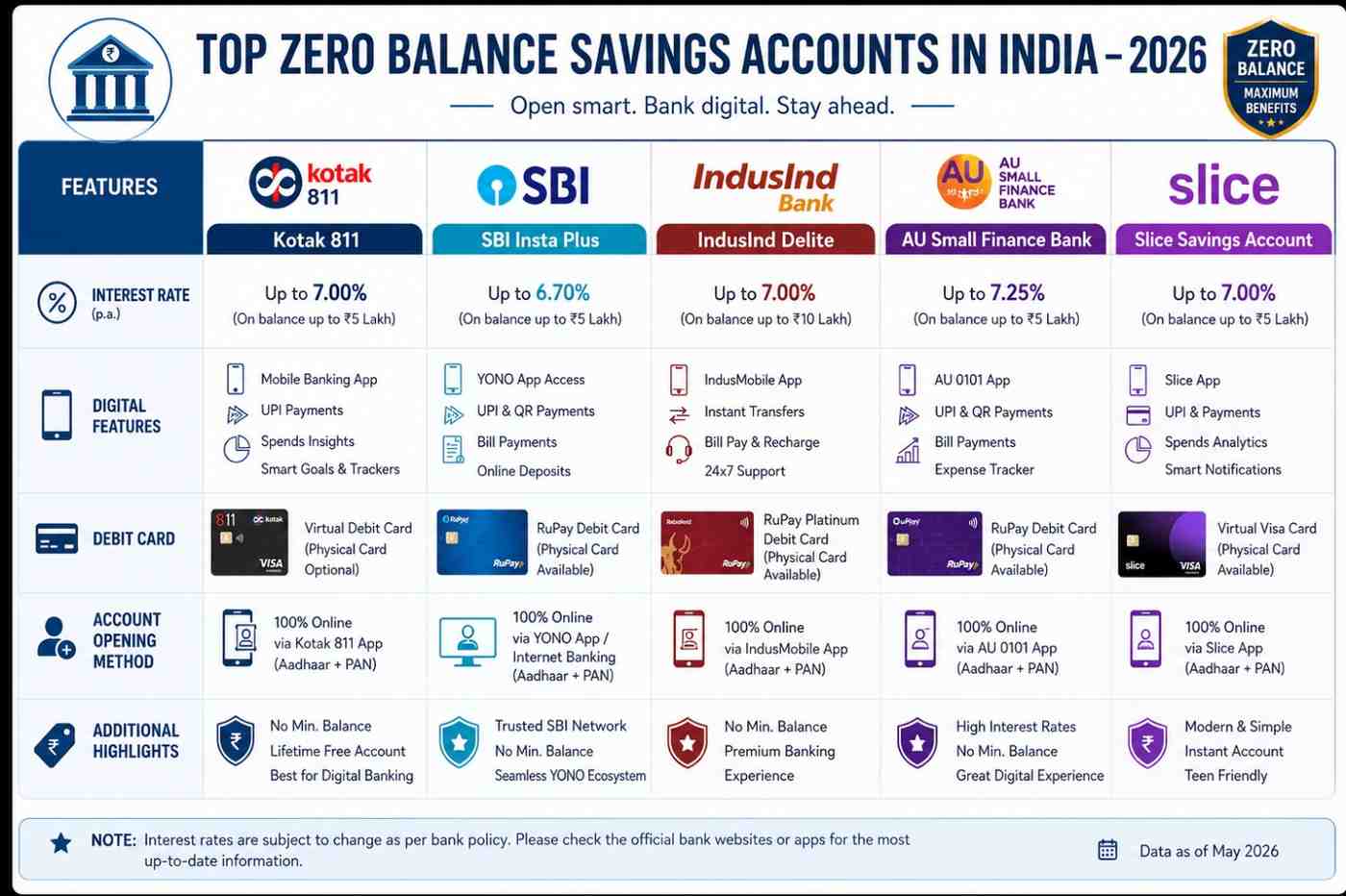
The following accounts stand out in 2026 based on features, interest rates, digital experience, and overall value.
1. Kotak 811 Digital Savings Account
| Feature | Details |
|---|---|
| Minimum Balance | ₹0 |
| Interest Rate | Up to 5.25% |
| Account Opening | Fully Digital |
| Debit Card | Virtual Free |
| UPI | Yes |
Kotak 811 remains one of India's most popular zero balance savings accounts. It offers fully digital onboarding, strong mobile banking, virtual debit cards, and features like ActivMoney that can increase returns on idle funds.
Advantages
- Completely digital onboarding
- No minimum balance requirement
- Excellent mobile app
- Strong UPI experience
- Optional physical debit card
Best For
Digital-first users and young professionals.
2. SBI Insta Plus Savings Account
| Feature | Details |
|---|---|
| Minimum Balance | ₹0 |
| Interest Rate | Around 2.5% |
| Account Opening | Video KYC |
| Debit Card | Available |
| Branch Network | Largest in India |
The State Bank of India continues to dominate due to its unmatched trust and nationwide branch network. SBI Insta Plus offers a practical zero balance option with robust government banking compatibility.
Advantages
- Strong brand trust
- Huge ATM network
- Excellent for government transactions
- Low debit card fees
Best For
Students, families, and rural customers.
3. IndusInd Delite Savings Account
| Feature | Details |
|---|---|
| Minimum Balance | ₹0 |
| Interest Rate | Competitive |
| Account Opening | Digital |
| Debit Card | Free |
| Digital Banking | Excellent |
IndusInd Delite has emerged as one of the strongest private-bank zero balance accounts due to its premium features and modern banking experience.
Advantages
- Premium banking features
- Strong digital platform
- Attractive debit card benefits
- Smooth account opening
Best For
Urban professionals and premium banking users.
High Interest Zero Balance Accounts
Even when interest rates decline, some banks continue to offer relatively competitive returns on savings deposits. However, a high-interest zero balance savings account is not necessarily the same as a basic no-minimum-balance account. Interest rates, balance requirements, slabs, and eligibility conditions can vary significantly between banks.
When comparing high-interest zero balance accounts, look beyond the headline interest rate and consider:
- Savings account interest rate: Check the rate applicable to your expected account balance.
- Balance requirements: Confirm that the account genuinely has no mandatory minimum balance.
- Interest calculation: Understand how interest is calculated and credited.
- Transaction limits: Check restrictions on withdrawals, transfers, or other transactions.
- ATM and debit card charges: Review applicable fees and free transaction limits.
- Digital banking features: Consider UPI, mobile banking, internet banking, and other services you regularly use.
- Account eligibility: Some accounts may have specific customer or onboarding requirements.
A higher interest rate can be attractive, but the overall account features and charges matter just as much when choosing a zero balance savings account.
1. AU Small Finance Bank Digital Savings
AU Small Finance Bank offers digital savings account options that combine online account management with competitive savings interest rates. Its digital banking services can make everyday transactions convenient for customers who prefer managing their finances through mobile and internet banking.
Key features to consider include:
- Digital account opening: Customers can complete much of the account-opening process online, subject to eligibility and verification requirements.
- Competitive interest rates: Savings interest is determined by the applicable balance slab and the bank's prevailing rates, which can change over time.
- Digital banking: Mobile and internet banking facilities support routine transactions and account management.
- UPI and fund transfers: Customers can use common digital payment and transfer facilities, subject to applicable limits and terms.
- No-minimum-balance options: Certain AU savings products may have zero-balance or low-balance requirements, but customers should verify the specific account variant before applying.
- Debit card access: Eligible account holders may receive debit card facilities according to the selected account and applicable charges.
If your priority is earning better interest while keeping banking largely digital, AU Small Finance Bank can be worth comparing with other zero balance savings account options. Always check the bank's latest interest-rate slab, balance requirements, fees, and eligibility conditions before opening an account.
2. Slice Bank Account
Slice has gained popularity among younger users by focusing on a digital-first banking experience with simple account management and app-based financial services. Its appeal is particularly strong among customers who prefer handling everyday banking through their smartphones.
Key features that may attract younger users include:
- Digital-first experience: Account management and routine banking activities can be handled through the Slice app.
- Easy digital payments: Users can access UPI and other everyday payment facilities, subject to applicable limits and terms.
- Simple account management: The app-based interface is designed to make checking balances and managing transactions straightforward.
- Modern banking experience: Slice focuses on convenience and technology rather than traditional branch-based banking.
- Useful for young customers: Students, first-job professionals, and digitally active users may find an app-centric account particularly convenient.
Before opening a Slice account, check the latest interest rate, minimum-balance requirement, transaction limits, charges, eligibility criteria, and applicable terms, as these can change over time.
Traditional Banks vs Digital Zero Balance Accounts
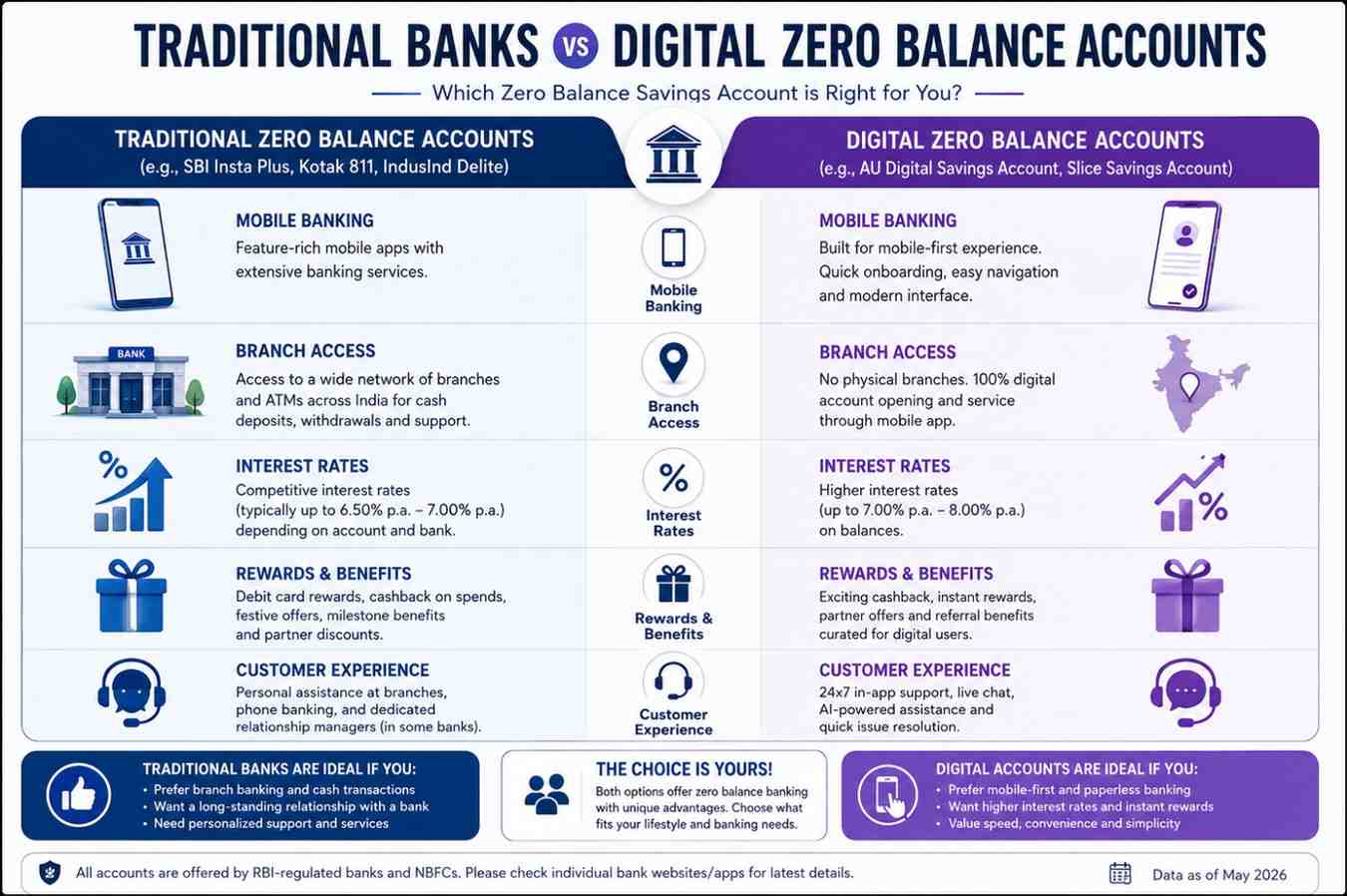
1. Traditional Bank Accounts
Benefits include:
- Physical branch support
- Higher trust factor
- Better loan relationships
- Government transaction compatibility
Examples:
- SBI
- HDFC BSBDA
- ICICI BSBDA
- Bank of Baroda BSBDA
2. Digital-First Accounts
Benefits include:
- Fast onboarding
- Better mobile apps
- Higher rewards
- Modern user experience
- Faster customer support
Examples:
- Kotak 811
- Slice
- Jupiter
- AU Digital Savings
Key Features to Compare Before Opening
1. Interest Rate
While many large banks offer around 2.5% interest, several digital and small finance banks provide substantially higher returns.
2. Debit Card Charges
Some banks advertise zero balance accounts but charge annual debit card fees. Always verify:
- Joining fees
- Annual maintenance charges
- Replacement fees
3. Mobile Banking Experience
A good banking app should provide:
- Fast UPI
- Bill payments
- Investment options
- Card controls
- Instant notifications
4. Hidden Charges
Check for:
- SMS alert fees
- ATM withdrawal limits
- Branch transaction fees
- Statement charges
Which Zero Balance Savings Account Is Best for Different Users?
1. Best for Students
- SBI Insta Plus
- Slice Bank
- Bank of Baroda Lite
2. Best for Professionals
- Kotak 811
- IndusInd Delite
- AU Digital Savings
3. Best for High Interest
- AU Small Finance Bank
- Slice
- Select Small Finance Banks
4. Best Secondary Account
- Kotak 811
- SBI Insta Plus
- Jupiter
Common Mistakes to Avoid
1. Ignoring Debit Card Fees
Many users focus only on zero balance requirements and overlook annual card charges.
2. Choosing Only Based on Interest Rate
Higher interest does not always mean better banking experience.
3. Ignoring Customer Support Quality
A bank with excellent support can save significant time during issues.
4. Not Checking Branch Availability
Even digital users occasionally require branch services.
Future of Zero Balance Banking in India
Competition among traditional banks, small finance banks, and fintech platforms is transforming Indian banking rapidly. Features expected to become standard include:
- AI-powered banking assistance
- Higher savings rewards
- Personalized financial insights
- Better UPI integrations
- Embedded investment products
FAQ
1. Which is the best zero balance savings account in India in 2026?
Kotak 811, SBI Insta Plus, IndusInd Delite, and AU Digital Savings are among the best options depending on your banking preferences.
2. Can I open a zero balance account online?
Yes. Most major banks now offer fully digital onboarding through Aadhaar, PAN verification, and video KYC.
3. Are zero balance accounts safe?
Yes. Accounts opened with RBI-regulated banks offer the same level of safety as traditional savings accounts.
4. Do zero balance accounts provide debit cards?
Most zero balance accounts provide virtual or physical debit cards, although some may charge annual maintenance fees.
5. Which zero balance account offers the highest interest?
Small finance banks and certain fintech-backed accounts generally provide the highest interest rates among zero balance savings accounts.
Conclusion
The best zero balance savings account in India for 2026 depends on your priorities:
- Best overall: Kotak 811
- Best government bank: SBI Insta Plus
- Best digital experience: IndusInd Delite
- Best interest rate: AU Small Finance Bank
- Best fintech option: Slice
For most users, maintaining at least one reliable zero balance account has become essential. It eliminates unnecessary penalties, provides financial flexibility, and supports India's rapidly evolving digital payments ecosystem.

Write a comment