
Choosing the right savings account in 2026 is no longer just about convenience. With interest rates varying significantly across banks, the difference between earning 2.5% and 6.5% annually can substantially impact your returns over time. While traditional banks continue offering lower but stable rates, several private and small finance banks are competing aggressively for deposits by offering much higher yields.
If you're planning to park your emergency fund, salary savings, or short-term investments, understanding the latest savings account interest rates can help maximize returns without compromising liquidity. This guide covers the best savings account interest rates in India as of August 2026, compares major banks, and explains how to choose the right account for your financial needs.
Best Savings Account Interest Rates in India (August 2026)
1. Top Savings Account Interest Rate Comparison
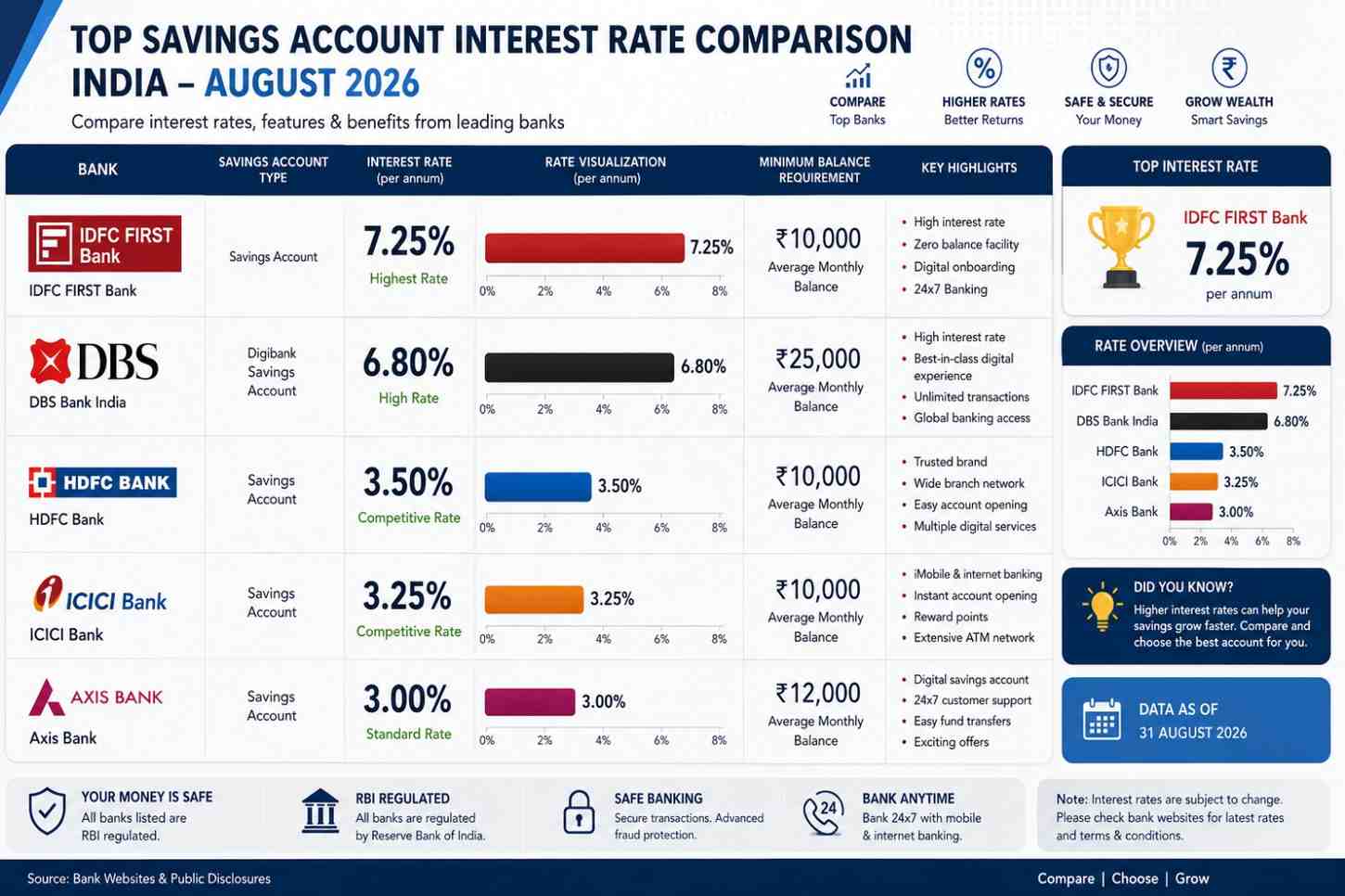
| Bank | Interest Rate (p.a.) | Applicable Balance |
|---|---|---|
| IDFC FIRST Bank | Up to 6.50% | Above ₹3 lakh up to ₹25 crore |
| DBS Bank India | Up to 5.00% | ₹2 lakh to ₹50 lakh |
| Standard Chartered Bank | Up to 5.00% | Large balance slabs |
| Axis Bank | Up to 3.50% | Select balance slabs |
| ICICI Bank | 2.50% | All balances |
| HDFC Bank | Up to 3.50% | Select balance slabs |
| Bank of India | 2.50%–3.30% | Based on balance slabs |
Rates are subject to revision by banks and may vary depending on account type and balance maintained.
Why Savings Account Interest Rates Matter in 2026
1. Inflation Reduces Idle Cash Value
Money kept in a low-interest savings account can gradually lose purchasing power when inflation rises faster than the interest earned. In other words, your balance may increase in rupee terms while the amount of goods and services it can buy grows more slowly.
Earning a more competitive interest rate can help offset some of this effect, particularly for money that needs to remain relatively liquid. However, interest rates alone should not determine where you keep your savings; safety, accessibility, taxes, and your financial goals also matter.
2. Emergency Funds Should Still Earn Returns
An emergency fund needs to be readily accessible, but that does not mean it should sit completely idle. Many financial planners suggest keeping around six to twelve months of essential expenses in liquid assets, depending on your income stability, responsibilities, and financial situation.
A competitive savings account can help your emergency fund earn interest while keeping the money available when unexpected expenses arise. The priority, however, should remain safety and liquidity rather than chasing the highest possible return.
3. Higher Rates Compound Over Time
Even a 2–3% difference in annual interest rates can make a noticeable difference over several years, particularly when you maintain a larger balance. The additional interest can also generate further interest when it remains in the account, allowing the benefit to compound over time.
For example, the impact of a higher rate becomes more meaningful as both your balance and holding period increase. However, compare the effective rate applicable to your actual balance, not just the highest advertised rate, before switching accounts.
Best Banks for High Savings Account Interest
1. IDFC FIRST Bank
IDFC FIRST Bank is often considered by customers looking for a competitive savings account interest rate along with modern digital banking features. Its progressive interest-rate structure means the rate may vary across different balance slabs, potentially benefiting customers who maintain higher account balances.
The bank also offers features such as convenient digital banking and ATM access, making it a strong option for customers who value both returns and everyday banking convenience. However, interest rates and account terms can change, so it is important to review the latest rate structure and eligibility conditions before opening an account.
2. DBS Bank India
DBS Bank India can be an attractive option for customers looking for competitive savings rates alongside a convenient digital banking experience. Its savings account offerings may appeal particularly to customers who maintain balances within specific interest-rate slabs.
The bank’s digital-first approach can also make everyday banking more convenient, with features designed for customers who prefer managing their finances through online and mobile channels. However, interest rates, balance slabs, and account terms can change, so check the latest official details before making a decision.
3. Small Finance Banks
Several small finance banks offer savings account interest rates that can be higher than those available from many traditional banks. This can make them worth considering for customers who want better returns while retaining the convenience of a savings account.
However, a higher rate should not be the only deciding factor. Check the applicable balance slabs, withdrawal and liquidity conditions, minimum balance requirements, and deposit insurance coverage before choosing an account. For larger savings, spreading deposits appropriately across institutions can also help manage concentration risk.
Traditional Banks vs High-Interest Banks
1. Traditional Banks
Traditional banks such as SBI, HDFC Bank, ICICI Bank, and Axis Bank typically offer a wider branch network, established customer service systems, and strong integration with salary and everyday banking needs. For many customers, the familiarity and physical presence of these banks also create a greater sense of trust and security.
However, the convenience and stability of traditional banking can come with a trade-off: savings account interest rates may be lower than those offered by some digital banks or alternative financial platforms.
- Greater branch presence
- Established customer service networks
- Higher perceived safety
- Better integration with salary accounts
The trade-off is relatively lower interest rates.
2. High-Interest Banks
High-interest savings accounts generally provide:
- Higher interest rates on eligible account balances
- Better returns for customers with substantial savings
- Competitive features designed to attract depositors
- Online tools for easy account monitoring and fund management
However, higher interest rates may come with conditions such as balance limits, tiered rates, transaction requirements, or promotional terms. It is important to compare the actual rate applicable to your balance before opening an account.
- Better returns
- Digital-first experience
- Competitive features
- Attractive onboarding offers
However, they may have:
- Balance slabs
- Limited physical branches
- Variable interest policies
How to Choose the Best Savings Account
1. Consider Your Average Balance
Your average savings balance should be one of the first factors you consider. A high interest rate may look attractive, but it may apply only to specific balance ranges.
For example, if your savings usually remain below ₹50,000, a bank offering its highest interest rate only on balances above ₹3 lakh may provide little practical benefit. Choose an account whose interest structure matches the amount you realistically maintain rather than simply selecting the bank advertising the highest headline rate.
2. Evaluate Digital Banking Features
Look for:
- Mobile app quality
- UPI support
- Instant transfers
- Online account opening
- Customer support responsiveness
3. Check Additional Charges
Review:
- Minimum balance requirements
- ATM withdrawal fees
- Debit card charges
- Non-maintenance penalties
4. Understand Deposit Insurance
Bank deposits in India are insured up to ₹5 lakh per depositor per bank under the DICGC framework. This limit includes both the principal amount and accrued interest, subject to applicable rules.
If you hold significantly more than ₹5 lakh in bank deposits, spreading funds across multiple banks can help reduce concentration risk. However, diversification should be planned carefully based on your liquidity needs, interest rates, account convenience, and overall financial goals.
Should You Keep Large Amounts in Savings Accounts?
1. For Emergency Funds
Yes. Emergency funds require a balance of liquidity, safety, and easy access. A savings account can be a suitable place to keep money needed for unexpected expenses because funds are generally accessible without the lock-in periods associated with many other savings options.
The key is to prioritize reliability and accessibility over chasing the highest possible interest rate. Choose an account that allows quick withdrawals, offers convenient digital banking, and fits your day-to-day financial needs.
2. For Long-Term Wealth Creation
No. For long-term goals, consider alternatives such as:
- Fixed deposits
- Debt mutual funds
- Equity mutual funds
- Government securities
- Hybrid investments
Savings accounts prioritize liquidity over maximum returns.
Savings Account vs Fixed Deposit
| Feature | Savings Account | Fixed Deposit |
|---|---|---|
| Liquidity | Very High | Limited |
| Interest Rate | 2.5%–6.5% | 6%–8%+ |
| Lock-in | None | Fixed tenure |
| Risk | Very Low | Very Low |
| Best For | Emergency funds | Long-term savings |
Fixed deposits continue offering higher yields than savings accounts in 2026, particularly through small finance banks.
Common Mistakes to Avoid
1. Choosing Only Based on Interest Rate
The highest advertised interest rate may apply only to a specific balance range, while lower rates apply to the rest of your savings. As a result, the headline rate may not reflect the actual return you earn.
Before choosing an account, check the interest-rate slabs, average balance requirements, withdrawal conditions, fees, and how interest is calculated. The best savings account is one that offers competitive returns while matching your typical balance and everyday banking needs.
2. Ignoring Hidden Charges
Account maintenance charges can quickly offset the interest you earn, especially when your savings balance is relatively low. Fees for failing to maintain a minimum balance, debit card services, ATM transactions, cash deposits, or other account services can reduce your overall returns.
Before opening a savings account, review the complete schedule of charges and minimum balance requirements. A slightly lower interest rate may still be more beneficial if the account has fewer fees and lower maintenance costs.
3. Keeping Excess Cash Idle
Keeping a large amount of money in a low-interest savings account for long periods can limit your long-term wealth accumulation. While cash is important for emergencies and short-term expenses, funds beyond your immediate liquidity needs may earn better returns elsewhere.
Consider keeping enough money readily available for emergencies and planned expenses, then evaluating suitable options for surplus funds based on your time horizon, risk tolerance, and financial goals. The objective is not to eliminate cash entirely, but to avoid leaving more money idle than necessary.
4. Concentrating All Savings in One Bank
Keeping all your savings in a single bank can reduce flexibility and increase concentration risk. If you face a temporary service disruption, account issue, or access problem, having funds in another bank can provide an additional layer of convenience.
Diversifying savings across suitable banks can also help you manage deposit insurance limits and access different interest-rate structures or banking features. The goal is not to open unnecessary accounts, but to spread larger balances thoughtfully while keeping your finances simple and manageable.
FAQ
1. Which bank offers the highest savings account interest rate in India in August 2026?
Among major private banks, IDFC FIRST Bank offers one of the highest savings account interest rates, reaching up to 6.5% per annum on eligible balance slabs. Some small finance banks may offer even higher rates depending on account conditions.
2. Are savings account interest rates fixed?
No. Savings account interest rates are variable and can change based on RBI policy decisions and bank-specific strategies.
3. Is money in savings accounts safe?
Yes. Scheduled banks regulated by the Reserve Bank of India are generally considered safe, and deposits up to ₹5 lakh per depositor per bank are insured under DICGC.
4. Should I choose a small finance bank for higher interest?
Small finance banks can offer excellent returns, but diversification and understanding deposit insurance limits remain important considerations.
5. Is a savings account better than a fixed deposit?
Savings accounts are better for liquidity and emergency funds, while fixed deposits typically provide higher returns for long-term savings goals.
Conclusion
The best savings account in India during August 2026 depends on your priorities. If maximizing returns is your primary objective, banks like IDFC FIRST Bank and select small finance banks remain strong choices. If convenience, branch access, and stability matter more, established institutions such as HDFC Bank, ICICI Bank, and Axis Bank continue to be reliable options.
A practical strategy for many savers is to maintain a primary account with a large established bank while parking surplus funds in a higher-interest savings account within deposit insurance limits. This approach balances safety, convenience, and returns effectively.


Write a comment