
India's MSME sector is the backbone of the economy, contributing significantly to employment, exports, and GDP. Whether you're launching a startup, expanding a manufacturing unit, or managing working capital, choosing the right MSME business loan can reduce financing costs and improve business growth.
In this comprehensive 2026 guide, you'll discover the best government-backed and bank MSME loan schemes, compare eligibility, interest rates, loan amounts, and understand how to choose the most suitable financing option for your business.

Understanding MSME Business Loan Schemes
1. What is an MSME Business Loan?
An MSME business loan is financial assistance offered by banks, NBFCs, and government-supported institutions to Micro, Small, and Medium Enterprises (MSMEs). These loans help businesses access the capital they need to manage daily operations, invest in growth, and overcome financial challenges.
- Business expansion
- Machinery purchase
- Working capital
- Inventory
- Commercial equipment
- Factory setup
- Technology upgrades
Many government-supported schemes also offer collateral-free financing through credit guarantee programs.
2. Why Government-Backed MSME Loans Matter
Government schemes reduce the lender's risk through guarantees or subsidies, making it easier for businesses to secure funding with:
- Lower collateral requirements
- Better approval chances
- Competitive interest rates
- Longer repayment periods
- Subsidies for eligible entrepreneurs
Best Government MSME Business Loan Schemes in India (2026)
1. Pradhan Mantri Mudra Yojana (PMMY)
Best for: Small businesses, retailers, service providers, and first-time entrepreneurs.
Pradhan Mantri Mudra Yojana (PMMY) is a government-backed lending scheme designed to improve access to credit for micro and small businesses. It supports entrepreneurs who need funds to start, operate, or expand income-generating business activities.
Under PMMY, eligible borrowers can generally seek funding for purposes such as:
- Starting a new small business
- Purchasing equipment or machinery
- Buying inventory and raw materials
- Meeting working capital requirements
- Expanding an existing business
- Supporting retail, trading, manufacturing, and service activities
The scheme is commonly divided into loan categories based on the stage and funding needs of the business, making it particularly relevant for first-time entrepreneurs and smaller enterprises.
Interest Rate
No fixed rate. Banks decide the applicable rate based on borrower profile.
Collateral
Usually not required.
Ideal For
- Grocery shops
- Salons
- Food businesses
- Tailoring units
- Small manufacturers
2. CGTMSE (Credit Guarantee Fund Trust for Micro and Small Enterprises)
Best for: Businesses seeking collateral-free loans.
CGTMSE is not a loan itself. Instead, it is a government-backed credit guarantee scheme that encourages eligible lenders to provide collateral-free credit to Micro and Small Enterprises (MSEs). The guarantee reduces the lender’s risk, making it easier for qualifying businesses to access funding without pledging traditional assets such as property or equipment.
CGTMSE-backed financing may help businesses obtain funds for:
- Starting a new micro or small enterprise
- Purchasing machinery, equipment, or business assets
- Meeting working capital requirements
- Expanding operations or production capacity
- Managing business growth without providing traditional collateral
However, approval still depends on the lender’s assessment of factors such as business viability, repayment capacity, credit history, and eligibility under the scheme.
Loan Amount
Collateral-free loans are available through participating lenders under the scheme, subject to prevailing limits and lender policies.
Benefits
- No property mortgage in many eligible cases
- Easier bank approval
- Available through many public and private banks
3. PMEGP (Prime Minister Employment Generation Programme)
Best for: First-generation entrepreneurs starting a new business.
The Prime Minister’s Employment Generation Programme (PMEGP) is a government-supported scheme designed to encourage self-employment and entrepreneurship. It is particularly suitable for individuals who want to establish a new micro-enterprise in the manufacturing or service sector.
PMEGP typically combines bank financing with government support in the form of a margin money subsidy, helping eligible entrepreneurs reduce their initial financial burden.
The scheme can support expenses related to:
- Setting up a new manufacturing or service business
- Purchasing machinery, equipment, and tools
- Arranging initial working capital
- Developing small-scale production facilities
- Creating self-employment and local job opportunities
For first-generation entrepreneurs with a viable business idea and limited access to capital, PMEGP can provide a structured path toward launching a new enterprise.
Project Cost
- Manufacturing: Up to ₹50 lakh
- Service Sector: Up to ₹20 lakh
Government Subsidy
Typically ranges between 15% and 35% depending on category and location.
Eligibility
- New businesses only
- Minimum age: 18 years
- Educational qualification required for larger projects
4. Stand-Up India Scheme
Designed for: Women entrepreneurs and entrepreneurs belonging to Scheduled Castes (SC) and Scheduled Tribes (ST) who want to start a new business.
The Stand-Up India Scheme facilitates bank loans for eligible entrepreneurs setting up a greenfield enterprise in the manufacturing, services, trading, or agriculture-allied sectors. It aims to promote entrepreneurship among groups that may face greater barriers to accessing formal business finance.
The scheme can help eligible applicants fund:
- Setting up a new business
- Purchasing machinery, equipment, or other business assets
- Working capital requirements
- Establishing manufacturing, service, or trading enterprises
- Agriculture-allied business activities
For eligible first-time entrepreneurs, Stand-Up India can provide access to institutional credit while encouraging greater participation in entrepreneurship and business ownership.
Loan Amount
₹10 lakh to ₹1 crore
Suitable for greenfield manufacturing, trading, and service businesses.
5. SIDBI MSME Loans
The Small Industries Development Bank of India (SIDBI) supports the growth and development of Micro, Small, and Medium Enterprises through various financing options. These facilities can help established and growing businesses meet both investment and working capital requirements.
SIDBI financing may be useful for:
- Business expansion and modernization
- Purchasing machinery, equipment, and technology
- Working capital requirements
- Setting up or upgrading manufacturing facilities
- Adopting energy-efficient and sustainable technologies
- Increasing production capacity
- Supporting business growth and modernization
SIDBI-backed financing can be particularly relevant for MSMEs looking to scale operations, improve productivity, or invest in long-term business infrastructure.
- Machinery
- Expansion
- Technology
- Working capital
- Manufacturing projects
Indicative interest rates vary by scheme and borrower profile, often remaining competitive compared with commercial lending.
Best Banks Offering MSME Business Loans
1. State Bank of India (SBI)
Suitable for:
- Working capital
- Term loans
- Government-backed MSME schemes
- Digital loan processing
SBI also supports PMEGP, Mudra, CGTMSE, and Stand-Up India.
2. Punjab National Bank (PNB)
Offers:
- MSME working capital
- Machinery finance
- Term loans
- Government-sponsored loan schemes
3. Bank of Baroda
Known for:
- Competitive MSME interest rates
- Manufacturing finance
- Service business loans
4. Canara Bank
Popular among:
- Small manufacturers
- Retail businesses
- New entrepreneurs
5. SIDBI
Ideal for growth-stage MSMEs requiring specialized business financing.
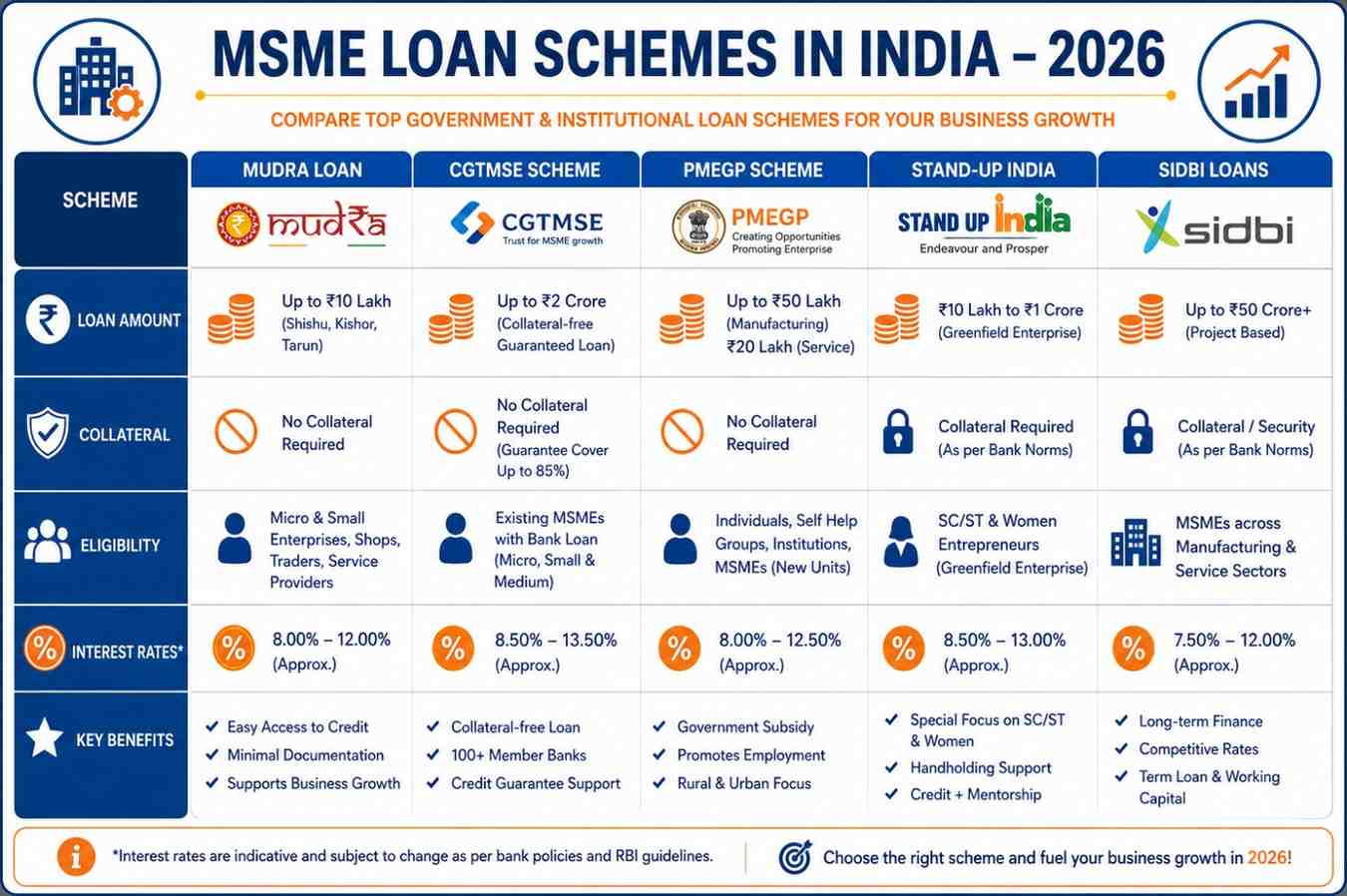
MSME Loan Comparison
| Scheme | Loan Amount | Collateral | Best For |
|---|---|---|---|
| Mudra | Up to ₹10 lakh (higher for eligible repeat borrowers) | No | Small businesses |
| CGTMSE | As per lender and scheme limits | Generally No | Existing MSMEs |
| PMEGP | Manufacturing up to ₹50 lakh, Services up to ₹20 lakh | Usually bank norms with subsidy support | New businesses |
| Stand-Up India | ₹10 lakh–₹1 crore | Scheme support available | Women & SC/ST entrepreneurs |
| SIDBI | Varies by program | Depends on product | Manufacturing & growth businesses |
Eligibility Criteria
Most lenders require:
1. Business Registration
- Udyam Registration (recommended)
- GST Registration (where applicable)
- Business incorporation documents
2. Credit Profile
A healthy credit score and strong repayment history improve approval chances.
3. Financial Documents
- Bank statements
- Income Tax Returns
- GST returns
- Profit & Loss statement
- Balance Sheet
4. Business Vintage
Some schemes support new businesses, while others require an operating history.
Interest Rates
Interest rates vary by:
- Bank
- Credit score
- Business turnover
- Loan amount
- Collateral
- Government guarantee support
Public sector banks advertise MSME lending rates starting from competitive benchmark-linked levels, but the final rate depends on the borrower and scheme.
Step-by-Step Application Process
1. Register Your Business
Obtain Udyam Registration if eligible.
2. Choose the Right Scheme
Select based on:
- Business age
- Funding requirement
- Industry
- Collateral availability
3. Prepare Documents
Keep all financial and identity documents ready before applying.
4. Apply Through a Participating Bank
Submit the application online or at a branch participating in the chosen scheme.
5. Loan Assessment
The bank evaluates:
- Business viability
- Creditworthiness
- Financial statements
- Repayment capacity
6. Approval and Disbursement
Upon approval, funds are credited according to the sanctioned terms.
Tips to Improve Loan Approval
- Maintain a CIBIL score above 700 where possible.
- Keep GST and tax filings current.
- Maintain consistent business cash flow.
- Prepare a realistic business plan.
- Apply for an amount aligned with repayment capacity.
- Keep financial records organized.
These factors often help lenders offer better terms.
Common Mistakes to Avoid
1. Applying Without Udyam Registration
Many government benefits are easier to access with proper MSME registration.
2. Choosing the Wrong Scheme
A startup may benefit more from PMEGP or Mudra than a standard commercial loan.
3. Poor Documentation
Incomplete paperwork is a common cause of delays.
4. Overestimating Loan Requirements
Borrow only what your business genuinely needs and can comfortably repay.
FAQ
Which MSME loan is best for a new business?
PMEGP and Mudra are among the most suitable options for first-time entrepreneurs because they are designed to support new ventures and small businesses.
Can I get an MSME loan without collateral?
Yes. Many loans supported through CGTMSE and Mudra are available without traditional collateral, subject to lender policies and eligibility.
Is Udyam Registration mandatory?
Not always, but it is highly recommended because it simplifies access to many MSME benefits and government-backed schemes.
What is the maximum MSME loan available?
The maximum amount depends on the lender and scheme. Large expansion projects through banks and SIDBI can extend well beyond the limits of entry-level schemes.
How long does loan approval take?
Processing times vary. Digital applications with complete documentation are often faster than manual applications.
Conclusion
India's MSME financing ecosystem in 2026 offers a wide range of solutions for businesses at every stage—from first-time entrepreneurs seeking small collateral-free loans to established manufacturers requiring large expansion capital. Government-backed initiatives such as Mudra, CGTMSE, PMEGP, Stand-Up India, and SIDBI significantly improve access to affordable credit. Before applying, compare eligibility, repayment terms, total borrowing costs, and documentation requirements to select the scheme that best aligns with your business goals.



Write a comment