PM Vishwakarma Yojana 2026: Benefits, Eligibility & Online Application
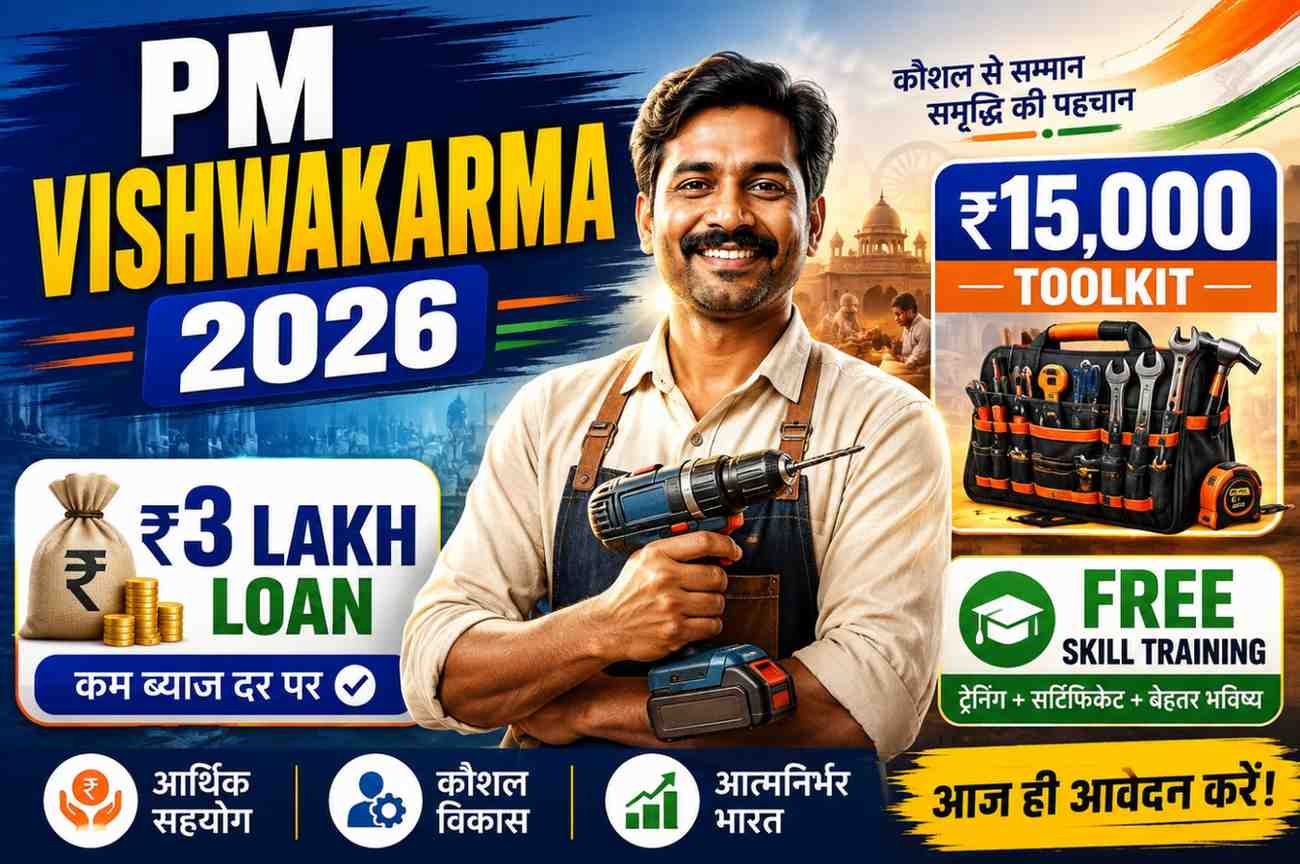
PM Vishwakarma Yojana 2026 is designed to support traditional artisans and craftspeople who depend on skilled, hands-on work for their livelihoods. The scheme combines recognition, skill training, modern tools, affordable credit, digital incentives and marketing support.
For eligible artisans, the real value is not just financial assistance. The scheme attempts to solve several practical problems at once: outdated equipment, limited access to formal credit, weak market connections and lack of business recognition. Here is everything you need to know before applying.
What Is PM Vishwakarma Yojana 2026?
1. Purpose of PM Vishwakarma Yojana
PM Vishwakarma is a Central Sector Scheme implemented by the Ministry of Micro, Small and Medium Enterprises. It focuses on artisans and craftspeople working with their hands and traditional tools across 18 identified trades. The scheme aims to improve their skills, productivity, access to finance and market opportunities.
The broader idea is simple: traditional skills can become stronger livelihoods when artisans receive better tools, training, credit and access to modern markets.
The scheme was launched in September 2023 and has been structured as a multi-year initiative. The government has allocated substantial resources to support artisans through training, toolkit assistance, credit and market linkage.
2. Why the Scheme Matters for Artisans
Many traditional workers operate as small, informal businesses. Their skills may be strong, but access to working capital, technology and organised markets can remain limited.
PM Vishwakarma addresses these gaps through an integrated support system rather than offering only a single benefit. It provides recognition through a certificate and ID card, skill development, toolkit assistance, subsidised credit, digital transaction incentives and marketing support.
This makes the scheme particularly relevant for artisans who want to continue their traditional occupation while improving productivity and business opportunities.
Who Is Eligible for PM Vishwakarma Yojana?
1. Basic Eligibility Conditions
The scheme is intended for artisans and craftspeople who work in one of the 18 specified traditional trades. The occupation should generally be carried out on a self-employment basis in the unorganised or informal sector.
The eligibility framework is occupation-specific. Simply being a skilled worker does not automatically make someone eligible. The applicant must fall within one of the trades covered by the scheme.
Applicants should also complete the required verification process. Registration and verification are important because PM Vishwakarma is intended to identify genuine artisans rather than provide a general-purpose cash benefit.
2. Age and Family Restrictions
Applicants must generally be at least 18 years old at the time of registration. The scheme also contains restrictions concerning multiple beneficiaries from the same family and government employment.
Before submitting an application, applicants should therefore check the current eligibility requirements through the official scheme information or their nearest Common Service Centre.
3. The 18 Eligible Trades
PM Vishwakarma covers the following traditional occupations:
- Carpenter (Suthar/Badhai)
- Boat Maker
- Armourer
- Blacksmith (Lohar)
- Hammer and Tool Kit Maker
- Locksmith
- Goldsmith (Sonar)
- Potter (Kumhaar)
- Sculptor, Stone Carver and Stone Breaker
- Cobbler, Shoesmith and Footwear Artisan
- Mason (Rajmistri)
- Basket, Mat and Broom Maker and Coir Weaver
- Doll and Toy Maker
- Barber (Naai)
- Garland Maker (Malakaar)
- Washerman (Dhobi)
- Tailor (Darzi)
- Fishing Net Maker
These trades are specifically listed in the Ministry of MSME's scheme material.
What Are the Main Benefits of PM Vishwakarma Yojana?
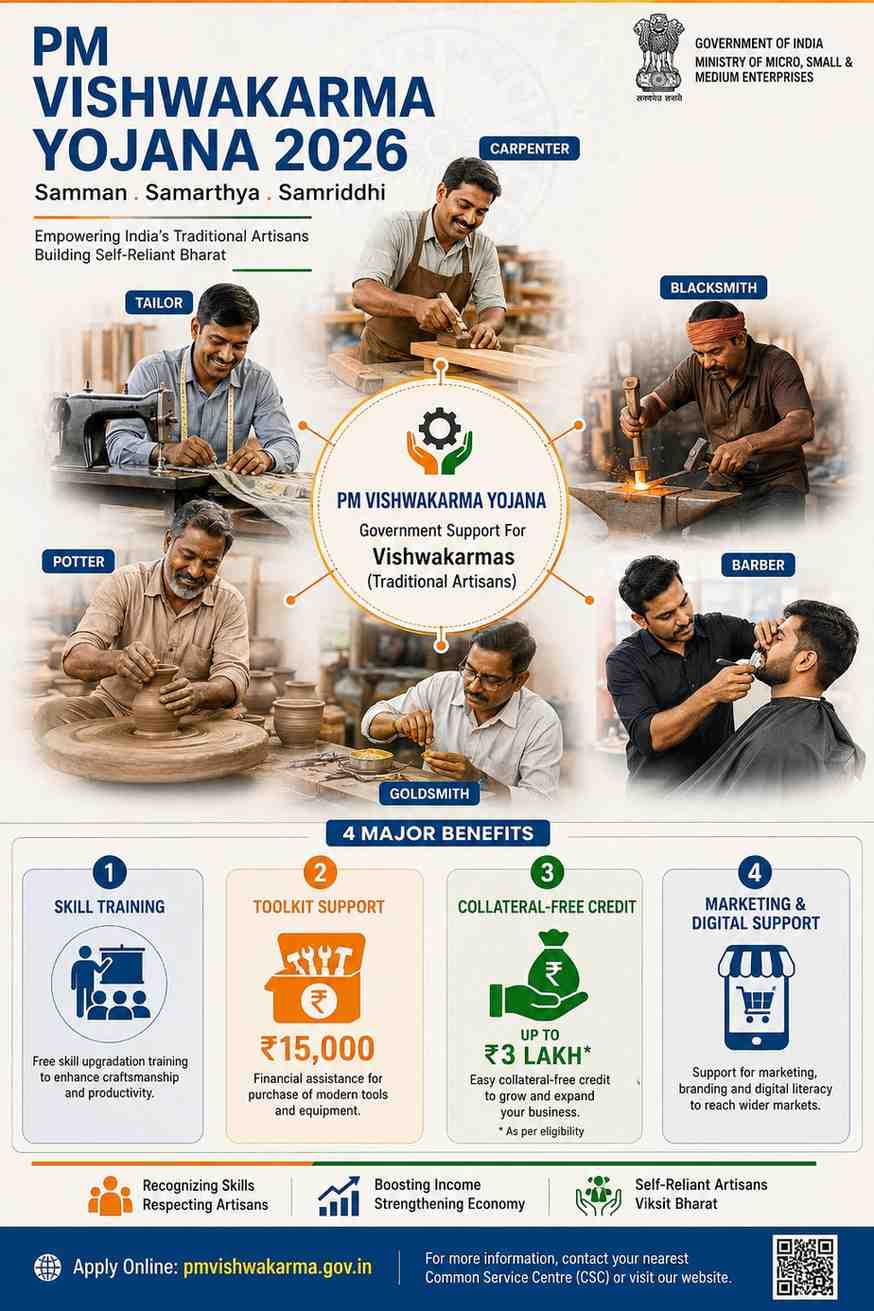
1. PM Vishwakarma Certificate and ID Card
One of the first benefits is formal recognition as a Vishwakarma artisan.
Eligible beneficiaries receive a PM Vishwakarma Certificate and ID Card. This recognition can help connect traditional workers with the other benefits available under the scheme.
For many informal workers, formal recognition is important because it creates an identifiable link between their occupation and government support.
2. Skill Training With Daily Stipend
Training is another major component of the scheme.
Beneficiaries can receive skill upgradation training, including exposure to modern techniques, equipment and digital tools. The scheme provides a training stipend of ₹500 per day during eligible training.
The purpose is not to replace traditional craftsmanship. Instead, training is intended to help artisans combine existing skills with modern production methods.
This can be particularly useful when an artisan wants to improve finishing quality, productivity, safety or the ability to handle changing customer expectations.
3. Toolkit Support Up to ₹15,000
Traditional work often depends heavily on the quality of tools.
PM Vishwakarma provides toolkit assistance of up to ₹15,000, generally through an e-voucher mechanism. The support is intended to help beneficiaries obtain modern tools relevant to their trade.
The official scheme material also specifies that toolkits should be obtained through the prescribed process and from eligible sources.
A better toolkit can have a direct impact on productivity. For a carpenter, tailor, blacksmith, potter or footwear artisan, even small improvements in equipment can affect production time and product quality.
4. Collateral-Free Credit Up to ₹3 Lakh
Access to affordable working capital is one of the most significant benefits.
Eligible beneficiaries can access collateral-free credit of up to ₹3 lakh under the scheme. The credit support is structured in two stages, with an initial tranche followed by a second tranche subject to the applicable conditions. The scheme provides interest support so that the beneficiary's effective interest burden is reduced.
This funding can potentially help artisans purchase raw materials, improve equipment, increase production or expand their small businesses.
Importantly, this is loan assistance, not a ₹3 lakh cash grant. Applicants should understand this distinction before planning their finances.
5. Incentive for Digital Transactions
The scheme also encourages beneficiaries to adopt digital payments.
An incentive of ₹1 per eligible digital transaction, subject to a maximum of 100 eligible transactions in a month, is provided under the scheme's digital transaction component.
This may appear small, but the objective is broader. Digital transactions can help artisans build familiarity with cashless payments and create a more organised financial trail for their businesses.
6. Marketing and Branding Assistance
Having a good product is only half the challenge. An artisan also needs customers.
PM Vishwakarma includes marketing assistance covering areas such as quality certification, branding, advertising, publicity and onboarding on e-commerce platforms such as GeM.
This component can help traditional products move beyond local markets.
For an artisan who previously depended almost entirely on neighbourhood customers, better branding and digital market access can create opportunities to reach customers in other cities and regions.
How Much Financial Assistance Can You Get?
1. Understanding the Major Benefits
The scheme should not be viewed as a single payment scheme. Different components provide different forms of assistance.
| Benefit | Support |
|---|---|
| Skill training stipend | ₹500 per day |
| Toolkit assistance | Up to ₹15,000 |
| Business credit | Up to ₹3 lakh |
| Digital transaction incentive | ₹1 per eligible transaction, up to 100/month |
| Certificate and ID | Provided to eligible beneficiaries |
| Marketing support | Branding, quality certification, promotion and market linkage |
The ₹3 lakh component is credit that must be repaid according to the applicable loan terms. Toolkit support and training assistance are separate components and should not be confused with the loan amount.
2. Why the Combined Support Matters
Imagine a tailor who has strong stitching skills but works with outdated equipment. Training can improve technical and digital skills, toolkit assistance can support better equipment, and credit can provide working capital.
Marketing support can then help the tailor reach customers beyond the immediate neighbourhood.
That combination is the central strength of PM Vishwakarma: it attempts to support the artisan throughout the business journey rather than focusing on only one financial need.
How to Apply for PM Vishwakarma Yojana Online?
1. Where Should You Apply?
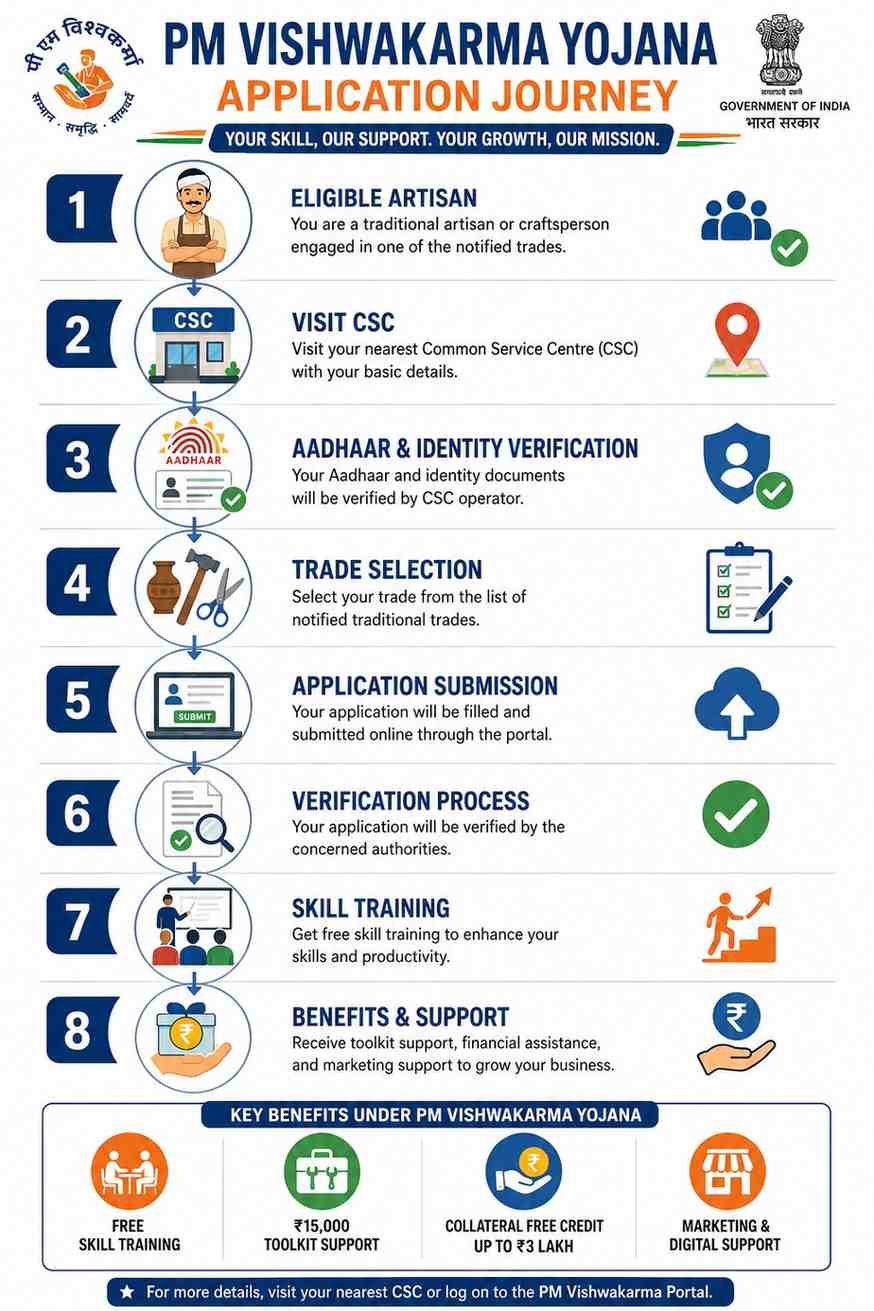
The official scheme information directs applicants to use the PM Vishwakarma system and nearest Common Service Centres (CSCs) for online application assistance. The Ministry of MSME's scheme booklet specifically states that online applications can be submitted through the nearest CSC.
Applicants should be cautious about unofficial websites promising guaranteed approval, instant loans or paid registration.
2. Basic Application Process
The application process generally involves these stages:
Step 1: Visit a Common Service Centre
Go to a nearby CSC that provides PM Vishwakarma registration services.
Step 2: Provide Aadhaar and Required Details
The applicant's identity and other information are entered through the prescribed registration process.
Step 3: Complete Verification
The applicant's details and occupation are subject to the scheme's verification process.
Step 4: Select the Applicable Trade
The applicant must register under the eligible traditional trade that matches their actual occupation.
Step 5: Submit the Application
The CSC operator completes the online application and submits the information through the official system.
Step 6: Wait for Verification and Approval
Registration does not automatically mean every benefit is immediately available. Different benefits may depend on verification, training completion and other applicable conditions.
3. What Documents May Be Required?
Applicants should keep their basic identity and banking information ready before visiting a CSC.
Commonly required information can include:
- Aadhaar details
- Mobile number
- Bank account information
- Basic personal details
- Details of the traditional trade or occupation
- Other information required during verification
Because document requirements and verification procedures can change, applicants should confirm the current requirements through the official portal or CSC rather than relying on social-media posts.
How Does the PM Vishwakarma Loan Work?
1. First Loan Tranche
The scheme provides an initial business loan tranche of up to ₹1 lakh for eligible beneficiaries, subject to the scheme's conditions and lending process.
The objective is to provide working capital without requiring conventional collateral.
2. Second Loan Tranche
An eligible beneficiary can subsequently access the second tranche of up to ₹2 lakh, subject to the conditions applicable to the second loan.
Together, the two stages can provide up to ₹3 lakh in collateral-free credit support.
The important point is that the second tranche is not simply an automatic additional ₹2 lakh payment. Beneficiaries must satisfy the relevant requirements.
3. What Can the Loan Be Used For?
The credit component is intended to support the artisan's business.
Depending on the trade and business requirements, funds may help with working capital, raw materials, tools, production improvements or expansion.
Applicants should treat the loan as business finance and plan repayment before borrowing.
What Happens After Registration?
1. Verification Is Important
PM Vishwakarma is not simply a form-submission scheme.
The government uses a verification process to identify artisans who genuinely belong to the covered occupations. This helps ensure that benefits reach the intended group.
The MSME dashboard reported 3 million registrations, with more than 2.69 million skill verifications completed and more than 2.41 million beneficiaries completing basic training as of June 30, 2026.
2. Training Can Open the Door to More Opportunities
After successful verification, eligible beneficiaries can progress through the scheme's support structure.
Training can improve traditional techniques while introducing modern machinery and digital tools. The government has also promoted market and exhibition opportunities for beneficiaries, demonstrating that the scheme extends beyond basic registration.
3. Building a Business Matters More Than Receiving One Benefit
The strongest results are likely when artisans use the different components together.
A toolkit alone may improve productivity. Training alone may improve skills. Credit alone may provide working capital.
But combining all three with branding and market access can potentially create a much stronger business model.
Common Mistakes to Avoid
1. Treating the ₹3 Lakh as Free Money
The ₹3 lakh figure refers to credit support. It is not a ₹3 lakh grant deposited into the beneficiary's bank account.
Always understand the repayment obligation and applicable interest conditions before accepting a loan.
2. Choosing the Wrong Trade
Applicants should register according to their actual occupation.
Choosing a trade merely because it appears more beneficial can create problems during verification.
3. Paying Unofficial Agents
Registration assistance should be obtained through authorised channels.
Avoid anyone claiming they can guarantee approval, arrange a toolkit immediately for a fee, or release the loan in exchange for an unofficial payment.
4. Ignoring Training
Training should not be viewed as a formality.
The purpose is to improve skills, introduce modern tools and strengthen the artisan's ability to compete in changing markets.
5. Sharing OTPs or Banking Credentials
Never share an OTP, ATM PIN, internet banking password or other sensitive banking credentials with an unknown person.
A genuine registration process should not require you to hand over control of your banking account.
Why PM Vishwakarma Yojana Can Be Valuable in 2026
1. Traditional Skills Are Becoming Marketable Again
Consumers increasingly value handmade and locally produced goods, but traditional artisans need access to quality, branding and modern distribution.
PM Vishwakarma attempts to connect traditional craftsmanship with these modern business requirements.
2. Digital Markets Can Expand Customer Reach
An artisan no longer has to depend entirely on customers who live nearby.
With digital payments, e-commerce and stronger branding, a traditional business can potentially reach customers far beyond its local market. The scheme's marketing component specifically includes e-commerce onboarding and market-linkage activities.
3. Better Tools Can Increase Productivity
Traditional knowledge remains valuable, but modern tools can make production faster and more consistent.
The toolkit component is therefore more than a one-time material benefit. It can be viewed as an investment in the artisan's productive capacity.
FAQ
Is PM Vishwakarma Yojana available in 2026?
Yes. PM Vishwakarma continues to operate in 2026. The scheme was designed as a multi-year programme covering the 2023-24 to 2027-28 period. Applicants should check the official portal for the latest registration and benefit information.
Who can apply for PM Vishwakarma Yojana?
Artisans and craftspeople working in one of the 18 trades covered by the scheme can apply, subject to the applicable eligibility and verification conditions. The scheme is intended primarily for self-employed traditional artisans working in the unorganised sector.
How much money is given under PM Vishwakarma?
The scheme provides several forms of assistance. These include a training stipend of ₹500 per day, toolkit support up to ₹15,000 and collateral-free credit support of up to ₹3 lakh. The ₹3 lakh amount is loan assistance, not a free cash grant.
Is the PM Vishwakarma ₹15,000 toolkit money free?
The scheme provides toolkit assistance of up to ₹15,000 through the prescribed e-voucher mechanism. Beneficiaries should follow the official process and use the voucher according to the scheme's rules.
Is the PM Vishwakarma loan collateral-free?
Yes. The scheme provides collateral-free credit support for eligible beneficiaries, with total credit support of up to ₹3 lakh through its loan structure. Applicable lending and repayment conditions still apply.
Can a tailor apply for PM Vishwakarma?
Yes. Tailor or Darzi is one of the 18 trades specifically covered under PM Vishwakarma. The applicant must still satisfy the scheme's other eligibility and verification requirements.
Can a barber apply for PM Vishwakarma?
Yes. Barber or Naai is one of the eligible traditional trades listed under the scheme.
Where can I apply for PM Vishwakarma Yojana?
Applicants can use the official PM Vishwakarma system and seek online registration assistance from a nearby Common Service Centre. The Ministry of MSME specifically directs applicants to the nearest CSC for online application submission.
Does registration guarantee a PM Vishwakarma loan?
No. Registration alone does not guarantee loan approval. Applicants must undergo the prescribed verification and satisfy the relevant conditions for the particular benefit, including lending requirements.
What is the main advantage of PM Vishwakarma Yojana?
Its biggest advantage is the combination of support. Instead of focusing only on money, the scheme combines artisan recognition, skill training, a daily training stipend, toolkit support, collateral-free credit, digital incentives and marketing assistance.
Conclusion
PM Vishwakarma Yojana 2026 is particularly relevant for traditional artisans who want to turn existing skills into stronger and more sustainable businesses. Its support extends from identity and training to tools, affordable credit, digital transactions and market access.
The most important step is to verify eligibility based on your actual trade and use the official application channel. If you qualify, do not look at the scheme only as a source of financial assistance. The greater opportunity lies in combining training, better tools, responsible credit and wider market access to build a more competitive artisan business.
Write a comment