
Sukanya Samriddhi Yojana (SSY) remains one of India’s most popular government-backed savings options for securing a daughter’s future. Its combination of a government-set interest rate, long investment horizon and tax advantages makes it especially relevant for long-term education and financial planning.
In 2026, the SSY interest rate is 8.2% per annum, with interest calculated annually and compounded yearly according to India Post’s current scheme information. The rate is subject to periodic revision by the government.
What Is Sukanya Samriddhi Yojana?
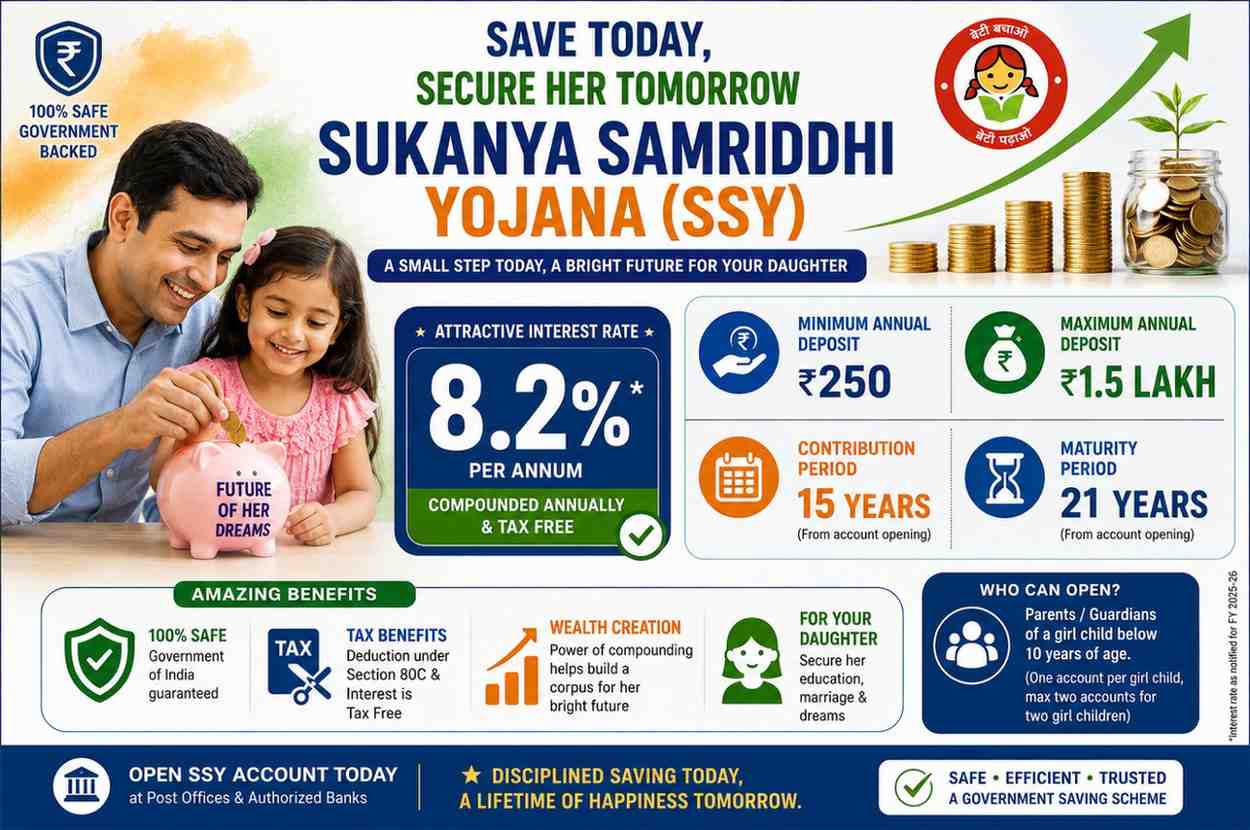
1.1 Purpose of the SSY scheme
Sukanya Samriddhi Yojana is a small-savings scheme designed specifically for the financial future of a girl child. It was introduced under the government’s broader Beti Bachao Beti Padhao initiative.
The basic idea is simple: parents or legal guardians start saving early, continue deposits for a limited period, and allow the accumulated corpus to grow over a longer period.
This structure can be useful when the goal is several years away, such as higher education or other major financial requirements.
1.2 Who manages the account?
An SSY account can be opened through India Post and eligible banks. The scheme is governed by government rules rather than being a conventional bank deposit product.
India Post currently lists SSY at an 8.2% annual interest rate, compounded yearly.
1.3 Why parents consider SSY
The biggest attraction is not simply the headline interest rate. It is the combination of long-term compounding, government backing and tax treatment.
For parents, this can create a psychological advantage too: a dedicated account makes it easier to separate a daughter’s future fund from everyday household savings.
Sukanya Samriddhi Yojana Interest Rate in 2026
2.1 Current SSY interest rate
The current Sukanya Samriddhi Yojana interest rate is 8.2% per annum. India Post states that interest is calculated on a yearly basis and compounded annually.
The rate is not permanently fixed for the entire life of an account. Small-savings interest rates are reviewed periodically by the government.
Therefore, the 8.2% rate should be understood as the applicable rate currently listed, rather than a guaranteed rate for the next 21 years.
2.2 How compounding helps
SSY is designed for long-term accumulation. Interest earned becomes part of the account balance, allowing subsequent interest to build on a larger corpus.
For example, consistently investing over many years can create a substantially larger maturity amount than simply adding up the deposits.
The exact maturity value depends on the timing and amount of deposits and the interest rates applicable during the investment period.
2.3 When is interest calculated?
The account earns interest according to the SSY rules, with the interest credited annually. India Post describes the account as earning interest on a yearly basis with yearly compounding.
Because interest calculation has specific rules, investors should not assume that making a deposit at any random point in the month produces the same result.
For maximum efficiency, deposits should be planned with the applicable interest-calculation rules in mind.
SSY Eligibility and Account Rules
3.1 Age limit for the girl child
An SSY account can be opened for a girl child who is below 10 years of age. The account is opened by a parent or legal guardian on behalf of the child.
This age restriction is important because an account cannot simply be opened whenever the family decides to start saving.
Starting early therefore matters. A child who is already close to the age limit gives the family less time to initiate the account.
3.2 Number of accounts allowed
Generally, only one SSY account can be opened in the name of a girl child.
A family can normally open accounts for up to two girl children, subject to the applicable scheme rules and specified exceptions.
Parents should therefore verify eligibility carefully before opening multiple accounts.
3.3 Who can open the account?
A natural or legal guardian can open the account in the name of the eligible girl child. India Post specifically identifies the guardian as the person who can initiate the account.
The girl child becomes the account holder, while the guardian manages the account according to the applicable rules until the child reaches the relevant age.
SSY Deposit Limit, Duration and Contribution Rules
4.1 Minimum and maximum deposit
The minimum annual deposit is ₹250, while the maximum permitted deposit is ₹1.5 lakh in a financial year.
This creates considerable flexibility.
A family does not necessarily need to invest ₹1.5 lakh every year. The amount can be adjusted according to income and financial priorities, provided the account remains compliant with the applicable minimum-deposit requirement.
4.2 Is monthly investment compulsory?
No. Monthly deposits are not compulsory.
India Post states that deposits can be made during the financial year and that monthly contributions are not mandatory.
This means a parent could plan contributions around salary cycles, bonuses or other predictable cash flows.
4.3 For how many years must you deposit?
Deposits can generally be made for 15 years from the date of opening the account. The account itself continues until maturity, which is generally 21 years from the opening date.
This distinction is crucial.
Deposit period: up to 15 years
Maturity period: 21 years from account opening
After the contribution period ends, the existing balance can continue earning applicable interest until maturity.
4.4 What happens if you deposit more than ₹1.5 lakh?
The annual contribution ceiling is ₹1.5 lakh. Families should therefore avoid depositing beyond the permitted annual limit.
Before making large contributions, check the account balance and the amount already deposited during the financial year.
Sukanya Samriddhi Yojana Tax Benefits
5.1 Section 80C deduction
Contributions to SSY qualify for tax benefits under Section 80C of the Income Tax Act, subject to the applicable tax rules. India Post explicitly lists SSY as eligible for Section 80C tax benefits.
This can make SSY particularly attractive to taxpayers who can actually use the Section 80C deduction.
5.2 Interest is tax-exempt
India Post’s scheme material states that interest earned in the SSY account is exempt from income tax.
This is an important advantage because the return is not merely about the nominal interest rate. Tax treatment affects the effective outcome an investor receives.
5.3 Maturity proceeds
The tax treatment of SSY proceeds is another reason the scheme is widely used for long-term girl-child financial planning.
However, taxpayers should consider their own tax regime and circumstances before making an investment decision. Tax rules can change, so current Income Tax Department provisions should be checked when filing a return.
SSY Withdrawal and Premature Closure Rules
6.1 Withdrawal for higher education
SSY allows partial withdrawal for higher education, subject to the prescribed conditions.
A withdrawal of up to 50% of the eligible balance can be permitted for higher education after the girl child reaches the required age or educational milestone under the scheme rules. India Post currently describes the permitted withdrawal as up to 50%.
Documentation supporting the educational requirement may be required.
6.2 Is the entire amount available at age 18?
No. Reaching 18 does not automatically mean the entire SSY balance can be withdrawn.
The scheme provides a specific mechanism for partial withdrawal, particularly for higher education. The remaining balance can continue under the account rules until maturity or another permitted closure event.
6.3 Closure for marriage
The scheme also permits closure in connection with the girl child’s marriage after she reaches the prescribed age.
India Post states that the account holder can close the account at the time of marriage after attaining 18 years of age.
This is subject to the conditions and documentation specified under the scheme.
SSY Maturity Rules Explained
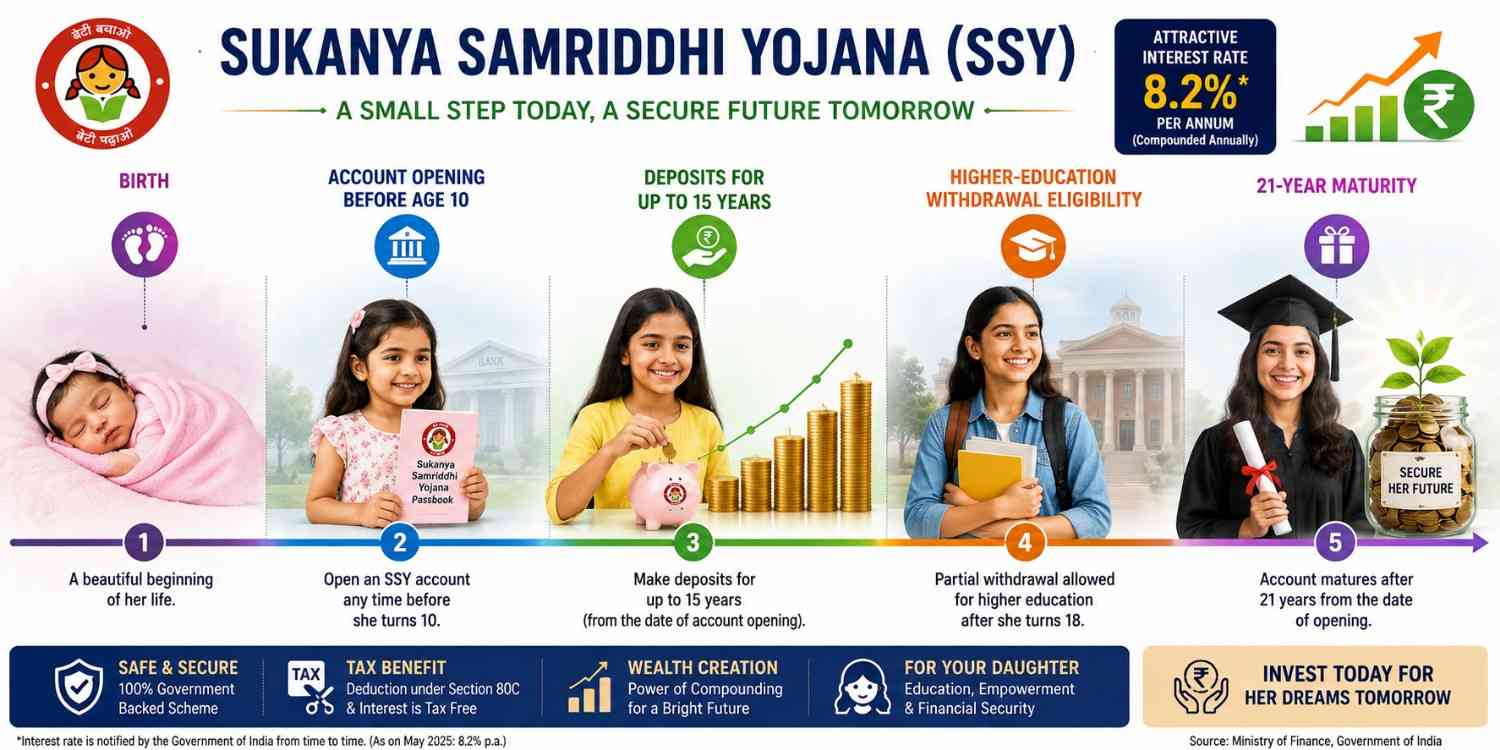
7.1 When does SSY mature?
An SSY account generally matures 21 years from the date of opening.
The maturity date is therefore account-specific.
For example, an account opened when a daughter is very young may mature considerably later than her 18th birthday.
7.2 What happens after the 15-year deposit period?
The end of the deposit period does not mean the account immediately matures.
Deposits may stop after the permitted contribution period, but the account can continue until its maturity date while earning the applicable interest according to the rules.
This is one of the most important features parents should understand before planning withdrawals.
7.3 Why the maturity period matters
SSY works best when the financial goal is genuinely long term.
If parents expect to need the entire investment within a few years, the scheme's long maturity structure may not match their objective.
The psychological strength of SSY is precisely its long horizon: money earmarked for a daughter's future is less likely to be spent impulsively.
How to Open a Sukanya Samriddhi Account
8.1 Where can you open an SSY account?
An SSY account can be opened at an eligible post office and through eligible banks offering the scheme. India Post states that the account can be opened at any post office.
The process generally involves submitting the prescribed account-opening form and supporting KYC and age documents.
8.2 Documents generally required
The exact documentation can depend on the institution, but commonly required documents include:
- Girl child's birth certificate
- Guardian's KYC documents
- Identity and address proof
- PAN or other applicable KYC information
- Recent photograph, where required
- Prescribed SSY account-opening form
India Post's current account-opening material specifically identifies proof of date of birth or a birth certificate as mandatory for an SSY account.
8.3 Account-opening process
The basic process is straightforward:
- Visit an eligible post office or participating bank.
- Obtain the SSY account-opening form.
- Enter the girl child's and guardian's details.
- Submit the required KYC and birth documents.
- Make the initial deposit.
- Complete the account-opening formalities.
- Keep the account details and deposit records safely.
India Post also provides account-opening forms through its official forms section.
Key Benefits and Limitations of SSY
9.1 Major benefits
The main advantages of Sukanya Samriddhi Yojana include:
- Government-backed small-savings structure
- Current interest rate of 8.2% per annum
- Annual compounding
- Flexible annual deposits between the prescribed minimum and maximum
- Section 80C tax benefit, subject to applicable rules
- Tax-exempt interest under the scheme's stated tax treatment
- Partial withdrawal facility for eligible higher-education needs
- Long-term maturity structure
- Dedicated savings specifically for a girl child's future
India Post currently lists the 8.2% rate and the ₹250 to ₹1.5 lakh annual contribution range.
9.2 Limitations to understand
SSY is not designed to replace an emergency fund or short-term savings account.
Its long tenure can also become a disadvantage if your financial goals change.
Parents should also remember that the interest rate can be revised periodically. Therefore, today's 8.2% should not be projected as a guaranteed rate for the complete 21-year period.
9.3 Who may find SSY suitable?
SSY can be particularly suitable for parents who:
- Have an eligible daughter below 10 years of age.
- Want a dedicated long-term savings vehicle.
- Can leave the money invested for many years.
- Want to use applicable tax benefits.
- Are comfortable with government-set interest rates.
- Are saving primarily for education or another long-term objective.
Common Mistakes to Avoid With SSY
10.1 Treating 8.2% as permanently guaranteed
The most common misunderstanding is assuming that the current interest rate will remain unchanged until maturity.
Small-savings rates can be revised periodically. The government determines the applicable rate for each period.
10.2 Confusing the deposit period with maturity
A parent may incorrectly assume that contributions continue for 21 years.
In general, deposits are permitted for up to 15 years from account opening, while maturity occurs after 21 years from opening.
10.3 Ignoring the annual contribution limit
Depositing more than the permitted annual ceiling does not create an additional SSY benefit.
Track contributions throughout the financial year so you do not accidentally exceed the ₹1.5 lakh limit.
10.4 Assuming the entire balance can be withdrawn at 18
SSY has specific partial-withdrawal rules. Reaching adulthood does not automatically make the complete corpus freely withdrawable.
10.5 Choosing SSY without considering the goal
A high headline rate can be psychologically attractive, but the investment must match the timeline.
If you need money soon, locking it into a long-term structure may create unnecessary financial pressure.
FAQ
Is Sukanya Samriddhi Yojana interest rate 8.2% in 2026?
Yes. India Post currently lists the Sukanya Samriddhi Account interest rate at 8.2% per annum, calculated yearly and compounded annually. The government can revise small-savings rates periodically.
What is the maximum SSY deposit in one year?
The maximum permitted deposit is ₹1.5 lakh in a financial year. The minimum annual deposit is ₹250.
Can parents deposit money every month?
Yes, deposits can be made during the year, but monthly deposits are not compulsory. Parents can structure contributions around their cash flow while staying within the annual limits.
At what age can an SSY account be opened?
The account can be opened for a girl child who is below 10 years of age. A parent or legal guardian opens it on her behalf.
How long does SSY take to mature?
The account generally matures 21 years from its date of opening. This is different from the contribution period, which is generally limited to 15 years.
Can money be withdrawn from SSY before maturity?
Yes, but only under specified conditions. Partial withdrawal can be permitted for higher education, with the permitted amount generally capped at 50% of the relevant balance under the scheme rules.
Is SSY interest taxable?
India Post states that interest earned in the SSY account is exempt from income tax. Contributions may also qualify for Section 80C benefits, subject to applicable tax provisions.
Is Sukanya Samriddhi Yojana better than every other investment?
Not necessarily. SSY is designed for a specific purpose and long investment horizon. Its suitability depends on your daughter's age, financial goals, liquidity requirements, tax situation and overall investment strategy.
Can an SSY account be closed before 21 years?
Premature closure is possible in specified circumstances, including eligible marriage-related closure and other situations covered by the scheme rules. The conditions should be checked before requesting closure.
Conclusion
Sukanya Samriddhi Yojana can be a powerful long-term savings tool for parents planning their daughter's financial future. With the current 8.2% annual interest rate, ₹1.5 lakh annual contribution ceiling, long compounding period and tax advantages, it offers a compelling structure for disciplined savings.
The key is to understand what SSY is designed to do. It is not an emergency fund or a short-term investment. It is a purpose-driven, long-term savings account where patience can become one of the biggest advantages.
Before opening or contributing to an SSY account, verify the latest government interest rate and applicable tax rules. Small-savings rates can change, while individual tax treatment depends on current law.



Write a comment