
Emergency Fund Planning: How Much Money Should Every Indian Family Save?
An emergency fund is not money that sits idle. It is the financial buffer that protects your family when life suddenly becomes expensive.
A job loss, medical bill, major home repair, unexpected travel, business slowdown, or urgent family responsibility can disrupt even a well-planned budget. Without cash reserves, families often turn to credit cards, personal loans, gold loans, or investments that were never meant to be withdrawn early.
For most Indian families, a sensible starting point is to build an emergency fund covering at least three months of essential living expenses. If your income is unstable, you are self-employed, have a single earning member, or support several dependants, six months or more can be more appropriate. The Reserve Bank of India’s financial education material similarly recommends at least three months of living expenses, with six months or more for people with less secure income.
The important point is that there is no universal rupee amount. Your ideal emergency fund depends on your monthly expenses, income stability, family responsibilities, debt, insurance coverage, and how quickly you could replace your income.
What Is an Emergency Fund and Why Does It Matter?
An emergency fund is a dedicated pool of easily accessible money reserved for genuine financial emergencies.
It is different from your normal savings account, vacation fund, investment portfolio, or money earmarked for a future purchase. Its primary purpose is financial protection, not wealth creation.
What Counts as a Financial Emergency?
Good examples include:
- Sudden job loss or loss of income
- Unexpected medical expenses not covered by insurance
- Major home or vehicle repairs
- Emergency family travel
- Urgent education or caregiving expenses
- Temporary business income disruption
- Essential expenses during a financial crisis
A new smartphone, weekend trip, expensive restaurant bill, or an impulsive purchase generally does not qualify.
This distinction matters because an emergency fund becomes useful only when you protect it from ordinary spending.
Why Indian Families Need a Larger Safety Cushion
Indian households can have financial responsibilities that extend beyond the immediate nuclear family.
Parents may depend on their children. Families may contribute toward education, healthcare, weddings, rent, home loans, or other obligations. A household may also have one primary income earner.
That means a six-month emergency fund can be much more valuable for one family than a three-month reserve would be for another.
The goal is not to accumulate the largest possible cash balance. The goal is to create enough financial breathing room to make sensible decisions when income or expenses suddenly change.
How Much Emergency Fund Should an Indian Family Have?
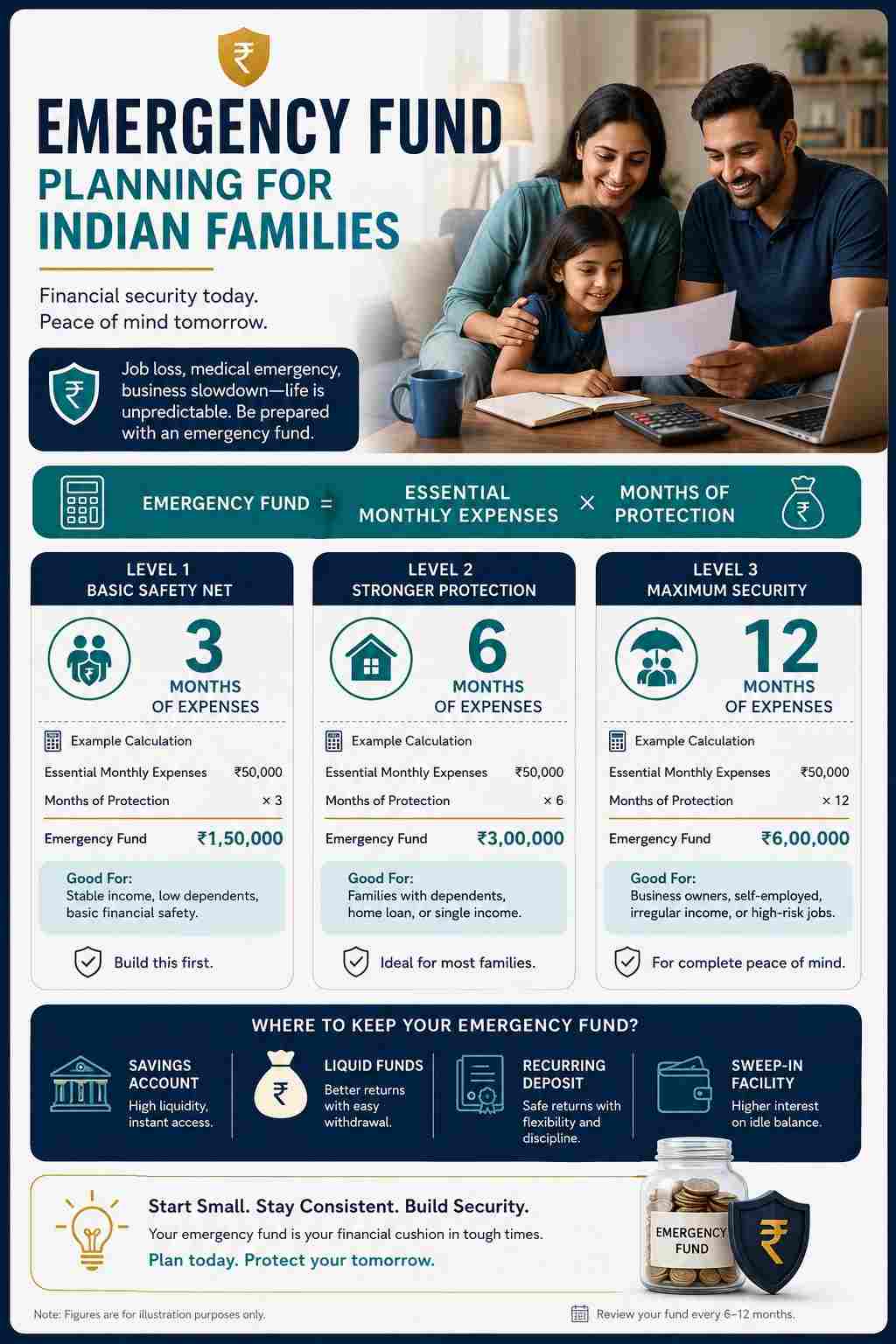
The simplest calculation is:
Emergency Fund = Essential Monthly Expenses × Number of Months of Coverage
For example, suppose a family spends ₹50,000 each month on essential expenses.
A three-month fund would be:
₹50,000 × 3 = ₹1.5 lakh
A six-month fund would be:
₹50,000 × 6 = ₹3 lakh
A nine-month reserve would be:
₹50,000 × 9 = ₹4.5 lakh
The right target depends on the family's risk profile.
Three Months of Expenses
Three months can be a reasonable starting target for households with:
- Stable salaried employment
- Two earning members
- Strong health insurance
- Low debt obligations
- Predictable monthly expenses
- Good employability
It should be viewed as a baseline rather than a rigid rule.
Six Months of Expenses
Six months is more appropriate when:
- One person provides most of the household income
- Employment is uncertain
- You work in a cyclical industry
- You are self-employed
- Your family has children or dependants
- You have substantial EMI commitments
- Replacing your income could take several months
Nine to Twelve Months
A larger reserve may make sense for:
- Business owners
- Freelancers
- Commission-based workers
- People with highly irregular income
- Families dependent on one income
- Households with significant medical or caregiving responsibilities
- People approaching retirement without reliable monthly income
However, holding an unnecessarily large amount entirely in cash also has a cost because inflation reduces purchasing power over time.
The objective is to balance liquidity, safety, and reasonable returns.
How to Calculate Your Emergency Fund Correctly
One of the most common mistakes is calculating the emergency fund using total monthly spending.
Instead, separate essential expenses from discretionary expenses.
Step 1: Calculate Essential Monthly Expenses
Include expenses that your family would still need during a financial crisis:
- Rent or essential home costs
- Groceries
- Electricity and utilities
- School or essential education expenses
- Insurance premiums
- Medicines and essential healthcare
- Transportation
- Home-loan or other unavoidable EMIs
- Basic phone and internet costs
- Essential family support
Do not automatically include:
- Dining out
- Holidays
- Entertainment
- Luxury shopping
- Non-essential subscriptions
- Expensive hobbies
- Planned investments
The question is simple:
"If my income stopped tomorrow, what would my family absolutely need to keep paying?"
That number is your emergency monthly burn rate.
Step 2: Multiply by Your Risk Level
Use your essential monthly expense figure and choose an appropriate coverage period.
| Family Situation | Suggested Starting Range |
|---|---|
| Stable dual-income household | 3–6 months |
| Single-income salaried family | 6–9 months |
| Self-employed household | 6–12 months |
| Highly variable income | 9–12 months |
| Major dependants or uncertain income | 9–12 months |
These are planning ranges, not financial laws. Your circumstances should determine the final target.
Step 3: Add a Small Extra Buffer
Suppose essential expenses are ₹45,000 per month and you choose six months.
Your basic target is:
₹45,000 × 6 = ₹2.7 lakh
Instead of stopping exactly there, you might set a practical target of around ₹3 lakh.
That extra margin can help absorb an unexpected bill or temporary increase in expenses.
Where Should You Keep an Emergency Fund?
The emergency fund should prioritize safety and accessibility, not maximum returns.
The RBI recommends keeping an emergency fund in a separate savings account that is easily accessible.
Separate Savings Account
For the first layer of your emergency fund, a separate savings account is often the simplest choice.
Keeping the money separate from your everyday account reduces the temptation to spend it.
You can also create an automatic monthly transfer immediately after receiving your salary.
For example:
Salary received → Emergency-fund transfer → Bills and investments → Discretionary spending
This turns saving into a system rather than a decision you have to make every month.
Fixed Deposits
Fixed deposits can be useful for a portion of an emergency reserve, especially when you already have enough immediately accessible cash.
However, do not lock the entire emergency fund away.
An emergency can happen on a weekend, during a bank holiday, or at exactly the wrong moment. Accessibility matters.
Also remember that deposit insurance has limits. DICGC currently insures eligible bank deposits up to ₹5 lakh per depositor per bank, including principal and accrued interest, subject to its rules. Deposits held in different branches of the same bank are aggregated for this purpose.
Therefore, families with larger cash reserves should understand how their deposits are structured rather than assuming that every rupee in every account has separate insurance coverage.
Liquid and Overnight Mutual Funds
Some investors consider liquid or overnight mutual funds for part of their short-term reserve.
These funds are designed around short-duration instruments and liquidity, but they are still mutual funds, not bank deposits. They are therefore not covered by DICGC deposit insurance. SEBI describes money-market and liquid funds as vehicles intended for short-term parking of surplus money, while AMFI notes that liquid and overnight fund redemptions are generally processed quickly.
For that reason, they should not automatically replace a readily accessible bank balance.
If you use them, understand the product, risks, redemption process, taxation, and the distinction between liquidity and guaranteed capital.
A Practical Three-Layer Emergency Fund Strategy
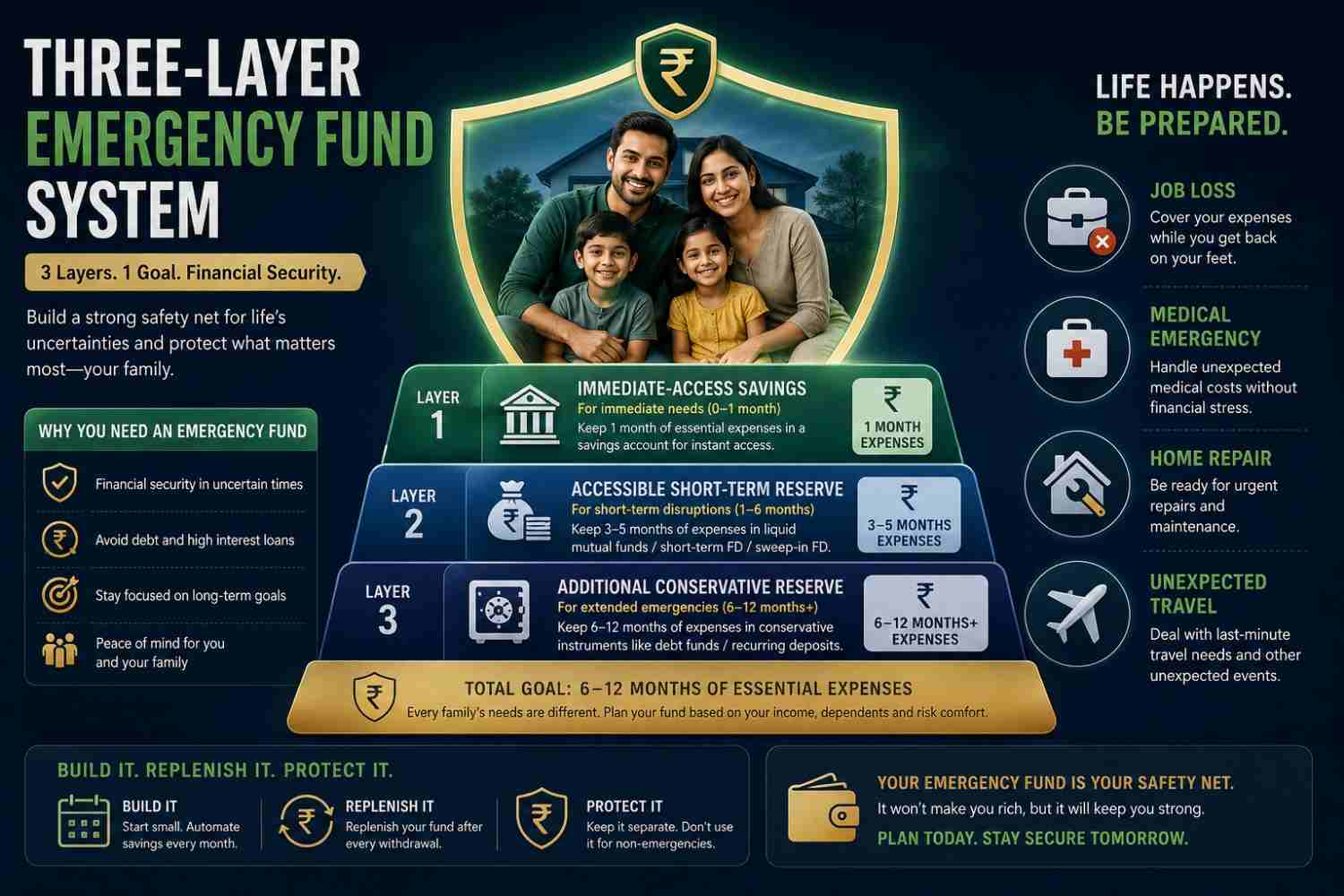
Instead of keeping the entire emergency fund in one place, many families can think in layers.
Layer One: Immediate Cash
Keep enough money in a separate savings account for expenses that may need to be paid immediately.
This could cover one month of essential expenses or a smaller amount based on your circumstances.
Layer Two: Accessible Short-Term Reserve
The next portion can remain in highly liquid, relatively low-risk instruments that you understand and can access without unnecessary complications.
The exact choice depends on your financial situation and comfort with the product.
Layer Three: Additional Safety Reserve
For households targeting six to twelve months of expenses, the remaining amount can be structured conservatively with accessibility still in mind.
The key principle is simple:
Do not sacrifice emergency access merely to chase a slightly higher return.
An emergency fund has a different job from a long-term investment portfolio.
How to Build an Emergency Fund From Zero
If you currently have no emergency savings, a ₹3 lakh or ₹5 lakh target can look overwhelming.
Do not let the final number stop you from starting.
Start With the First ₹10,000
Your first goal can simply be ₹10,000.
Then build toward one month of essential expenses.
Once that is complete, work toward three months and eventually your full target.
This creates psychological momentum and gives your household some protection while you continue building.
Automate Your Savings
Set up an automatic transfer on payday.
For example, if you can save ₹8,000 every month:
- ₹8,000 × 12 = ₹96,000 per year
- ₹8,000 × 24 = ₹1.92 lakh
- ₹8,000 × 36 = ₹2.88 lakh
The important factor is consistency.
If your income increases, increase the emergency-fund contribution until you reach the target.
Use Windfalls Strategically
Bonuses, tax refunds, gifts, incentives, freelance income, or other unexpected money can accelerate the process.
You do not necessarily have to put the entire amount into your emergency fund. Even allocating 25–50% of a windfall can significantly shorten the time needed to reach your target.
Common Emergency Fund Mistakes to Avoid
Building an emergency fund is only half the job. You also need to avoid weakening it.
Mistake 1: Keeping Everything in Cash at Home
Physical cash has a role for immediate contingencies, but storing a large emergency fund at home creates risks such as theft, loss, and lack of earning potential.
Keep only a sensible amount for immediate needs.
Mistake 2: Investing the Emergency Fund in Equity
Equity investments are designed for long-term wealth creation, not guaranteed short-term availability.
A market downturn can happen precisely when you lose your job.
Selling investments during a fall can turn a temporary emergency into a permanent investment loss.
Mistake 3: Counting Credit Cards as an Emergency Fund
A credit card is a borrowing facility, not savings.
If you lose your income and then rely on expensive revolving credit, the emergency can quickly become a debt problem.
Mistake 4: Ignoring Insurance
An emergency fund should work alongside insurance.
Health insurance can reduce the financial impact of hospitalization. Adequate life insurance can protect dependants from the loss of an earning member.
Without appropriate insurance, your emergency fund may be forced to absorb expenses that could otherwise have been transferred to an insurance policy.
Mistake 5: Never Recalculating the Target
Your emergency fund should change when your life changes.
Recalculate it after:
- Marriage
- Having children
- Buying a house
- Taking a major loan
- Changing jobs
- Starting a business
- Supporting parents
- Moving to a higher-cost city
- Experiencing a significant income change
A ₹2 lakh emergency fund may have been adequate five years ago but insufficient today.
Should You Build an Emergency Fund Before Investing?
For most households, having a basic emergency reserve before aggressively investing is sensible.
There is little benefit in investing every spare rupee while simultaneously having no money available for an unexpected expense.
A practical order can be:
Basic emergency reserve → adequate insurance → high-cost debt management → full emergency fund → long-term investing
This does not mean you must stop every investment until the emergency fund is complete. Someone who has an employer retirement contribution or an established investment habit may continue it while gradually building the reserve.
The right balance depends on income, debt, dependants, and existing savings.
What If You Already Have Debt?
Debt changes the calculation.
If you have high-interest credit-card debt, building an enormous emergency fund while continuing to pay very high interest may not be efficient.
A reasonable approach is often to create a starter emergency buffer first, then aggressively address expensive debt while continuing to build your full emergency reserve.
For example:
₹25,000 starter emergency fund → tackle high-interest debt → rebuild toward 3–6 months
Do not empty your account completely to repay debt, because having zero liquidity can force you to borrow again after the next unexpected expense.
When Should You Use Your Emergency Fund?
A good test is:
Is this expense unexpected, necessary, and difficult to handle from my normal monthly cash flow?
If the answer is yes, using the emergency fund may be appropriate.
Examples:
- Job loss
- Emergency medical expense
- Critical home repair
- Essential vehicle repair needed for work
- Urgent family travel
- Sudden income interruption
After using it, make rebuilding the fund a priority.
An emergency fund is not a trophy balance that must never be touched. It is insurance in the form of accessible savings.
FAQ
How much emergency fund should a family have in India?
A useful starting point is three months of essential living expenses. Families with unstable income, one primary earner, significant dependants, or business income may want six to twelve months. The RBI's financial education material recommends at least three months and suggests six months or more when income is less secure.
Is ₹1 lakh enough for an emergency fund?
It depends on your essential monthly expenses. If a family needs ₹50,000 per month, ₹1 lakh represents only two months of essential expenses. For another household spending ₹20,000, it could cover five months.
The number should therefore be based on expenses rather than an arbitrary rupee target.
Should I keep my emergency fund in a savings account?
A separate savings account is one of the simplest options because the money is accessible. The RBI specifically recommends a separate, easily accessible savings account for an emergency fund.
Is an FD good for an emergency fund?
An FD can be useful for part of the reserve, but keeping the entire emergency fund locked away can reduce accessibility. Make sure you understand premature-withdrawal rules and keep enough money immediately available.
Should emergency savings be invested in mutual funds?
Some investors use liquid or overnight mutual funds for short-term reserves, but they are not the same as bank deposits and do not carry DICGC deposit insurance. They should only be considered after understanding liquidity, market, credit, taxation, and redemption considerations.
How much should a single-income family save?
A single-income household generally has greater income-replacement risk. Six to nine months of essential expenses can be a sensible planning range, with a larger reserve potentially appropriate when finding replacement income could take longer.
Should I include EMIs in emergency fund calculations?
If an EMI is essential and cannot realistically be stopped during a financial crisis, include it. Your emergency fund should reflect the expenses you would still have to pay if income suddenly stopped.
Can I use my emergency fund for a planned vacation?
Generally, no. Planned expenses should have separate savings goals. Using emergency savings for predictable spending weakens the protection the fund is supposed to provide.
How often should I review my emergency fund?
Review it at least once a year and whenever your income, household size, rent, debt, insurance, or essential expenses change significantly.
Conclusion
The right emergency fund for an Indian family is not a magic number such as ₹1 lakh, ₹5 lakh, or ₹10 lakh. It is a number built around your family's essential monthly expenses and financial risk.
Start by calculating what your household genuinely needs to survive each month. Multiply that figure by three months if your income is stable, and consider six to twelve months if your income is uncertain or your family carries greater financial responsibilities.
Keep the first layer accessible and safe. Do not confuse an emergency fund with a long-term investment portfolio. And remember that bank-deposit protection has limits: DICGC currently covers eligible deposits up to ₹5 lakh per depositor per bank under its applicable rules.
Most importantly, do not wait until you can save the "perfect" amount.
Build the first ₹10,000. Then one month of expenses. Then three months. Keep going until your household has a reserve that allows you to face an unexpected financial shock without immediately turning to expensive debt.
That is the real purpose of emergency fund planning: not to make you richer overnight, but to make your family financially harder to destabilize.



Write a comment