If you have ever transferred money online in India, you must have come across something called an IFSC code. It looks like a short combination of letters and numbers, yet it plays a critical role in banking transactions. Without it, digital fund transfers would simply not work.
This article explains what an IFSC code is, its meaning, format, uses, and real-world examples. By the end, you will clearly understand why IFSC codes are essential and how to use them correctly in everyday banking.
Introduction to IFSC Code
The IFSC Code is a unique identifier used to recognize individual bank branches in India. It ensures that money transfers reach the correct bank and branch without errors.
In simple terms, an IFSC code works like a digital address for a bank branch. Whether you are sending money to a friend or paying a business, the IFSC code tells the banking system exactly where the funds should go.
What Is IFSC Code?
When you transfer money from one Indian bank account to another, your account number alone is not always enough. The banking system also needs to identify the exact bank branch where the recipient's account is maintained. That is where the IFSC Code comes in.
IFSC stands for Indian Financial System Code. It is an 11-character alphanumeric code used to identify a specific bank branch for electronic fund transfers in India. The Reserve Bank of India (RBI) uses IFSC as an important identifier in electronic payment systems, while RBI guidance specifically identifies the beneficiary branch IFSC as a routing detail for NEFT transactions.
Whether you are sending money through NEFT, RTGS, or IMPS, you may be asked for the beneficiary's IFSC Code along with details such as the account number and account holder's name. Understanding the code can help you avoid entering the wrong branch details and potentially delaying a transfer.
What Is an IFSC Code?
An IFSC Code is an 11-character code assigned to a bank branch in India's electronic banking network. IFSC stands for Indian Financial System Code.
The code helps identify the bank and the particular branch associated with a customer's account. In an NEFT transaction, for example, the beneficiary branch IFSC is used to route the transaction to the correct destination. RBI has described the IFSC as a mandatory field in NEFT transactions for identifying the beneficiary branch.
Think of it as a banking address.
Your account number identifies your account within the bank, while the IFSC Code helps identify the bank branch to which the electronic payment should be routed.
An IFSC Code is different for different branches. Two branches belonging to the same bank can therefore have different IFSC Codes.
What Does IFSC Stand For?
IFSC stands for Indian Financial System Code.
It is sometimes informally called an "IFSC number," but "IFSC Code" is the standard term used by banks and payment systems.
The code is generally written in a format such as:
SBIN0000300
Here, the code identifies State Bank of India's Mumbai Main branch. The first four characters identify the bank, the fifth character is reserved, and the final six characters identify the branch.
Why Is the IFSC Code Important?
The banking system processes enormous numbers of electronic transactions every day. A standardized branch identifier makes it easier to route funds to the intended destination.
The IFSC Code helps:
- Identify the beneficiary bank.
- Identify the relevant bank branch.
- Route electronic fund transfers.
- Reduce ambiguity between branches.
- Provide standardized branch information for payment processing.
- Help customers enter the correct beneficiary details.
A small typing error can matter. If you are transferring a significant amount, checking the IFSC against the recipient's current bank records before confirming the transaction is a sensible precaution.
IFSC Code Format Explained
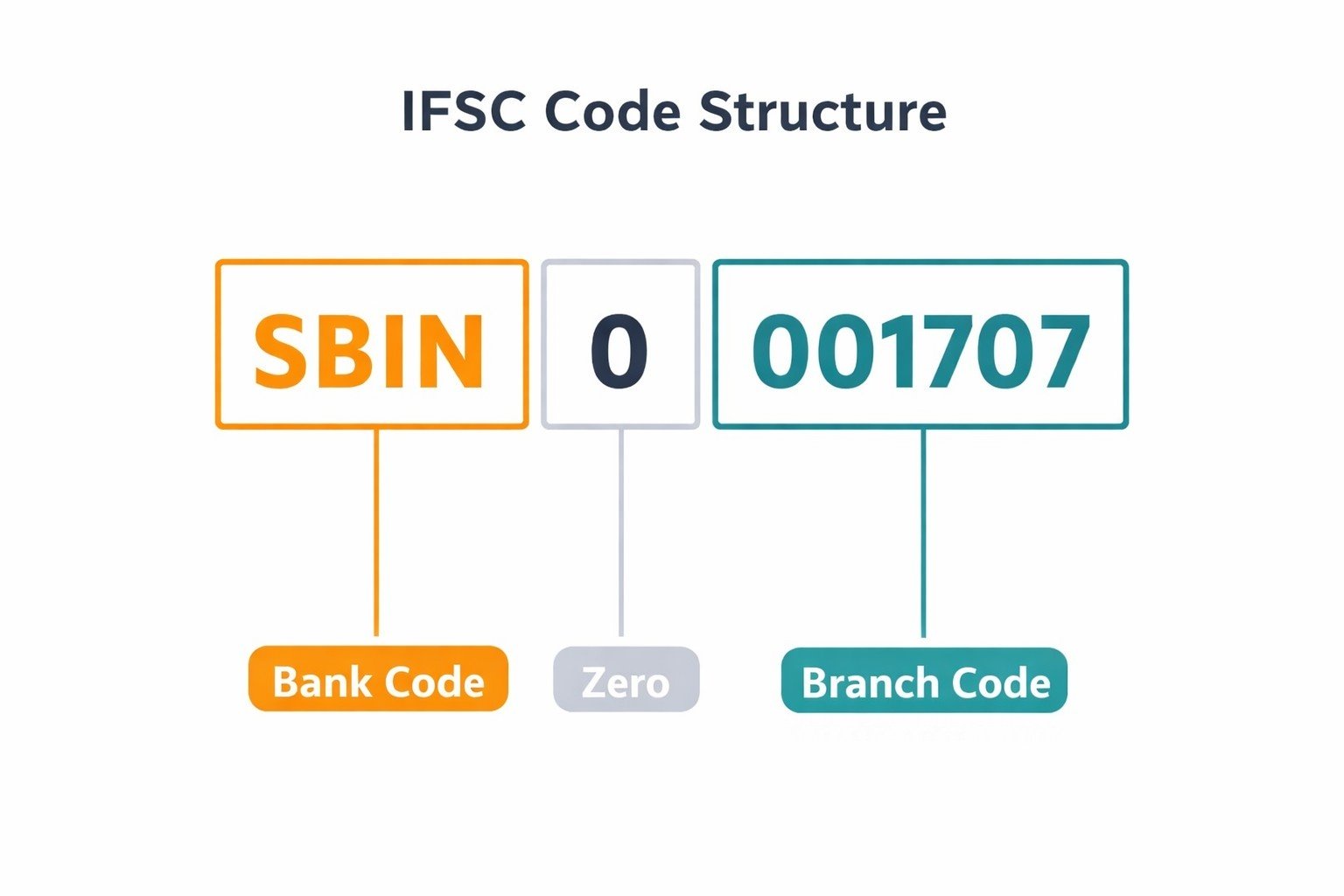
One of the easiest ways to understand an IFSC Code is to break it into sections.
A typical IFSC Code follows this structure:
AAAA0BBBBBB
For example:
SBIN0000300
| Part | Characters | Example | Meaning |
|---|---|---|---|
| Bank code | 1–4 | SBIN | Identifies the bank |
| Reserved character | 5 | 0 | Reserved for future use |
| Branch code | 6–11 | 000300 | Identifies the branch |
The first four characters are alphabetic and represent the bank identifier. The fifth character is generally 0 (zero) and is reserved for future use. The final six characters represent the branch identifier.
Example: Breaking Down SBIN0000300
Consider the IFSC Code:
SBIN0000300
It can be separated as:
SBIN | 0 | 000300
- SBIN = State Bank of India bank identifier
- 0 = reserved fifth character
- 000300 = branch identifier
The complete code is associated with State Bank of India's Mumbai Main branch.
This structure means you should not treat an IFSC Code as a random collection of letters and numbers. Each section has a specific role.
Is the Fifth Character Always Zero?
The standard IFSC structure uses the fifth character as 0, reserved for future use. This is why codes commonly appear as:
ABCD0XXXXXX
For example, both SBIN0000300 and HDFC0000001 contain zero as their fifth character.
When entering an IFSC manually, make sure you distinguish the digit 0 from the letter O.
Real IFSC Code Examples
Seeing actual codes makes the format much easier to understand.
State Bank of India
IFSC Code: SBIN0000300
This code is listed for State Bank of India's Mumbai Main branch. Its structure is:
SBIN | 0 | 000300
The bank code is SBIN, while 000300 identifies the branch.
HDFC Bank
IFSC Code: HDFC0000001
HDFC Bank's official branch information lists HDFC0000001 for its Nariman Point/Tulsiani Chambers branch in Mumbai and states that the code is used for IMPS, RTGS, and NEFT transactions.
The structure is:
HDFC | 0 | 000001
ICICI Bank
IFSC Code: ICIC0000001
This is listed for ICICI Bank's Cenotaph Road branch in Chennai.
The structure is:
ICIC | 0 | 000001
These examples demonstrate an important point: the first four characters identify the bank, but the complete 11-character code identifies the particular branch.
Never assume that every branch of the same bank has the same IFSC Code.
What Are the Uses of an IFSC Code?
The main purpose of an IFSC Code is to identify and route transactions to the appropriate bank branch within India's electronic payment infrastructure.
1. NEFT Transfers
NEFT, or National Electronic Funds Transfer, allows customers to transfer money between participating bank accounts.
RBI guidance specifically states that the beneficiary branch's IFSC is an important routing field in an NEFT transaction.
When adding a beneficiary through internet banking or mobile banking, you may therefore need:
- Beneficiary name
- Bank name
- Account number
- IFSC Code
- Other details requested by the bank
Always enter the beneficiary's current bank details rather than relying on an old IFSC Code saved from a previous transaction.
2. RTGS Transfers
RTGS stands for Real Time Gross Settlement. It is used for electronic bank-to-bank fund transfers, particularly when the transaction meets the applicable requirements of the payment system.
The beneficiary's bank and branch details, including IFSC where required by the transaction process, help the banking system route the funds correctly.
Banks may display RTGS and NEFT together when collecting beneficiary details because both systems rely on standardized banking information.
3. IMPS Transfers
IMPS, or Immediate Payment Service, is an interbank electronic fund transfer service operated within India's digital payments ecosystem.
NPCI describes IMPS as a 24x7x365 interbank fund transfer service.
Depending on the bank and transaction method, customers can use an IFSC and account number to transfer funds through IMPS.
The exact fields shown can vary between banks and payment channels, so follow the instructions displayed by your bank when initiating the transaction.
4. Other Banking Processes
IFSC information can also appear in various electronic banking and institutional payment processes. NPCI documentation identifies IFSC as an addressing code used in financial messaging and payment-system processes.
This is why IFSC Codes are commonly found on banking forms, account documents, payment instructions, and online banking interfaces.
How to Find Your Bank's IFSC Code
Finding an IFSC Code is usually straightforward, but the most important thing is finding the correct code for the correct branch.
Check Your Cheque Book
Many bank cheque leaves contain important account information, including the IFSC Code.
If you have a cheque book issued for the relevant account, look for the IFSC information printed on the cheque.
Check Your Passbook
Your bank passbook may display:
- Account number
- Branch name
- Bank name
- IFSC Code
- MICR Code
- Other account information
The exact layout depends on the bank.
Use Your Bank's Official Website
Most banks provide a branch locator or IFSC search facility on their official website.
This is one of the better ways to verify a code, particularly if you are unsure whether an old IFSC Code is still valid.
Check the RBI's IFSC Information
The RBI provides banking and IFSC-related information through its official resources. The RBI website includes an IFSC/MICR Codes section among its banking resources.
For an important transaction, cross-checking the code rather than relying solely on an unfamiliar third-party website is a good practice.
IFSC Code vs MICR Code
IFSC and MICR are often confused because both can appear on a cheque, but they serve different purposes.
| Feature | IFSC Code | MICR Code |
| Full form | Indian Financial System Code | Magnetic Ink Character Recognition |
| Typical length | 11 characters | 9 digits |
| Main purpose | Electronic fund transfer and branch identification | Cheque processing and clearing |
| Format | Alphanumeric | Numeric |
| Commonly associated with | NEFT, RTGS, IMPS | Cheque processing |
The simplest distinction is this:
IFSC is primarily associated with electronic fund transfers, while MICR is associated with cheque processing.
For example, the IFSC SBIN0000300 and MICR 400002010 can belong to the same SBI branch, but they are different codes serving different purposes.
IFSC Code vs Account Number
Another common misunderstanding is assuming that an IFSC Code identifies a person's bank account.
It does not.
The two pieces of information serve different purposes:
IFSC Code: identifies the relevant bank branch.
Account Number: identifies the customer's account within the banking system.
For many electronic transfers, both are required because the payment system needs to know where the account is held and which account should receive the money.
For example, imagine you want to transfer money to a friend. Their account number tells the bank which account to credit, while the IFSC helps identify the bank branch associated with that account.
How to Use an IFSC Code for Online Banking
The exact steps vary between banks, but the process usually follows a familiar pattern.
1. Add the Beneficiary
Open your bank's internet banking or mobile banking service and select the option to add a new beneficiary or payee.
2. Enter Bank Details
You may be asked for:
- Beneficiary name
- Account number
- Bank name
- IFSC Code
- Account type or other information
3. Verify the Details
Check every character carefully.
Pay particular attention to:
- Similar-looking characters
- Zero versus letter O
- The first four bank characters
- The final six branch characters
4. Select the Transfer Method
Depending on the bank and transaction, choose NEFT, RTGS, or IMPS.
5. Confirm the Transaction
Before authorizing the payment, review the beneficiary information and amount carefully.
A correct IFSC does not replace the need to verify the account number and beneficiary details.
Common Mistakes When Entering an IFSC Code
An IFSC Code may look simple, but small mistakes can cause problems.
Using the Wrong Branch Code
Two branches of the same bank can have different IFSC Codes. Never copy the code from another branch simply because the bank name is the same.
Confusing Zero With O
The fifth character in the standard format is 0, the number zero.
Typing O instead can make the code invalid.
Using an Old IFSC Code
Banks can reorganize, merge, relocate, or change branch details. A code saved years ago should not automatically be assumed to be current.
For important transfers, verify it through the bank or an authoritative banking source.
Checking Only the Bank Name
Knowing that the recipient uses SBI, HDFC Bank, ICICI Bank, or another institution is not enough.
The branch-specific IFSC matters.
Copying Without Verification
Copy-and-paste reduces typing mistakes, but it does not guarantee that the information itself is correct.
Always compare the code with the beneficiary's current bank details before transferring money.
Does Every Bank Account Have an IFSC Code?
For accounts maintained at branches participating in the relevant electronic fund-transfer infrastructure, the associated branch has an IFSC Code.
However, the code belongs to the bank branch, not uniquely to the individual customer.
That means multiple customers maintaining accounts at the same branch can have the same IFSC Code while having completely different account numbers.
This is an important distinction when filling out online transfer forms.
Is IFSC Code Required for UPI?
UPI is designed to simplify payments, so users generally do not need to manually enter an IFSC Code when making a typical UPI payment.
Instead, UPI uses identifiers such as a UPI ID or QR code, depending on the transaction.
NPCI describes UPI as an interoperable payment architecture designed to simplify digital payments across participating banks and applications.
That does not make IFSC obsolete. IFSC remains important in traditional bank-account-based electronic transfers and many banking workflows.
A useful rule is:
UPI payment → usually no manual IFSC entry.
Bank-account transfer through NEFT/RTGS/IMPS → IFSC may be required, depending on the method and bank.
Is IFSC Code the Same as SWIFT Code?
No. IFSC and SWIFT are different codes used for different payment environments.
IFSC is used within India's banking and electronic payment infrastructure to identify Indian bank branches.
SWIFT/BIC codes are used for international banking communications and cross-border transactions.
If you are receiving money from another country, the sender may need international banking details that are different from the IFSC Code. The exact requirements depend on the banks, currencies, and transaction route involved.
What Happens If You Enter the Wrong IFSC Code?
The outcome depends on the incorrect code and the bank's validation and processing systems.
A clearly invalid code may cause the transaction to fail or be rejected. A valid IFSC belonging to a different branch can be more concerning because the payment information may point to an unintended destination.
This is why you should verify the account number, beneficiary name, bank, and IFSC Code together before authorizing a transfer.
If you discover an error after submitting a transaction, contact your bank promptly and follow its procedure for reporting or attempting to resolve the transaction.
How to Check an IFSC Code Before Sending Money
Use this quick verification method:
- Confirm the bank name.
- Confirm the branch name and location.
- Confirm the 11-character IFSC Code.
- Make sure the fifth character is the digit 0 where applicable.
- Check the account number separately.
- Compare the information with the recipient's latest bank document or official bank source.
- Review everything again before authorizing the transfer.
For large-value transactions, taking an extra minute to verify the details is far better than trying to resolve a payment sent with incorrect information.
FAQ
What is an IFSC Code?
IFSC stands for Indian Financial System Code. It is an 11-character code used to identify a bank branch for electronic fund-transfer and banking processes in India.
How many digits are in an IFSC Code?
An IFSC Code has 11 characters, not simply 11 digits. The first four are generally letters, the fifth is 0, and the last six identify the branch.
What does the first four characters of an IFSC Code mean?
The first four characters identify the bank. For example, SBIN represents State Bank of India in the example SBIN0000300.
What does the fifth character of an IFSC Code mean?
The fifth character is generally 0 (zero) and is reserved for future use.
What do the last six characters of an IFSC Code represent?
The final six characters identify the particular bank branch associated with the IFSC Code.
Is IFSC required for NEFT?
The beneficiary branch IFSC is an important routing field for NEFT transactions. RBI guidance identifies the beneficiary branch IFSC as a mandatory field for NEFT processing.
Is IFSC required for RTGS?
Banks generally use beneficiary bank and branch information, including IFSC, when processing RTGS transfers. The exact information requested can depend on the bank's interface and transaction process.
Is IFSC required for IMPS?
IFSC can be used for account-based IMPS transfers. However, the exact details required can vary according to the bank and the IMPS transaction method.
Where can I find my IFSC Code?
You can usually find it on your cheque book, passbook, bank statement, banking app, or your bank's official website. You can also verify IFSC information through RBI resources.
Can two branches have the same IFSC Code?
A branch-specific IFSC is intended to identify the relevant branch, so different branches generally have different IFSC Codes. Do not assume that one branch's code applies to another branch of the same bank.
Is IFSC Code the same as MICR Code?
No. IFSC is an 11-character alphanumeric code primarily used for electronic banking and fund-transfer routing, while MICR is a 9-digit code associated with cheque processing.
Is IFSC Code needed for UPI?
Usually, you do not need to manually enter an IFSC Code for a normal UPI payment. UPI commonly uses a UPI ID, QR code, or other UPI-specific identifier.
Conclusion
An IFSC Code is essentially a standardized address for identifying a bank branch in India's electronic banking system. Its 11-character structure contains a bank identifier, a reserved fifth character, and a branch identifier.
Understanding the format makes codes such as SBIN0000300, HDFC0000001, and ICIC0000001 much easier to interpret. More importantly, knowing how IFSC works helps you enter the right information when making NEFT, RTGS, or IMPS transfers.
Before sending money, don't check only the IFSC. Verify the beneficiary name, account number, bank, branch, and current IFSC Code together. That simple habit can prevent avoidable payment errors.
Sources and further verification
For authoritative banking information, use the Reserve Bank of India and National Payments Corporation of India resources. RBI guidance confirms the role of IFSC in NEFT routing, while NPCI documentation describes IFSC as an addressing code used in financial messaging and payment processes.


Write a comment