
Fixed deposits continue to remain one of India's most preferred investment options for investors seeking guaranteed returns and capital protection. With interest rates stabilizing after recent RBI policy decisions, several banks—particularly small finance banks—are offering attractive FD returns exceeding 8% annually.
Whether you're a conservative investor, a retiree seeking regular income, or someone looking to diversify your portfolio, comparing FD rates across banks can significantly improve your returns. This guide covers the latest FD interest rates available in August 2026, helping you make an informed investment decision.
Highest Fixed Deposit Interest Rates in India – August 2026
1. Why FD Interest Rates Matter in 2026
Fixed deposit rates have become increasingly competitive as banks attempt to attract stable deposits. While large public and private banks prioritize safety and brand trust, small finance banks often offer substantially higher returns to attract customers.
1.1 Benefits of Choosing the Right FD
- Higher guaranteed returns
- Capital protection
- Flexible tenure options
- Additional senior citizen benefits
- Predictable income planning
- Loan facility against FD
1.2 Current Interest Rate Environment
In 2026, the fixed deposit (FD) interest-rate environment has become more stable after the RBI’s key policy rates remained broadly unchanged. As a result, many major banks have kept their standard FD rates relatively steady, while some banks continue to adjust rates on specific tenures to attract fresh deposits.
For investors, this means that comparing FD rates is still important. A small difference in interest rates can have a noticeable impact on returns, particularly when investing a large amount or choosing a longer tenure. Special-tenure FDs may also offer higher rates than a bank’s regular deposits, but these offers can be available only for a limited period.
Small finance banks continue to deserve attention because they may offer higher FD rates than many large banks. However, investors should evaluate the interest rate alongside factors such as deposit insurance coverage, premature-withdrawal rules, tenure, and the bank’s overall financial profile. The highest advertised rate is not always the best choice for every investor.
Highest FD Interest Rates Offered by Small Finance Banks
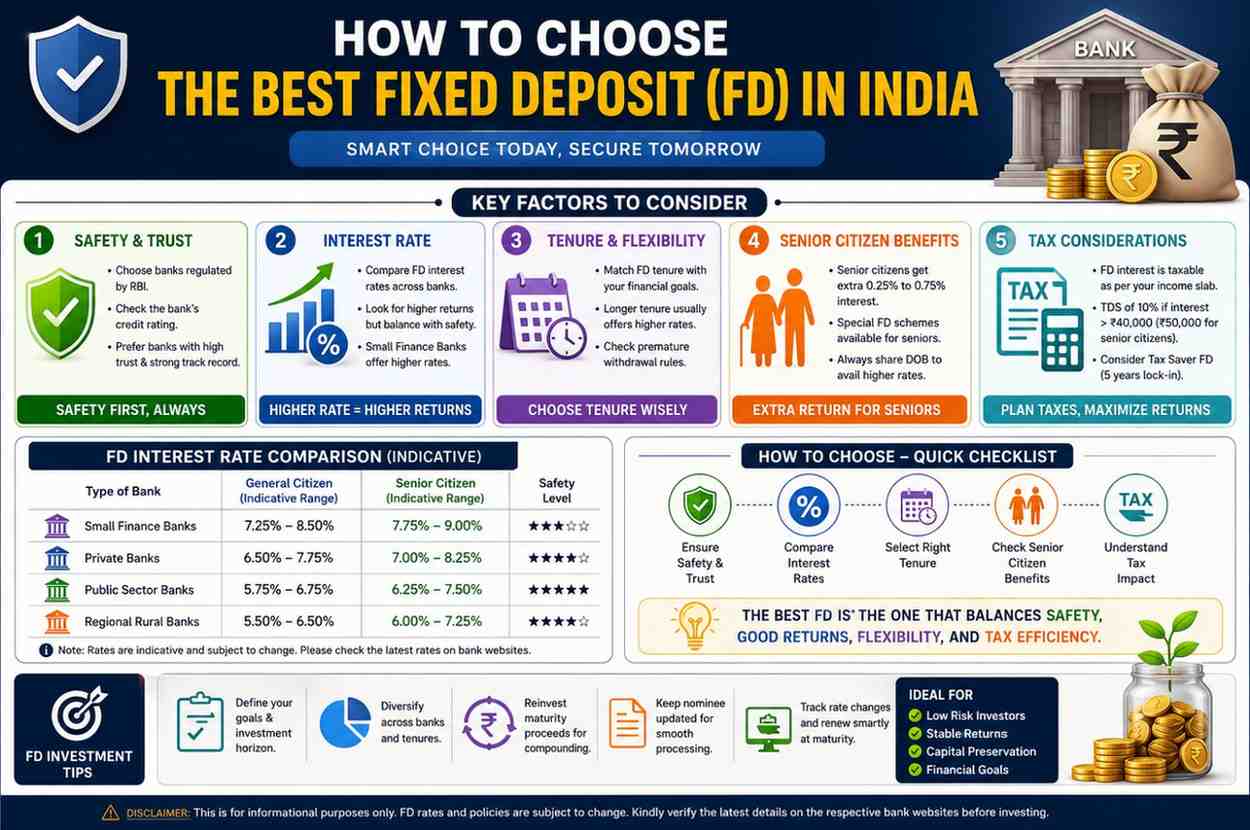
Small finance banks currently offer the highest FD returns in India.
1. Northeast Small Finance Bank
| Category | Interest Rate | Best Tenure |
|---|---|---|
| General Citizens | Up to 9.00% | 3 Years |
| Senior Citizens | Up to 9.50% | 3 Years |
Northeast Small Finance Bank currently offers one of the highest FD rates available in the banking sector.
2. Suryoday Small Finance Bank
| Category | Interest Rate | Best Tenure |
|---|---|---|
| General Citizens | Up to 8.50% | 2–3 Years |
| Senior Citizens | Up to 9.10% | 2–3 Years |
Suryoday remains a preferred option for investors seeking higher guaranteed returns.
3. Utkarsh Small Finance Bank
| Category | Interest Rate | Best Tenure |
|---|---|---|
| General Citizens | Up to 8.10% | 666 Days |
| Senior Citizens | Up to 8.25% | 666 Days |
Utkarsh continues offering attractive short-to-medium tenure deposits.
4. Equitas Small Finance Bank
| Category | Interest Rate | Best Tenure |
|---|---|---|
| General Citizens | Up to 8.00% | Special Tenures |
| Senior Citizens | Up to 8.50% | Special Tenures |
Equitas remains popular among senior citizens due to its enhanced rates.
Best FD Rates Among Private Sector Banks
Private banks generally offer lower rates than small finance banks but provide stronger brand confidence and wider branch networks.
1. DCB Bank
| Category | Interest Rate |
|---|---|
| General Citizens | Up to 8.05% |
| Senior Citizens | Up to 8.55% |
2. Yes Bank
| Category | Interest Rate |
|---|---|
| General Citizens | Up to 8.00% |
| Senior Citizens | Up to 8.50% |
3. Bandhan Bank
| Category | Interest Rate |
|---|---|
| General Citizens | Up to 7.40% |
| Senior Citizens | Up to 7.90% |
Best FD Rates Among Public Sector Banks
Public sector banks remain the preferred choice for maximum safety.
1. State Bank of India (SBI)
| Category | Interest Rate |
|---|---|
| General Citizens | Up to 7.10% |
| Senior Citizens | Up to 7.60% |
2. Punjab National Bank (PNB)
| Category | Interest Rate |
|---|---|
| General Citizens | Up to 7.50% |
| Senior Citizens | Up to 8.00% |
3. Bank of Baroda
| Category | Interest Rate |
|---|---|
| General Citizens | Up to 7.25% |
| Senior Citizens | Up to 7.75% |
Senior Citizen FD Benefits in 2026
Senior citizens can continue to benefit from preferential FD interest rates in 2026, with many banks offering an additional 0.50% to 0.75% over their standard rates, depending on the bank and deposit tenure. This additional interest can make a meaningful difference for retirees who rely on fixed-income investments to supplement their regular cash flow.
Some small finance banks advertise FD rates of more than 9% per year for eligible senior citizens on selected tenures. However, these higher rates are generally tenure-specific and may come with conditions. Before investing, senior citizens should compare the effective interest rate, tenure, premature-withdrawal rules, payout frequency, and applicable deposit insurance coverage rather than choosing an FD solely because it offers the highest headline rate.
For retirees, the ideal FD is usually one that balances competitive returns, safety, liquidity, and predictable income. Splitting a large deposit across suitable tenures or banks can also help avoid locking the entire amount into a single rate or maturity date.
1. Additional Interest Benefits
- Extra 0.50% to 0.75% annual interest
- Monthly income options
- Special senior citizen schemes
- Better post-retirement cash flow
2. Highest Senior Citizen FD Rates
| Bank | Maximum Rate |
|---|---|
| Northeast SFB | 9.50% |
| Suryoday SFB | 9.10% |
| Equitas SFB | 8.50% |
| DCB Bank | 8.55% |
| Yes Bank | 8.50% |
How to Choose the Best FD Before Investing
1. Consider Bank Safety
Bank safety should be the first consideration when choosing an FD, especially when a higher interest rate is the main attraction. Banks operating in India are regulated by the Reserve Bank of India (RBI), but regulation does not mean every bank carries the same level of financial risk.
Deposit insurance is another important factor. The Deposit Insurance and Credit Guarantee Corporation (DICGC) generally provides insurance coverage of up to ₹5 lakh per depositor per bank, including both principal and interest. This limit applies across eligible deposits held with the same bank, rather than separately to each FD or account.
For investors with larger savings, it can therefore be sensible to consider spreading deposits across different banks rather than concentrating the entire amount in one institution. When comparing high-interest FDs, look beyond the advertised rate and consider the bank's financial strength, deposit terms, liquidity requirements, and insurance coverage.
2. Match FD Tenure With Financial Goals
Choose:
- Short-term FDs for emergency funds
- Medium-term FDs for planned expenses
- Long-term FDs for retirement planning
3. Compare Effective Returns
Always compare:
- Interest rates
- Premature withdrawal penalties
- Senior citizen benefits
- Monthly payout options
- Tax implications
Common Mistakes Investors Make
1. Chasing Only the Highest Rate
Choosing an FD solely because it offers the highest interest rate can be a costly mistake. A higher rate may look attractive, but returns should always be considered alongside bank safety, liquidity, tenure, and deposit insurance coverage.
Small finance banks may offer higher rates than larger banks, but investors should understand the conditions attached to those rates. Some attractive rates may apply only to specific tenures or deposit categories. Similarly, breaking an FD before maturity can result in reduced interest or a premature-withdrawal penalty.
Instead of chasing the highest advertised rate, consider whether the additional return adequately compensates for the factors that matter to you. For many investors, a slightly lower rate from a bank they are more comfortable with may provide a better balance between returns, accessibility, and peace of mind.
2. Ignoring Deposit Insurance Limits
Deposit insurance limits are an important consideration when placing a large amount in fixed deposits. The DICGC insurance cover is generally limited to ₹5 lakh per depositor per bank, including principal and accrued interest on eligible deposits.
Keeping a substantially larger amount in one institution means that the portion above the applicable insurance limit may not receive the same level of protection. This becomes particularly important when comparing banks offering unusually high FD rates.
Instead of concentrating all your savings in a single bank, consider diversifying deposits across different eligible banks based on your risk tolerance and financial goals. Also remember that deposits held with different branches of the same bank are generally treated together when determining the insurance limit.
3. Not Using FD Laddering
FD laddering can make your fixed-deposit portfolio more flexible while reducing the risk of locking all your money into a single maturity date. Instead of investing the entire amount in one FD, you divide it into several deposits with different tenures and maturity dates.
For example, an investor could split ₹5 lakh across FDs maturing in one, two, three, four, and five years. As each deposit matures, the money becomes available for planned expenses or can be reinvested at the prevailing interest rate.
This approach can provide regular liquidity and reduce reinvestment risk. If interest rates rise, a maturing FD can be reinvested at the newer rate instead of having the entire portfolio locked into an older, lower rate. At the same time, laddering can help avoid the need to prematurely break a long-term FD when an unexpected financial requirement arises.
FAQ
1. Which bank offers the highest FD interest rate in August 2026?
Northeast Small Finance Bank currently offers among the highest FD rates, reaching up to 9.00% for regular investors and 9.50% for senior citizens on select tenures.
2. Are small finance bank FDs safe?
Yes. Small finance banks are regulated by the RBI, and deposits are insured up to ₹5 lakh under DICGC insurance. However, diversification remains advisable.
3. How much extra interest do senior citizens receive?
Most banks offer an additional 0.50% interest, while some provide up to 0.75% higher returns for senior citizens.
4. Which FD tenure offers the highest returns?
Typically, special tenure deposits ranging between 1 year and 3 years currently provide the highest FD returns.
5. Should I choose a public bank or a small finance bank FD?
If safety is your primary concern, public banks are suitable. If maximizing returns is important and you diversify appropriately, small finance banks can offer significantly better yields.
Conclusion
Fixed deposits remain one of the safest investment avenues in India in 2026. While traditional banks continue offering stability and trust, small finance banks have emerged as the leaders in providing superior returns. Before investing, compare interest rates, tenure flexibility, bank safety, and senior citizen benefits to maximize your earnings while maintaining appropriate risk management.



Write a comment