
Tax planning becomes much easier when you stop viewing Section 80C as simply a way to reduce taxable income. The better approach is to choose investments that solve two problems together: lowering your tax burden and building wealth for a meaningful financial goal.
In 2026, investors have several choices, from equity-oriented ELSS to government-backed PPF and NSC, fixed deposits, insurance and retirement-focused NPS. The right option depends on your tax regime, risk tolerance, investment horizon and liquidity needs.
Introduction: Best Tax Saving Investments in India Under Section 80C
1. Why tax saving should not be the only objective
A tax deduction feels immediately rewarding, but an unsuitable investment can create problems for years. Locking money into a product you do not need can cost more than the tax you save.
Think beyond the deduction. Ask whether the investment can grow your money, protect capital, support a future goal and fit comfortably into your cash flow.
For taxpayers using the old tax regime, eligible payments and investments under Section 80C, 80CCC and 80CCD(1) have a combined deduction limit of ₹1.5 lakh. NPS also has a separate additional deduction of up to ₹50,000 under Section 80CCD(1B).
2. The 2026 tax-regime catch you cannot ignore
This is the first decision to make before investing.
The new tax regime is the default regime for eligible individual taxpayers. It offers lower slab rates but substantially fewer deductions. Section 80C benefits are available when you opt for the old tax regime and satisfy the relevant conditions.
Therefore, buying an ELSS or tax-saver FD purely because someone says it “saves tax” can be pointless if you are not actually using the old regime.
Your first calculation should be simple: Does choosing the old regime and claiming deductions produce a lower final tax bill than the new regime?
Section 80C Tax Saving Options at a Glance
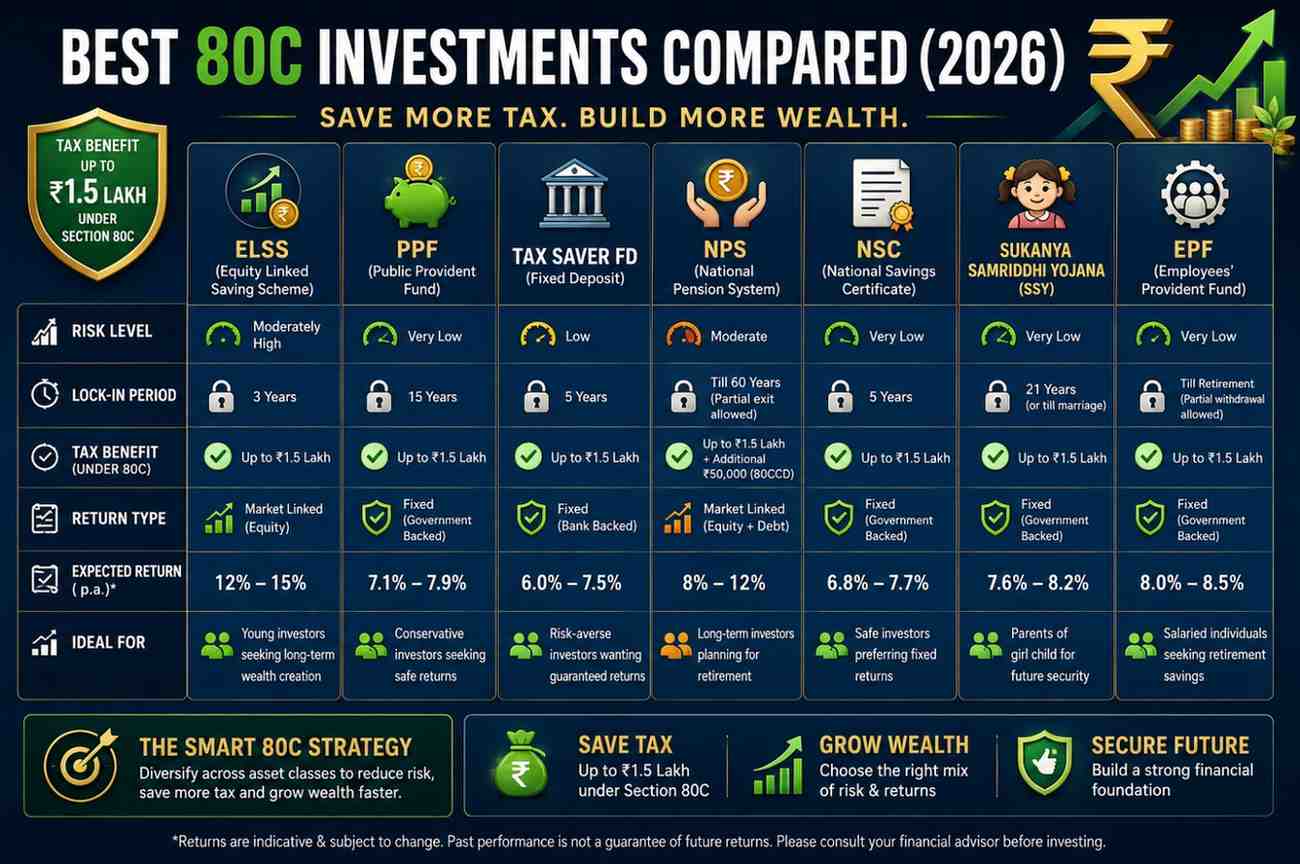
1. Quick comparison of popular investments
| Investment | Risk | Typical lock-in | Tax deduction | Return nature | Best suited for |
|---|---|---|---|---|---|
| ELSS | High | 3 years | Up to ₹1.5 lakh within 80C limit | Market-linked | Long-term growth |
| PPF | Very low | 15 years | Up to ₹1.5 lakh within 80C | Government-notified | Safe long-term wealth |
| Tax Saver FD | Low | 5 years | Up to ₹1.5 lakh within 80C | Fixed interest | Conservative investors |
| NPS | Market-linked | Retirement-focused | 80CCD benefits | Market-linked | Retirement planning |
| NSC | Low | 5 years | Up to ₹1.5 lakh within 80C | Government-notified | Fixed-income investors |
| Sukanya Samriddhi | Very low | Long-term | 80C eligible | Government-notified | Eligible girl-child goals |
| EPF | Low | Employment-linked | Eligible contribution within 80C | Government-notified | Salaried employees |
| Life insurance premium | Depends on policy | Policy-linked | Eligible premium within 80C | Not primarily an investment return product | Protection plus eligible tax benefit |
The ₹1.5 lakh figure is a combined limit, not a separate ₹1.5 lakh allowance for every product. The Income Tax Department specifically includes provident fund, life insurance premiums, NSC, tuition fees, housing-loan principal and certain other payments within Section 80C.
2. Why the “best” investment differs by investor
A 28-year-old with a 15-year wealth-building horizon should not necessarily invest like a 58-year-old protecting retirement capital.
The younger investor may value equity growth and choose ELSS. A conservative investor may prefer PPF or NSC. Someone approaching retirement may prioritize capital stability and liquidity planning.
The objective is not to find one universal winner. It is to build the right combination of tax efficiency, risk and wealth creation.
ELSS vs PPF: Growth Potential or Stability?
1. Why ELSS can be powerful for long-term wealth
Equity Linked Savings Schemes, or ELSS, invest primarily in equities and qualify for Section 80C benefits. Their biggest structural advantage is the relatively short three-year statutory lock-in.
That does not mean you should automatically sell after three years. Equity is volatile, and a three-year period may be insufficient for a reliable wealth-building outcome.
ELSS makes more sense when you can tolerate market fluctuations and remain invested for much longer than the mandatory lock-in.
The psychological advantage is also important. A tax-saving investment with a three-year lock-in can feel less restrictive than a 15-year product, even though long-term equity investing requires patience.
2. Why PPF remains attractive for conservative investors
PPF is designed for long-term savings and offers government-backed interest. For July–September 2026, the PPF interest rate is 7.10% per year. The rate is notified periodically by the government.
PPF has a 15-year maturity structure, although extensions are possible under the scheme rules. This makes it fundamentally different from ELSS.
Its biggest attraction is not simply the headline interest rate. It is the combination of long-term compounding, capital stability and tax treatment.
For investors who become uncomfortable when equity markets fall, PPF can provide psychological stability that prevents panic-driven decisions.
Tax Saver FD, NSC and Other Fixed-Income Options
1. Tax Saver FD for predictable returns
A five-year tax-saving fixed deposit can be suitable when capital preservation is more important than market-linked growth.
The investment qualifies for the Section 80C deduction, subject to the overall limit. However, interest earned on an FD is generally taxable according to the applicable tax rules.
This creates an important distinction: the tax deduction applies to the eligible investment, but the interest does not automatically become tax-free.
For someone in a high tax bracket, that post-tax return can be materially less attractive than the headline FD rate.
2. NSC for government-backed fixed-income investing
The National Savings Certificate offers a five-year maturity and qualifies for Section 80C subject to the overall limit.
For July–September 2026, the NSC interest rate is 7.70% per year. The government kept the major small-savings rates unchanged for that quarter.
One useful feature is that accrued NSC interest, except the final-year interest, is generally treated as reinvested and can itself qualify for Section 80C subject to the overall limit.
That can make NSC interesting for investors who want a disciplined fixed-income product rather than an equity-linked investment.
3. Sukanya Samriddhi for eligible girl-child goals
Sukanya Samriddhi Account can be highly attractive for eligible families planning long-term expenses for a girl child.
The interest rate for July–September 2026 is 8.20%, according to the current small-savings schedule.
It is not a general-purpose investment available to everyone. Eligibility and withdrawal rules matter, so it should be considered primarily when the underlying family goal fits the scheme.
The lesson is broader: never select an investment simply because its current interest rate looks highest.
NPS: Tax Saving Plus Retirement Wealth
1. How NPS fits into tax planning
NPS is slightly different from traditional Section 80C products.
An individual's own NPS contribution can receive deductions under Section 80CCD(1), within the applicable overall limits, while Section 80CCD(1B) provides an additional deduction of up to ₹50,000 beyond the amount claimed under 80CCD(1). The Income Tax Department confirms the separate ₹50,000 limit.
This makes NPS particularly relevant for taxpayers who have already used much of their ₹1.5 lakh Section 80C capacity.
2. Why NPS should be treated as a retirement product
NPS is not simply another tax-saving investment.
Its real purpose is retirement accumulation. Contributions are invested through market-linked assets, and the eventual withdrawal structure is governed by NPS rules.
That means NPS can work exceptionally well when retirement is the goal, but it may be unsuitable for money you expect to spend in the near future.
For salaried employees, employer contributions can also receive a separate deduction under Section 80CCD(2), subject to applicable limits. For AY 2026–27, the Income Tax Department lists a 10% salary limit for PSU/other employers and 14% for Central or State Government employers under the old regime, while the new-regime rules provide a 14% limit for all employer categories.
How to Choose the Best 80C Investment for Your Profile
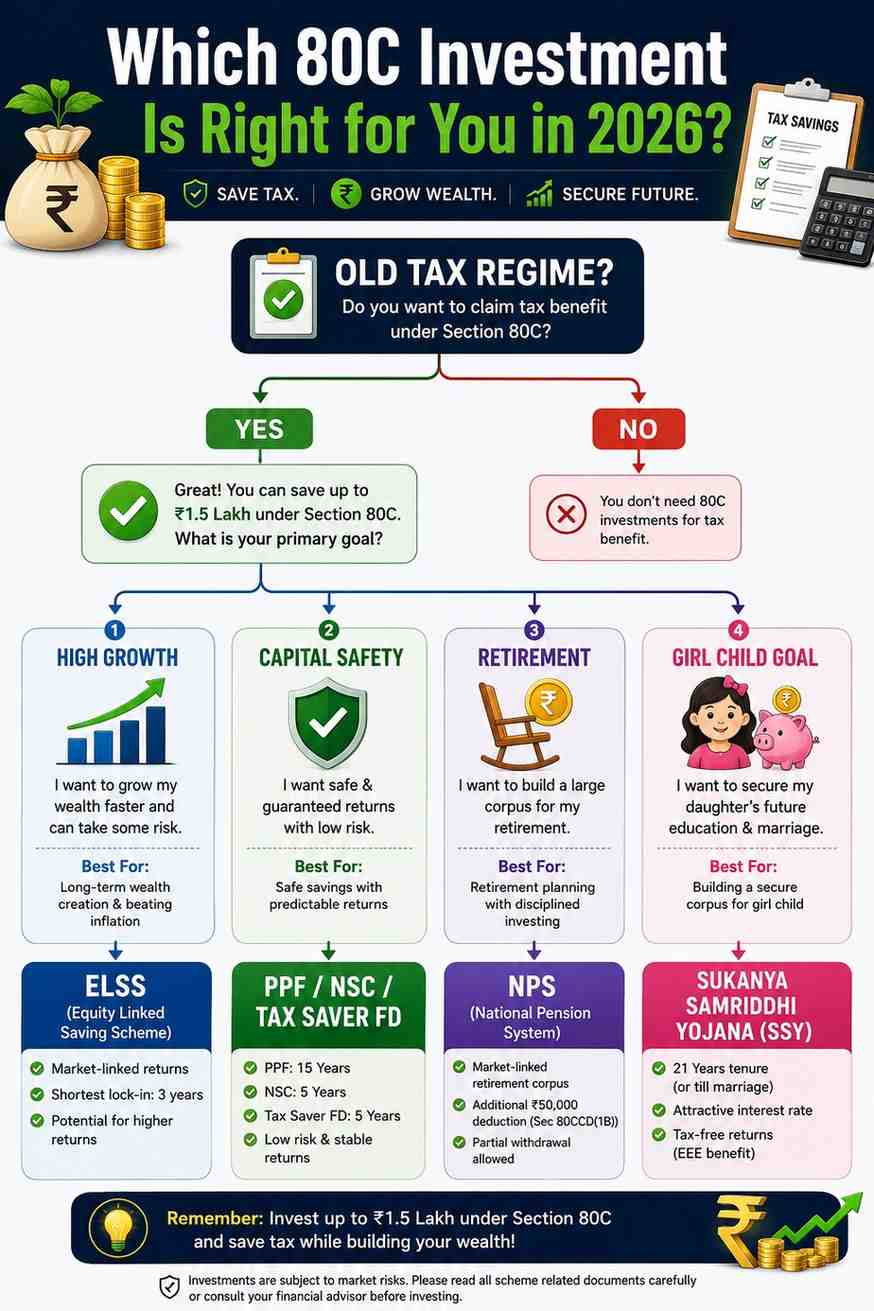
1. If you want maximum long-term growth
If your investment horizon is 10 years or longer and you can tolerate volatility, ELSS deserves serious consideration.
Its equity exposure creates substantially higher growth potential than traditional fixed-income products, although returns are not guaranteed.
The key psychological test is simple: Could you continue investing if your portfolio temporarily fell 20% or more?
If the answer is no, choosing equity only for the tax deduction may create more stress than wealth.
2. If safety is your highest priority
PPF, NSC and eligible fixed deposits are more suitable for conservative investors.
PPF is particularly useful for long-term goals. NSC and tax-saver FDs can be more intuitive when you prefer a defined maturity period.
For July–September 2026, the government-backed small-savings rates include 7.10% for PPF, 7.70% for NSC and 7.50% for five-year Post Office Time Deposits.
3. If retirement is your main goal
NPS becomes more compelling when the tax deduction is combined with disciplined retirement investing.
Instead of asking, “Which product saves the most tax?” ask, “Which product helps me build the retirement corpus I actually need?”
That shift changes the quality of the decision.
How to Use the ₹1.5 Lakh 80C Limit Strategically
1. First subtract deductions you already receive
Many people unnecessarily buy tax-saving products at the end of the financial year.
Before making a fresh investment, calculate existing eligible contributions.
These may include EPF contributions, eligible life insurance premiums, children's tuition fees, housing-loan principal and other qualifying payments. The Income Tax Department lists these among eligible Section 80C items.
If ₹90,000 is already covered, you do not need another ₹1.5 lakh investment. You may only need to fill the remaining eligible capacity.
2. Build the investment around your financial goal
Suppose your remaining eligible limit is ₹60,000.
Do not automatically put the entire amount into the product with the highest advertised return.
Instead, consider the goal:
Retirement: NPS or a suitable long-term portfolio.
Long-term conservative wealth: PPF.
Five-year fixed-income goal: NSC or tax-saver FD.
Long-term growth: ELSS.
Eligible daughter's future goal: Sukanya Samriddhi.
This approach prevents tax planning from becoming disconnected from financial planning.
Common Mistakes to Avoid While Investing for 80C
1. Buying investments at the last minute
March often creates artificial urgency.
Investors rush into ELSS, insurance policies or FDs without comparing costs, lock-ins and suitability.
Tax planning should ideally happen throughout the financial year. Monthly investing can also reduce the psychological burden of finding a large lump sum at year-end.
2. Choosing insurance mainly for tax benefits
Life insurance exists primarily to provide financial protection.
A policy can qualify for tax benefits under certain conditions, but that does not automatically make it a good investment.
First determine how much life insurance protection your family needs. Then evaluate the product's premium, coverage, policy term, exclusions and overall cost.
3. Ignoring taxation after the deduction
A deduction is only one part of the equation.
You should compare:
Tax saved + expected investment growth − taxes on returns − costs − liquidity restrictions.
For example, an FD may offer predictable interest but that interest is generally taxable. PPF's tax treatment is much more favorable, while ELSS is market-linked and has different taxation on eventual gains.
The product with the highest pre-tax return is not necessarily the product that creates the highest after-tax wealth.
80C Investment Strategy for 2026
1. A balanced approach for a moderate-risk investor
A moderate-risk taxpayer could combine different products rather than relying on one.
For example, an investor might use existing EPF contributions for part of the 80C capacity, add PPF for stable long-term savings and consider ELSS for growth.
The exact allocation should depend on goals, age, income stability and existing investments.
Diversification matters because tax efficiency cannot compensate for excessive concentration in one asset class.
2. A simple decision framework
Use this sequence before investing:
- Check whether the old tax regime actually benefits you.
- Calculate your existing 80C-eligible contributions.
- Identify your remaining deduction capacity.
- Match the money with a financial goal.
- Choose the risk level you can realistically tolerate.
- Compare post-tax returns rather than headline returns.
- Check lock-in and withdrawal rules.
- Invest before the deadline instead of making an emotional year-end purchase.
This process is more reliable than searching for a single “best tax-saving investment.”
FAQ
1. What is the maximum deduction under Section 80C in 2026?
The combined deduction limit under Section 80C, 80CCC and 80CCD(1) is ₹1.5 lakh for taxpayers eligible to claim these deductions under the old tax regime. NPS can additionally qualify for up to ₹50,000 under Section 80CCD(1B), subject to the applicable conditions.
2. Is ELSS better than PPF for tax saving?
Neither is universally better. ELSS offers market-linked equity exposure and a three-year lock-in, making it more suitable for investors seeking long-term growth and able to tolerate volatility. PPF is designed for long-term, relatively stable savings and currently offers 7.10% for July–September 2026.
3. Is PPF tax-free?
PPF has highly favorable tax treatment, including tax benefits on eligible contributions and tax-free interest and maturity proceeds under the prevailing rules. The current notified PPF rate for July–September 2026 is 7.10%.
4. Is NPS included in the ₹1.5 lakh 80C limit?
NPS contributions can receive deductions through Section 80CCD. Importantly, Section 80CCD(1B) provides an additional deduction of up to ₹50,000 beyond the deduction claimed under Section 80CCD(1), subject to the rules.
5. Is a tax-saving FD completely tax-free?
No. The eligible principal invested in a qualifying five-year tax-saving FD can provide a Section 80C deduction within the overall limit, but the interest earned is generally taxable.
6. Which is safer: ELSS or NSC?
NSC is generally the more conservative choice because it is a government-backed small-savings instrument with a notified interest rate. ELSS invests in equities and can experience significant market fluctuations. For July–September 2026, NSC offers 7.70%.
7. Can I claim 80C benefits under the new tax regime?
Generally, Section 80C deductions are associated with the old tax regime. The new regime has fewer deductions, although certain specific deductions remain available. The Income Tax Department confirms that the old regime provides access to the broader set of deductions listed under Chapter VI-A.
8. Should I invest the full ₹1.5 lakh every year?
Not necessarily. You should invest only as much as is appropriate for your financial goals and eligible deduction capacity. If existing EPF, insurance, tuition fees or other eligible payments already consume part of the limit, only the remaining amount needs to be considered.
The smartest tax-saving strategy is not the one that produces the biggest deduction. It is the one that leaves you with the strongest combination of after-tax wealth, financial security and flexibility.
For 2026, ELSS stands out for investors prioritizing long-term growth, PPF for stability, NSC and tax-saver FDs for conservative fixed-income needs, and NPS for retirement-focused tax planning. Your choice should ultimately follow your goal rather than the tax deduction alone.
Government small-savings rates are reviewed periodically, so always verify the applicable rate and tax rules before investing. The Department of Economic Affairs maintains the official small-savings notifications, while the Income Tax Department provides the current deduction framework.



Write a comment