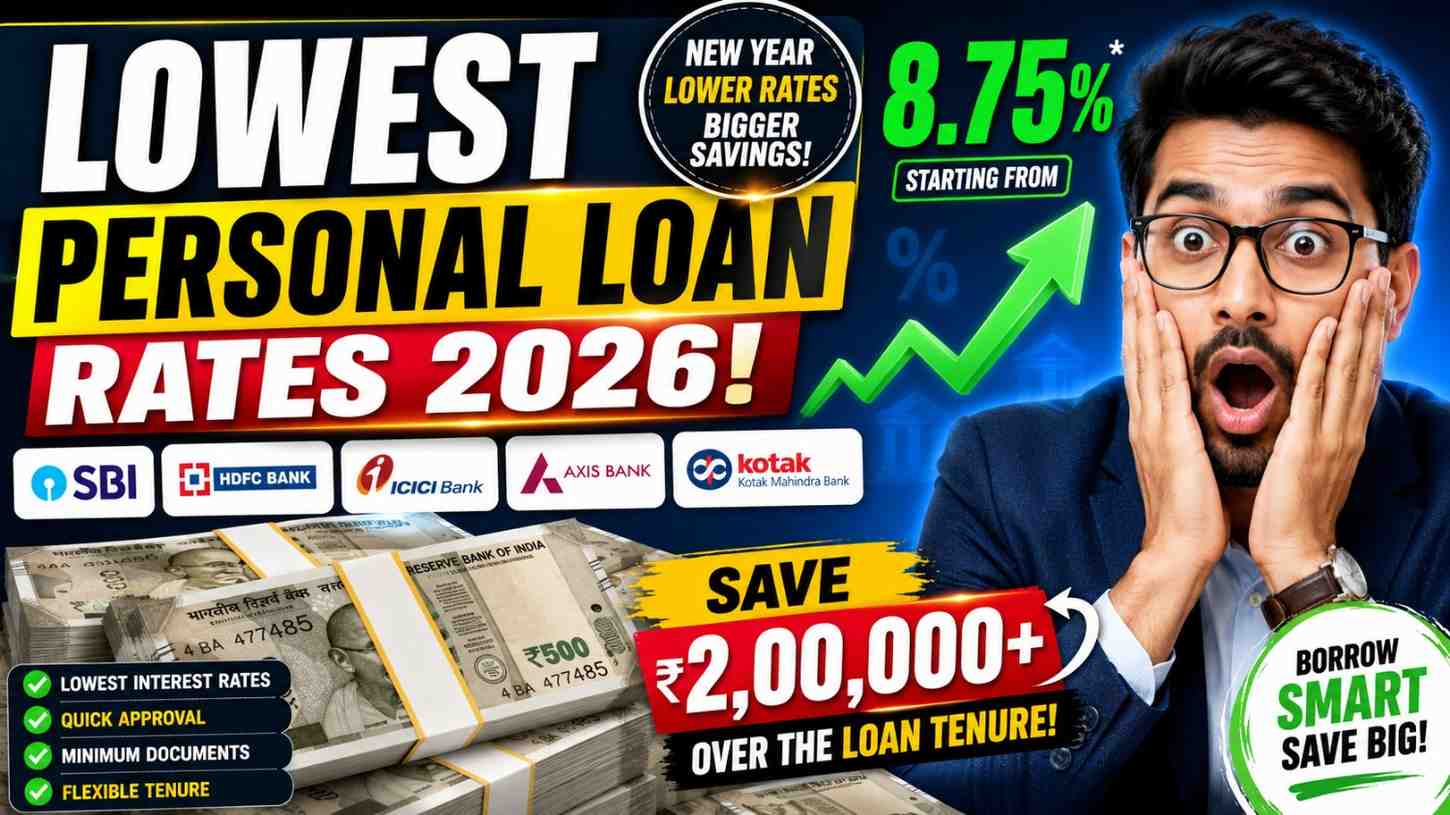
Personal loans remain one of the fastest and most flexible ways to access funds in India. Whether you need money for a medical emergency, home renovation, wedding expenses, education, or debt consolidation, choosing the right lender can save you thousands of rupees in interest.
In August 2026, increased competition among public sector banks, private banks, and NBFCs has pushed personal loan interest rates lower for borrowers with strong credit profiles. However, the "lowest advertised rate" is not always the rate you'll actually receive. Your credit score, income, employer category, and existing debt obligations all play a crucial role in determining your final interest rate.
Best Personal Loan Interest Rates in India (August 2026)
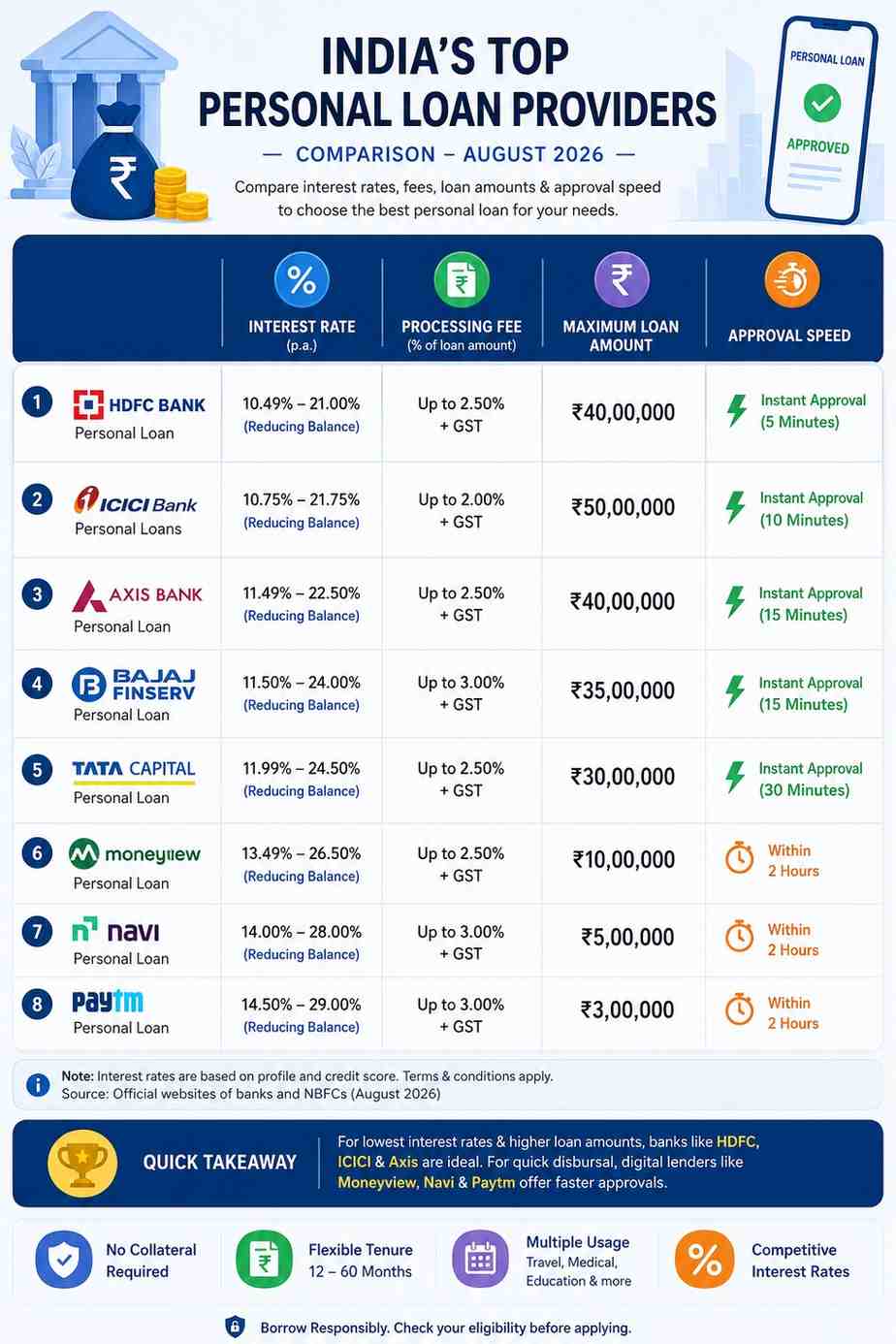
1. Lowest Personal Loan Interest Rate Comparison
| Bank/NBFC | Starting Interest Rate (p.a.) | Loan Amount | Processing Fee |
|---|---|---|---|
| Union Bank of India | 8.75% | Up to ₹15 lakh | As applicable |
| Bank of Maharashtra | 8.75% | Up to ₹20 lakh | Varies |
| Kotak Mahindra Bank | 9.98% | Up to ₹40 lakh | Up to 2.5% |
| HDFC Bank | 9.99% | Up to ₹50 lakh | Up to 2.5% |
| Axis Bank | 9.99% | Up to ₹40 lakh | 1.5%–2% |
| ICICI Bank | 9.99% | Up to ₹50 lakh | Up to 2.5% |
| State Bank of India | 10.00% | Up to ₹20 lakh | Up to 1.5% |
| Bajaj Finserv | 10.00% | Up to ₹55 lakh | Up to 3.93% |
| IndusInd Bank | 10.49% | Up to ₹50 lakh | Up to 3% |
| Federal Bank | 10.49% | Up to ₹25 lakh | From 0.5% |
Rates are indicative and vary based on credit profile, employer category, income, and lender policies.
Why Personal Loan Rates Have Become More Competitive in 2026
The Reserve Bank of India's monetary policy adjustments and strong competition among lenders have contributed to lower borrowing costs for qualified applicants. Banks are increasingly targeting salaried professionals, government employees, and customers with excellent credit histories.
1. RBI Policy Support
The RBI's monetary stance during 2026 has supported lower lending costs across retail loan segments.
2. Increased Competition
Banks and fintech lenders are competing aggressively by offering:
- Lower interest rates
- Faster approvals
- Instant digital disbursement
- Reduced documentation
- Pre-approved offers for existing customers
Who Gets the Lowest Personal Loan Interest Rates?
1. Borrowers With Excellent Credit Scores
Your credit score remains the most important factor.
| Credit Score | Typical Interest Rate |
| 750+ | 8.75%–11% |
| 700–749 | 11%–14% |
| 650–699 | 14%–18% |
| Below 650 | 18%–28% |
2. Salaried Professionals in Top Companies
Employees working in:
- IT companies
- MNCs
- Government organizations
- PSU enterprises
- Fortune 500 companies
often receive preferential pricing from banks.
Public Sector Banks vs Private Banks vs NBFCs
1. Public Sector Banks
Advantages:
- Lowest interest rates
- Transparent charges
- Suitable for salaried and government employees
Disadvantages:
- Longer approval times
- More documentation
2. Private Banks
Advantages:
- Fast processing
- Better digital experience
- Flexible loan amounts
Disadvantages:
- Slightly higher interest rates
3. NBFCs
Advantages:
- Easier eligibility
- Faster approvals
- Acceptance of moderate credit scores
Disadvantages:
- Higher interest rates
- Larger processing fees
Example EMI Calculation
Suppose you borrow ₹5 lakh for 5 years.
| Interest Rate | Approximate EMI | Total Interest |
| 9% | ₹10,379 | ₹1.23 lakh |
| 12% | ₹11,122 | ₹1.67 lakh |
| 15% | ₹11,895 | ₹2.14 lakh |
Even a 3% difference in interest rate can significantly increase your repayment burden.
How to Get the Lowest Personal Loan Interest Rate
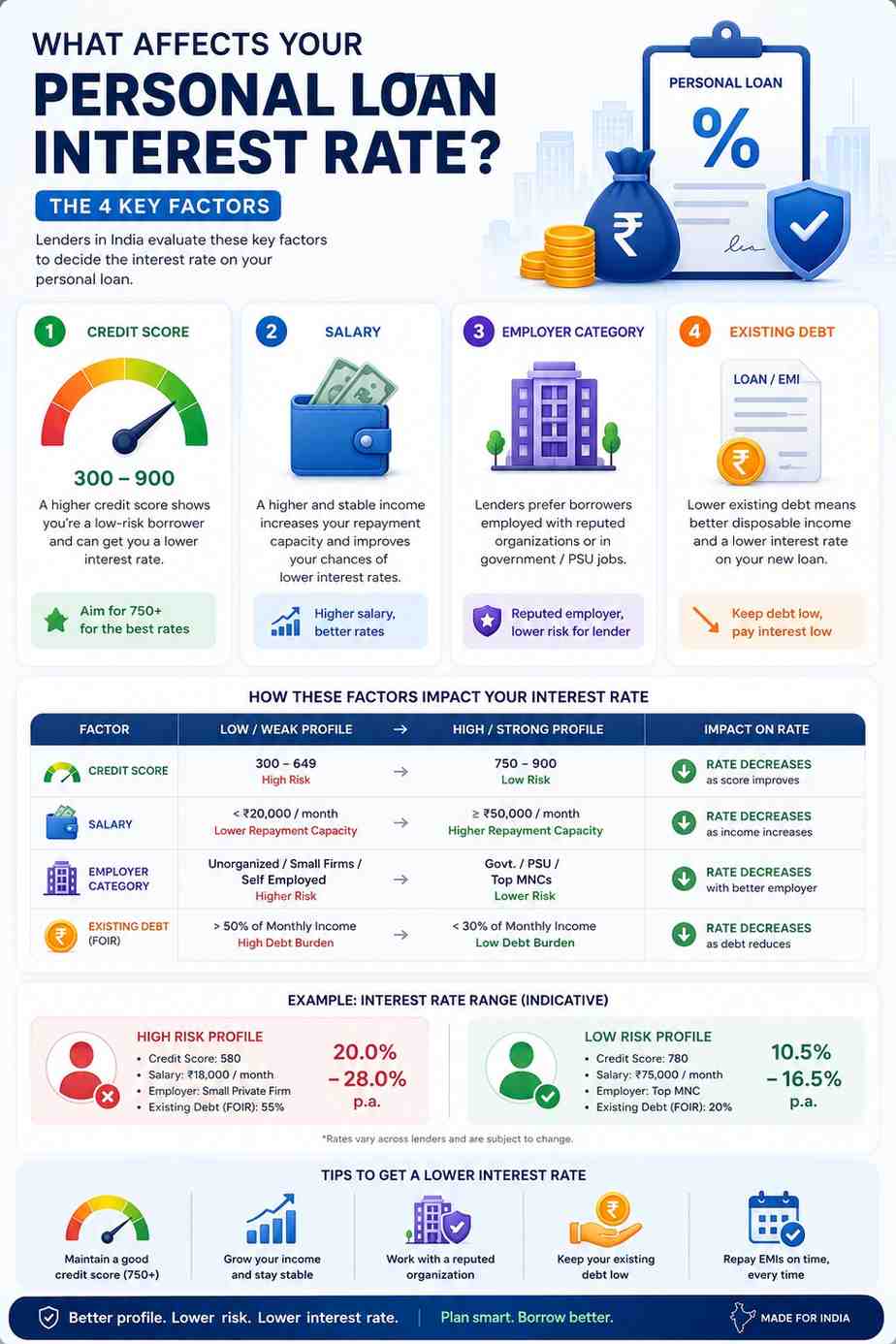
1. Maintain a Credit Score Above 750
Pay your credit card bills and loan EMIs on time, and avoid missed or delayed payments. A credit score above 750 can improve your chances of qualifying for a personal loan with a lower interest rate, as it signals responsible borrowing behavior to lenders.
Keep your credit utilization low, avoid applying for too many loans or credit cards at once, and regularly check your credit report for errors. Maintaining a strong repayment history can make you a more attractive borrower and help you access better loan terms.
2. Reduce Existing Debt
Lower your existing debt before applying for a new personal loan whenever possible. A lower debt-to-income ratio shows lenders that a smaller portion of your monthly income is already committed to EMIs and other debt payments.
Paying off high-interest balances, closing unnecessary credit obligations, and avoiding new debt can strengthen your financial profile. With a healthier debt-to-income ratio, you may have better negotiating power and a stronger chance of securing a lower personal loan interest rate.
3. Apply Through Your Salary Account Bank
If you receive your salary through a particular bank, check its personal loan offers before applying elsewhere. Banks often provide special interest rates, faster approval, and pre-approved loan offers to existing salary account holders because they already have access to your income and transaction history.
You may also face less paperwork and quicker disbursal. However, compare the offer with other lenders to ensure the convenience does not come at the cost of a higher overall loan expense.
4. Compare Multiple Lenders
Never accept the first loan offer you receive. Interest rates, processing fees, repayment terms, and eligibility criteria can vary significantly between banks and lenders. Compare multiple options to find a loan that offers the best overall value, not just the lowest advertised interest rate.
Pay close attention to the annual percentage rate, hidden charges, prepayment penalties, and monthly EMI. A small difference in the interest rate can make a noticeable difference in the total amount you repay over the loan tenure.
5. Negotiate Processing Charges
Many banks and lenders are willing to reduce or waive processing charges, especially for premium customers, existing account holders, or borrowers with a strong credit profile. Don’t assume the fee mentioned in the initial offer is non-negotiable.
Ask the lender directly about fee waivers, discounts, or special offers before signing the loan agreement. Even if the interest rate remains unchanged, reducing upfront charges can lower the overall cost of borrowing.
Hidden Charges to Watch Before Taking a Personal Loan
1. Processing Fees
Processing fees are charges that lenders may apply when you take out a personal loan. They can vary significantly depending on the lender, loan amount, and customer profile, with many lenders charging around 0.5% to 4% of the sanctioned loan amount.
Before accepting an offer, check whether the fee includes applicable taxes and whether there are any additional administrative or documentation charges. Even a seemingly small percentage can add a substantial amount to your upfront borrowing cost.
2. Foreclosure Charges
Foreclosure charges are fees that some lenders may impose when you repay your personal loan before the scheduled end of the tenure. These charges can reduce the savings you expect from paying off the loan early.
Before signing the agreement, check the lender’s foreclosure and prepayment terms carefully. Look for details about applicable charges, minimum lock-in periods, and any conditions for making an early repayment.
3. Late Payment Fees
Delayed EMI payments can add extra costs to your loan through late-payment fees, penal charges, or other applicable charges. Repeated delays may also negatively affect your credit profile, potentially making future borrowing more expensive.
Set up automatic payments or reminders to avoid missing due dates. If you anticipate a payment problem, contact your lender promptly and understand the available options before the EMI becomes overdue.
4. Insurance Add-ons
Some lenders may offer or bundle insurance products with a personal loan to provide coverage against certain risks. While loan insurance can be useful in specific circumstances, it can also increase the overall cost of borrowing.
Before agreeing to an insurance add-on, check whether it is optional, what it covers, the premium amount, exclusions, and cancellation terms. Compare the policy with independent insurance options before deciding whether the additional coverage is worth the cost.
Best Personal Loan Providers by Category
1. Lowest Interest Rates
- Union Bank of India
- Bank of Maharashtra
- SBI
2. Fastest Approval
- ICICI Bank
- HDFC Bank
- Bajaj Finserv
3. Best for Average Credit Scores
- Bajaj Finserv
- IndusInd Bank
- Select fintech lenders
4. Best for Existing Customers
- HDFC Bank
- ICICI Bank
- Axis Bank
Common Mistakes Borrowers Make
1. Applying to Too Many Lenders
Avoid submitting loan applications to multiple lenders within a short period. Each formal application may result in a hard inquiry on your credit report, and several inquiries in a short span can make you appear more credit-dependent to potential lenders.
Instead, compare interest rates, fees, eligibility criteria, and loan terms first. Once you identify the most suitable options, apply selectively rather than sending applications to every lender you consider.
2. Ignoring Processing Fees
A low interest rate does not always mean a cheaper personal loan. Lenders may charge processing fees, documentation charges, administrative costs, or other fees that increase the total cost of borrowing.
Before accepting an offer, calculate the overall repayment amount rather than comparing interest rates alone. A loan with a slightly higher interest rate but lower fees could sometimes be more affordable than one advertised with a lower rate.
3. Choosing Longer Tenures
A longer loan tenure can make your monthly EMI more manageable, but it usually increases the total interest you pay over the life of the loan. A lower EMI may therefore come with a significantly higher overall borrowing cost.
Choose the shortest tenure you can comfortably afford without putting unnecessary pressure on your monthly budget. Compare the EMI and total repayment amount for different tenures before making your final decision.
4. Missing EMI Payments
Missing or delaying EMI payments can negatively affect your credit profile and may lead to late-payment charges or additional costs. A history of missed payments can also make it harder to qualify for competitive loan terms in the future.
Set up automatic EMI payments or reminders to ensure your installments are paid on time. If you expect difficulty making a payment, contact your lender as early as possible to discuss the available options rather than simply skipping the EMI.
FAQ
1. Which bank offers the lowest personal loan interest rate in India in August 2026?
Currently, Union Bank of India and Bank of Maharashtra offer some of the lowest starting personal loan rates, beginning around 8.75% per annum for eligible borrowers. Actual rates depend on your credit profile and income.
2. What CIBIL score is required for the best personal loan rates?
A CIBIL score of 750 or above generally qualifies borrowers for the lowest available interest rates and faster approvals.
3. Is a personal loan from a bank better than an NBFC?
For borrowers with good credit profiles, banks usually offer lower interest rates. NBFCs may be preferable for faster processing or moderate credit scores.
4. Can I negotiate my personal loan interest rate?
Yes. Existing banking relationships, high income, excellent credit scores, and employer category can help you negotiate better rates and lower fees.
5. How quickly can I get a personal loan approved?
Private banks and NBFCs often approve and disburse loans within 24–48 hours, while public sector banks may take several days.
Conclusion
The best personal loan interest rate in India during August 2026 starts around 8.75% per annum for highly qualified borrowers. Public sector banks continue to offer the cheapest loans, while private banks excel in speed and convenience. Before applying, compare lenders carefully, maintain a strong credit score, negotiate fees, and calculate your total borrowing cost rather than focusing solely on the advertised interest rate.
Choosing the right lender today can save you lakhs of rupees over the life of your loan.


Write a comment