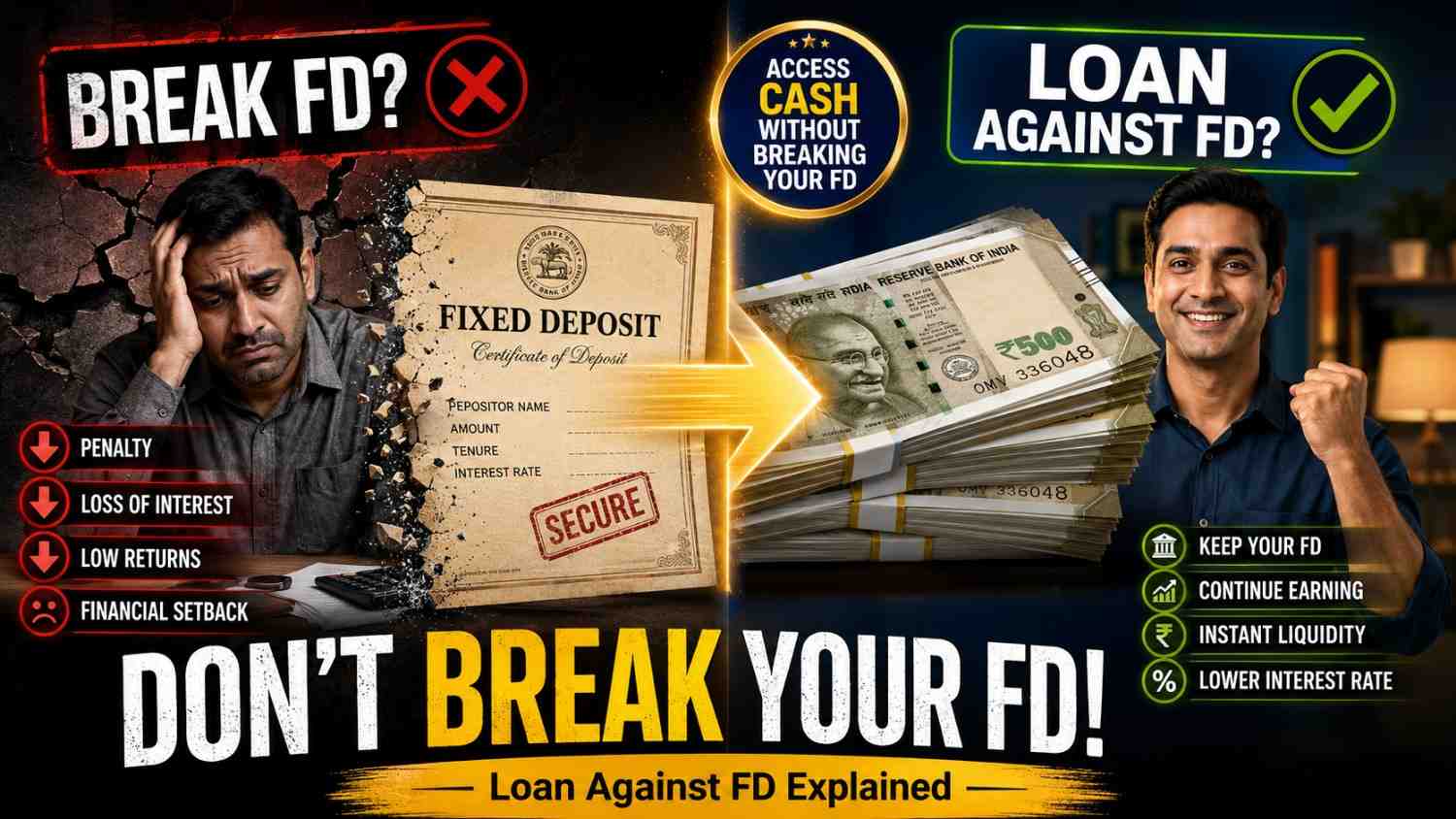
A fixed deposit is usually treated as money you should not touch until maturity. But what if you suddenly need funds for an emergency, business expense, education, or another large payment? Breaking the FD is not always your best option.
A loan against a fixed deposit can provide liquidity while allowing your deposit to continue earning interest. It can also be considerably cheaper and simpler than an unsecured personal loan, depending on your bank and FD terms.
Introduction: Loan Against Fixed Deposit
1. What a Loan Against Fixed Deposit Means
A loan against fixed deposit is a secured borrowing facility where your existing FD acts as security for the loan. Instead of closing the deposit and withdrawing the money, you borrow against its value.
Banks commonly allow borrowing up to a percentage of the FD value. For example, SBI states that its loan against deposits can provide up to 90% of the time deposit value, while ICICI Bank says eligible customers can typically access up to 90%, subject to its policies and the type of FD.
The important psychological advantage is simple: you access cash without immediately giving up the asset that created your savings in the first place.
2. Why Borrowers Consider This Option
People often consider an FD-backed loan when they need money quickly but do not want to liquidate their savings.
The facility can be particularly useful when:
- Your FD is earning a reasonable return.
- You need money for a short or medium period.
- You want to avoid an unsecured loan.
- You want a relatively straightforward borrowing process.
- You do not want to disturb your long-term savings plan.
Your FD generally continues earning interest during the loan period. ICICI Bank explicitly states that the FD remains intact and continues to earn interest at its contracted rate.
How Does a Loan Against FD Work?
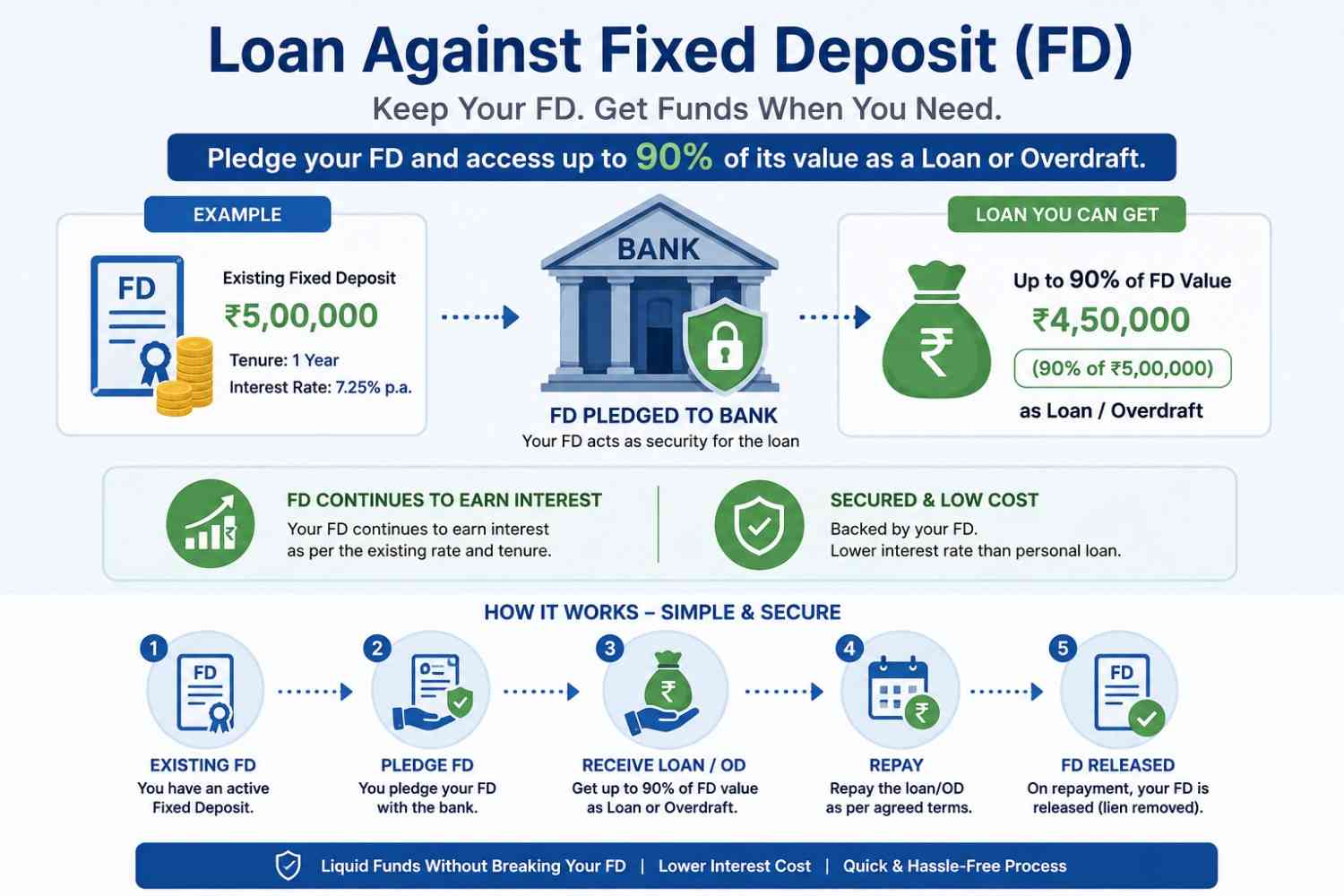
1. The FD Becomes Security for the Loan
When you take the facility, the bank places a lien or equivalent security interest against the eligible FD. You receive access to a portion of its value rather than withdrawing the entire deposit.
Suppose you have a ₹5 lakh FD and your bank permits borrowing up to 90%. Your maximum sanctioned amount could be around ₹4.5 lakh, subject to the bank's rules.
The exact percentage can differ by lender, FD type, customer profile, and product terms.
2. Your FD Usually Continues to Earn Interest
One of the biggest attractions is that the deposit does not necessarily stop earning interest simply because it is pledged.
This creates an important distinction from premature FD withdrawal. With an FD-backed loan, you retain the underlying deposit while paying interest on the amount borrowed.
For example, if your FD earns 6.5% and the bank charges a spread over that rate, the borrowing cost could still be competitive compared with many unsecured borrowing options. ICICI Bank says its rate is generally based on the FD interest rate plus a fixed spread, with an example of +2%.
The actual rate should always be checked in your sanction terms.
Loan Against FD Interest Rates in India
1. How Banks Typically Price These Loans
Loan-against-FD rates are often linked to the interest rate applicable to the underlying deposit plus a specified spread.
This structure makes sense from the bank's perspective. The FD provides collateral, reducing the lender's credit risk compared with an unsecured personal loan.
For example, SBI's published information describes an attractive rate of interest at 1% above the deposit rate for its loan against deposits product.
ICICI Bank's current FAQ says the rate is generally the FD interest rate plus a fixed spread, giving FD rate + 2% as an example.
Therefore, there is no single universal "loan against FD interest rate." The rate depends on the lender and product.
2. Loan Against FD vs Personal Loan Rates
The biggest pricing advantage is often the security behind the borrowing.
A personal loan is generally unsecured, so the lender prices the risk according to factors such as income, credit history, employment, existing obligations, and customer profile.
A loan against FD is secured by an existing deposit. That can make it cheaper.
For perspective, ICICI Bank's published rates currently show personal loans starting from 9.99% per annum, while its FD-backed borrowing is generally structured around the applicable FD rate plus a spread.
That does not mean every FD loan will automatically be cheaper. Processing charges, the FD rate, loan duration, and repayment structure all matter.
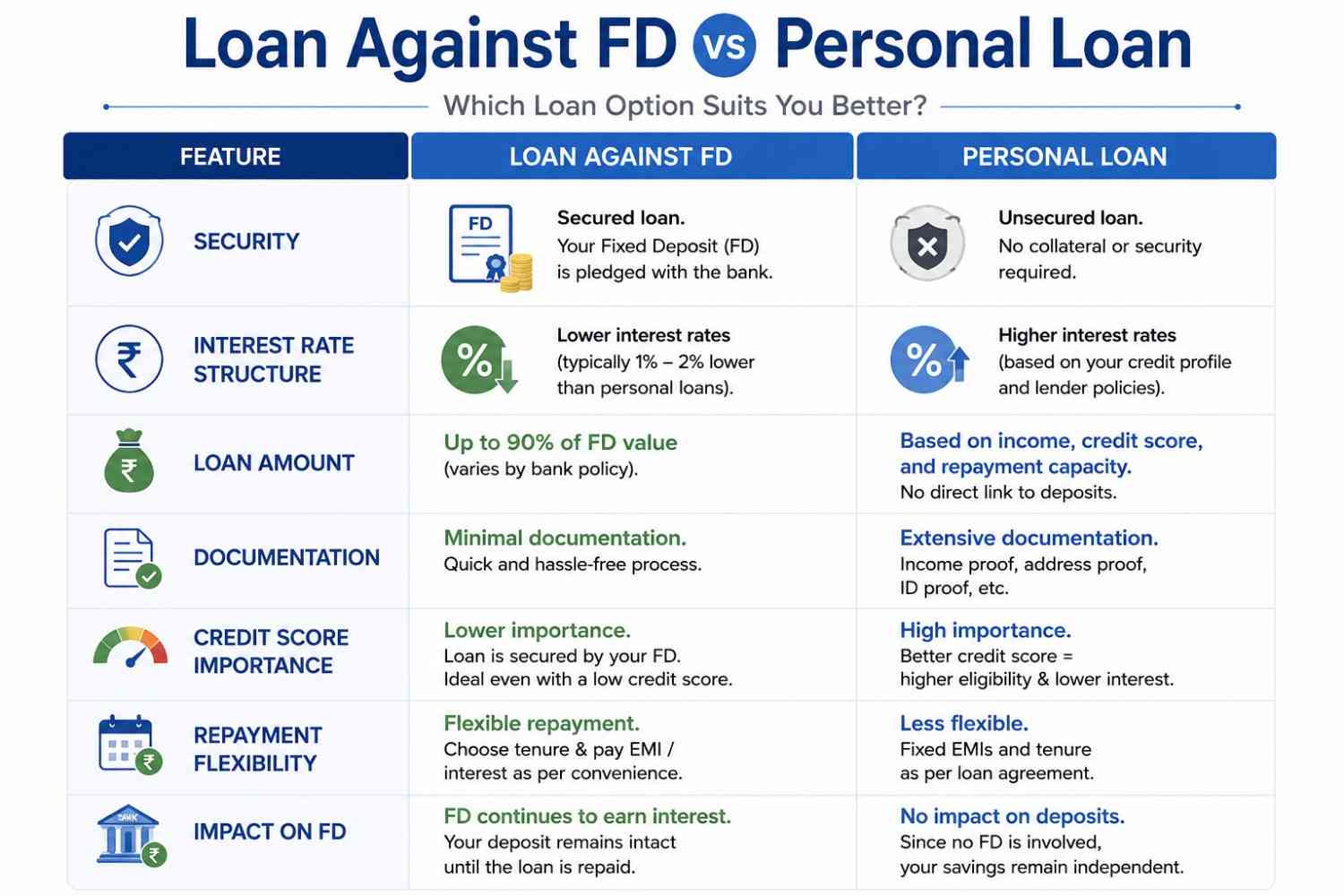
| Factor | Loan Against FD | Personal Loan |
|---|---|---|
| Security | FD-backed | Usually unsecured |
| Typical pricing logic | FD rate + spread | Risk-based lending rate |
| Loan amount | Linked to FD value | Linked to income and credit profile |
| Credit score importance | Often less significant | Usually more significant |
| FD remains invested | Generally yes | Not applicable |
| Processing | Often simpler for existing FD customers | Usually more documentation |
| Risk | FD may be adjusted if obligations aren't met | No FD collateral, but default affects credit profile |
Loan Against FD Eligibility and Loan Amount
1. Who Can Apply?
Eligibility depends on the bank and FD product, but the basic requirement is straightforward: you need an eligible fixed or term deposit that the lender accepts as collateral.
Banks may restrict loans against certain deposit types or impose additional conditions.
For example, SBI's published loan-against-deposit information includes time deposits as eligible security and offers both demand-loan and overdraft facilities.
The deposit may also need to be held with the same institution providing the loan.
2. How Much Can You Borrow?
The loan amount is usually a percentage of the FD's value rather than 100% of the deposit.
A commonly cited maximum is around 90%. SBI states up to 90% of the value of a time deposit, while ICICI Bank says eligible customers can typically avail up to 90%, subject to internal policies and FD type.
For example:
FD value: ₹8 lakh
Eligible percentage: 90%
Potential maximum borrowing: ₹7.2 lakh
The bank may sanction less depending on the specific deposit, product conditions, accrued interest, and other applicable rules.
Repayment Options and Loan Tenure
1. Demand Loan Repayment
Under a demand-loan structure, the bank provides a defined loan amount against the FD.
SBI lists both demand-loan and overdraft facilities for its loan-against-deposit product.
The repayment structure depends on the lender. Some products allow repayment before the deposit matures, while others tie the facility closely to the remaining maturity period.
2. Overdraft Facility
An overdraft can be attractive when you do not need the entire sanctioned amount immediately.
Instead of borrowing the full limit, you can draw funds as required, subject to the approved limit.
This can make an overdraft particularly useful for temporary cash-flow requirements. If you only use part of the available limit, the interest calculation can be based on the amount actually utilized, depending on the product terms.
ICICI Bank states that interest is charged on the utilized loan amount for its FD-backed loan or overdraft facility.
3. Tenure Linked to FD Maturity
The remaining maturity of the FD is an important consideration.
SBI's published product information states that repayment can extend through the remaining maturity period of the deposit, subject to a maximum of 120 months.
This means an FD that matures soon may not provide the same borrowing flexibility as a longer-term deposit.
Always check the exact maturity-linked repayment condition before accepting the loan.
Key Benefits of a Loan Against FD
1. You Don't Need to Break the FD
The most obvious benefit is preserving the deposit.
Prematurely closing an FD can affect the interest you receive and may involve terms related to premature withdrawal. By borrowing against the FD instead, you can potentially access funds while keeping the deposit active.
This can be valuable when the FD is part of a larger savings strategy.
2. Lower Borrowing Cost Can Be Possible
Because the FD provides security, the lender takes less collateral risk than with an unsecured personal loan.
That can result in a lower interest rate.
The difference becomes more meaningful when you borrow a substantial amount or keep the loan outstanding for several months.
3. Faster and Simpler Access to Funds
Existing FD customers may face less documentation than someone applying for a completely new unsecured loan.
ICICI Bank, for example, says eligible FD customers can activate the loan or overdraft facility instantly through its iMobile app or Net Banking.
However, "instant" availability depends on the FD being eligible and meeting the bank's conditions.
4. Credit Score May Matter Less Than for an Unsecured Loan
The FD provides tangible security to the lender.
That can make the facility more accessible than a personal loan for some borrowers. However, this does not mean credit history is irrelevant in every case. Banks can still apply their own internal eligibility and documentation requirements.
Loan Against FD vs Breaking Your FD
1. When Borrowing May Make More Sense
Consider a loan against FD when:
- You need temporary liquidity.
- Your FD has a meaningful remaining tenure.
- The loan interest rate is reasonable relative to your FD return.
- You expect to repay the borrowing soon.
- You want to preserve the deposit.
The key is to compare the total borrowing cost with the financial consequences of premature FD withdrawal.
2. When Breaking the FD May Be Better
Borrowing is not automatically the better decision.
If you need the money for a long period, paying loan interest continuously may become expensive. In that situation, withdrawing the FD could sometimes be financially simpler.
You should compare:
Cost of loan = Interest + fees + other charges
against:
Cost of breaking FD = Lost/adjusted interest + applicable withdrawal consequences
The cheaper option depends on your actual numbers, not just the advertised interest rate.
When Is a Loan Against FD Better Than a Personal Loan?
1. Choose an FD-Backed Loan for Short-Term Needs
A loan against FD can be particularly attractive when the requirement is temporary.
Imagine you need ₹3 lakh for six months. If you already have an eligible FD, borrowing against it could avoid taking a larger unsecured personal loan.
You also retain the deposit instead of liquidating it.
2. Consider a Personal Loan When You Need Larger Unsecured Funding
A personal loan may make more sense if you do not have sufficient FD collateral or need funding significantly beyond the amount your deposit can support.
It may also be preferable when you need a longer repayment structure and your personal-loan offer is competitive.
The correct choice depends on the total cost, required amount, repayment period, and your need to preserve the FD.
3. Compare the Effective Cost, Not Just the Advertised Rate
Before choosing, compare:
| Cost/Feature | FD-Backed Loan | Personal Loan |
| Interest rate | Check FD rate + spread | Check lender's quoted rate |
| Processing fee | Check lender schedule | Check lender schedule |
| Prepayment charges | Product-specific | Product-specific |
| Collateral | FD | Generally none |
| Maximum amount | Limited by FD | Based on eligibility |
| Flexibility | Depends on loan/OD structure | Often broader |
| Savings impact | FD generally remains intact | No FD involved |
A lower headline rate can still become expensive if additional charges are high.
Risks and Things to Check Before Borrowing
1. Your FD Is at Risk if You Don't Repay
The biggest misconception is that an FD-backed loan is risk-free because the money is already yours.
It isn't.
The FD serves as collateral. If you fail to meet the loan obligations, the bank can exercise its rights over the pledged deposit according to the agreement.
That means your emergency borrowing can ultimately affect your savings.
2. Interest Cost Can Outweigh the Benefit
Suppose your FD earns 6.5% but your loan costs 8.5%.
You are effectively paying a premium for liquidity. That can still be worthwhile for a short-term emergency, but keeping the loan for years may make less sense.
Do not think only in terms of "my FD is still earning interest." Think in terms of the net financial cost of keeping the loan outstanding.
3. Check Charges and Maturity Conditions
Before signing, verify:
- Interest rate and spread
- Processing charges
- GST and applicable taxes on charges
- Prepayment terms
- Overdraft conditions
- Minimum repayment requirements
- FD maturity treatment
- Whether the FD can be prematurely closed
- What happens if the loan remains outstanding at maturity
These details can differ between banks and products.
How to Apply for a Loan Against FD
1. Check Whether Your FD Is Eligible
Start by checking the FD's type, ownership, maturity date, and bank-specific eligibility.
Do not assume every FD automatically qualifies.
Some special deposit products can have different loan or premature-withdrawal rules. SBI, for example, distinguishes between deposit products when describing loan facilities.
2. Compare the Loan Terms
Ask your bank for the exact borrowing rate rather than relying on a generic advertisement.
Compare that rate with your FD's current interest rate and calculate the expected cost for the period you plan to borrow.
Also compare the personal-loan offer available to you.
3. Apply Through the Available Channel
Depending on the bank, an FD-backed facility may be available through internet banking, mobile banking, or a branch.
For eligible ICICI Bank FDs, the bank says customers can activate the loan or overdraft through iMobile or Net Banking.
Once approved, the sanctioned amount is made available according to the facility's structure.
4. Repay and Release the FD
After the outstanding loan and applicable charges are cleared, the bank's lien or security interest can be released according to its process.
Keep the closure confirmation and verify that the FD is no longer encumbered.
FAQ
Can I take a loan against an FD without breaking it?
Yes. That is the central purpose of the facility. Instead of prematurely withdrawing the deposit, you pledge the FD as security and borrow against part of its value. The FD can generally continue earning interest under its original terms.
How much loan can I get against a fixed deposit?
The amount depends on the bank and FD. Some major banks allow borrowing up to around 90% of the deposit value for eligible deposits. SBI and ICICI Bank both publish information supporting limits of up to 90%, subject to their respective conditions.
Is a loan against FD cheaper than a personal loan?
It can be. Since the FD acts as security, the interest rate may be lower than an unsecured personal loan. However, you should compare the complete cost, including interest, fees, tenure, and repayment terms, rather than assuming the FD loan is always cheaper.
Does my FD continue earning interest after taking the loan?
Generally, yes, when the FD remains active and pledged as collateral. ICICI Bank explicitly states that the FD continues earning interest at its contracted rate while the loan or overdraft is outstanding.
Does taking a loan against FD affect my credit score?
The facility is still a form of borrowing, so repayment behaviour matters. A secured loan does not mean missed payments have no consequences. Your lender's reporting practices and the specific product should be checked before borrowing.
Can I repay the loan before the FD matures?
This depends on the lender and product. Some facilities permit early repayment, while charges or specific conditions may apply. Always check the sanction terms before assuming there is no prepayment cost.
Is an overdraft against FD better than a normal loan?
An overdraft can be better when your cash requirement is unpredictable or temporary because you can draw funds as needed. A regular loan may be simpler when you know exactly how much you need and want a defined repayment structure.
What happens if the FD matures while the loan is outstanding?
The bank's terms determine how the maturity proceeds are handled. The outstanding liability may need to be settled or adjusted against the deposit. This is why checking the maturity clause before taking the loan is important.
Conclusion: Is a Loan Against FD Right for You?
A loan against fixed deposit can be an efficient way to unlock short-term liquidity without immediately sacrificing your savings instrument. Its strongest advantages are the FD-backed security, potentially lower interest cost, simpler access, and the ability to keep the deposit invested.
But the right decision depends on the numbers. Compare the loan's interest rate and fees with the cost of breaking the FD and with any personal-loan offer available to you.
If you need temporary funds and already have a suitable FD, an FD-backed loan can be one of the first borrowing options worth checking. If the borrowing period is long or the cost is high, liquidating part of the deposit or considering another funding source may be more sensible.
The smartest choice is not simply the loan with the lowest advertised rate. It is the option that solves your cash-flow problem at the lowest total cost while protecting your financial goals.


Write a comment